


YE Xingqian, born in 1963, is a painter of Chinese origin who later became a naturalized French citizen, embodying through his life and work a dialogue between cultures, histories, and artistic traditions. His journey as an artist began remarkably early. From the age of five, he was already painting, suggesting not only precocious talent but also a deep, intuitive connection to visual expression. Over decades, this early impulse matured into a refined practice centered on ink, gesture, and the poetic possibilities of landscape.
His career traces a path of migration and transformation. Emigrating to France in 1982, YE Xingqian entered a new cultural environment that would profoundly shape his artistic language. While rooted in the long tradition of Chinese ink painting, his work evolved in conversation with Western contemporary art, abstraction, and new modes of display. The result is a body of work that resists simple categorization: neither strictly traditional nor fully Westernized, but instead personal, hybrid, and exploratory.
Early Roots and Lifelong Practice
Beginning to paint at such a young age meant that art was never a secondary pursuit for YE Xingqian; it was a way of being. The discipline and sensitivity required in ink painting, especially on rice paper, demand years of practice to master control, pressure, dilution, and timing. Ink does not forgive hesitation. Every stroke is both deliberate and alive, carrying the trace of the artist’s breath and movement.
This lifelong engagement cultivated in him a nuanced understanding of ink’s expressive range. From translucent washes to dense, velvety blacks, ink in his hands becomes a language of atmosphere and emotion. Rather than merely depicting forms, he explores rhythm, space, and silence. Empty areas are as meaningful as painted ones, inviting viewers to slow down and contemplate.
Migration and the Meeting of Cultures
When YE Xingqian moved to France in 1982, he entered a radically different artistic landscape. France, with its deep history of modern and contemporary art, offered exposure to abstraction, conceptual approaches, and large-scale formats less common in traditional literati painting. Instead of abandoning his roots, he allowed these influences to expand his vocabulary.
His work can be seen as a bridge between East and West. The philosophical underpinnings of Chinese painting, such as the importance of spirit, resonance, and harmony with nature, remain present. Yet his compositions often embrace the freedom and scale associated with Western contemporary art. This synthesis gives his paintings a distinctive identity: they feel at once ancient and immediate.
Over time, his artistic legitimacy in France grew. Recognition by major museums and institutions signaled that his work spoke beyond cultural boundaries, touching on universal themes of nature, perception, and inner landscape.
Institutional Recognition and Public Collections
A significant marker of his career is the entry of his works into museum collections. In 2018, five watercolors on rice paper entered the permanent collection of a major national museum dedicated to Asian arts. This acknowledgment affirmed the quality and cultural value of his practice within the context of Asian artistic heritage.
Further recognition followed. In 2021, a large ink painting on canvas entered the collection of another Paris museum known for its focus on Asian art. This was particularly notable because it highlighted his expansion from traditional supports like rice paper to canvas, and from intimate formats to monumental ones.
His visibility continued to grow. In 2024, six of his works were acquired by a museum in Toulouse and exhibited in a museum of precious arts. Such acquisitions do more than honor an individual artist; they also reflect an institutional interest in contemporary ink painting as a living, evolving medium.
Interestingly, while he built a strong reputation in France, his relationship with the Chinese art world followed a different trajectory. His paintings were initially misunderstood in China, perhaps because they departed from strict conventions or resisted easy classification. Yet persistence and clarity of vision eventually led to regular exhibitions and increasing appreciation.
Recognition in China and a Symbolic Commission
A turning point came in 2023 when he received a commission from the Chinese government for a large canvas displayed at Zhengyangmen Gate in Tiananmen Square in Beijing. This commission carries symbolic weight. It suggests a renewed recognition from his country of origin and an acknowledgment of his artistic stature.
For an artist who once experienced misunderstanding at home, such a public and visible project represents a form of reconciliation. It also underscores how artistic language can evolve beyond borders and later be re-embraced by its culture of origin.
“Grand paysage”: The Idea of Landscape
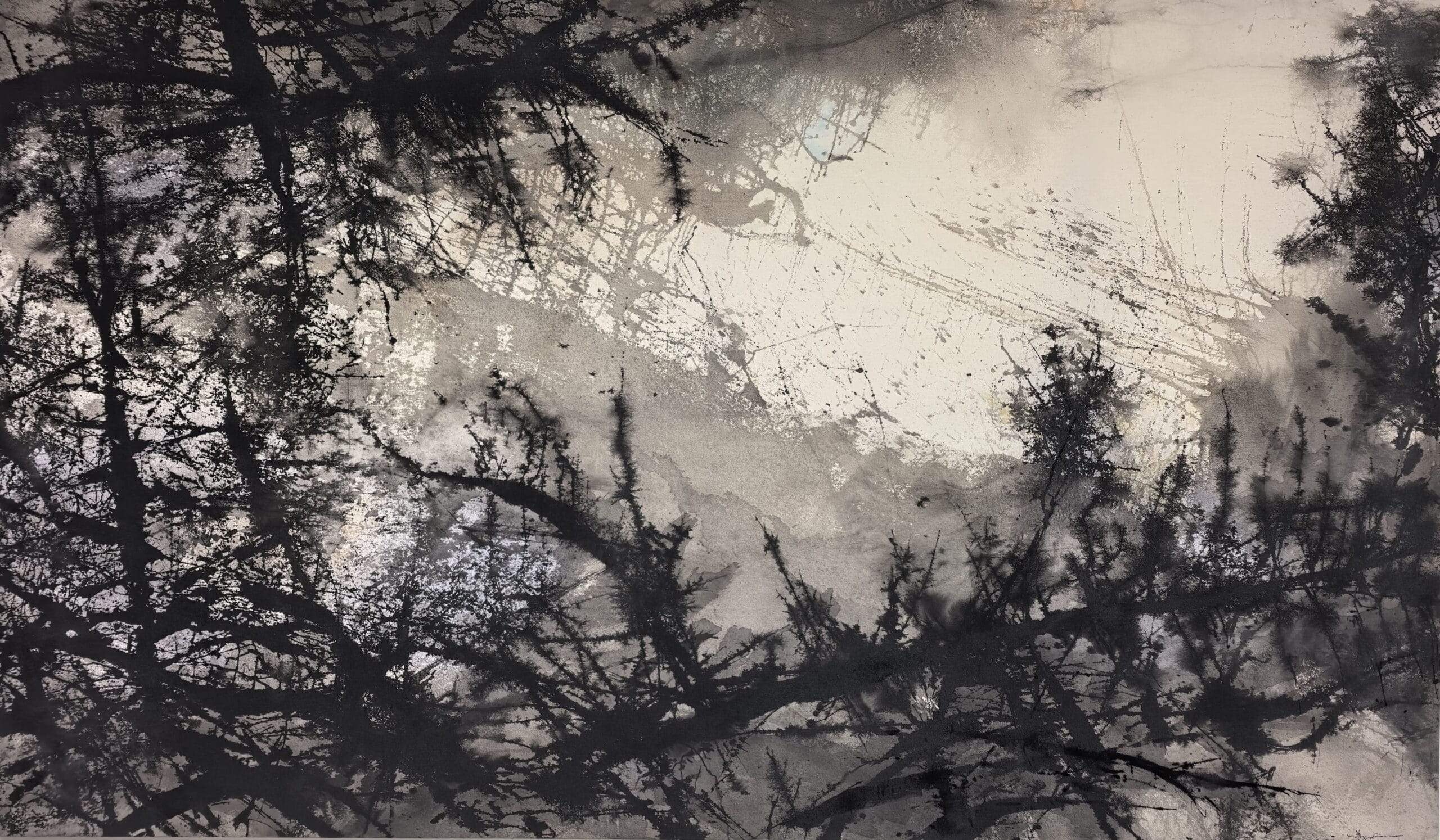
Among his works, “Grand paysage” (2024), an ink on canvas measuring 350 by 205 cm, stands out as a powerful example of his mature style. The very scale of the work changes the viewer’s relationship to it. This is not a painting one simply looks at; it is a painting one enters with the eyes and the body.
Created with India ink, the canvas demonstrates his mastery of tonal variation. He navigates an infinite spectrum, from the palest gray washes to the most profound blacks. These transitions are not merely technical; they generate depth, atmosphere, and a sense of movement.
Although inspired by landscape imagery, the work deliberately departs from direct figuration. Mountains, waters, or horizons are not explicitly defined. Instead, the painting proposes the idea of a landscape. It is a mental and emotional terrain rather than a geographic one.
This approach invites immersion. Viewers may sense mist, distance, or shifting light without seeing literal representations. The painting becomes a space for projection, where personal memories and sensations can surface. In this way, “Grand paysage” aligns with a long tradition in which landscape is less about depicting a site and more about expressing an inner state.
Ink as Philosophy
In YE Xingqian’s work, ink is more than a material; it is a philosophy. Ink carries history, discipline, and a meditative dimension. Its fluidity mirrors the unpredictability of life, while its gradations echo the subtlety of perception.
By using ink on both rice paper and canvas, he expands its territory. He shows that a medium associated with tradition can remain contemporary, experimental, and monumental. His paintings do not shout; they resonate quietly, rewarding sustained attention.
A Continuing Journey
YE Xingqian’s artistic path illustrates how identity can be layered rather than singular. Chinese by origin, French by nationality, and international by career, he paints from a place shaped by movement and dialogue. His landscapes are not tied to one geography because they emerge from lived experience, memory, and imagination.
As his works enter more collections and reach wider audiences, his contribution to contemporary ink painting becomes increasingly clear. He demonstrates that tradition is not a cage but a foundation from which new forms can grow.
Ultimately, his art offers viewers a place to pause. In a fast, image-saturated world, his ink landscapes open zones of quiet reflection. They remind us that a landscape can be an idea, a feeling, or a state of mind and that within washes of gray and black, entire worlds can unfold.

