


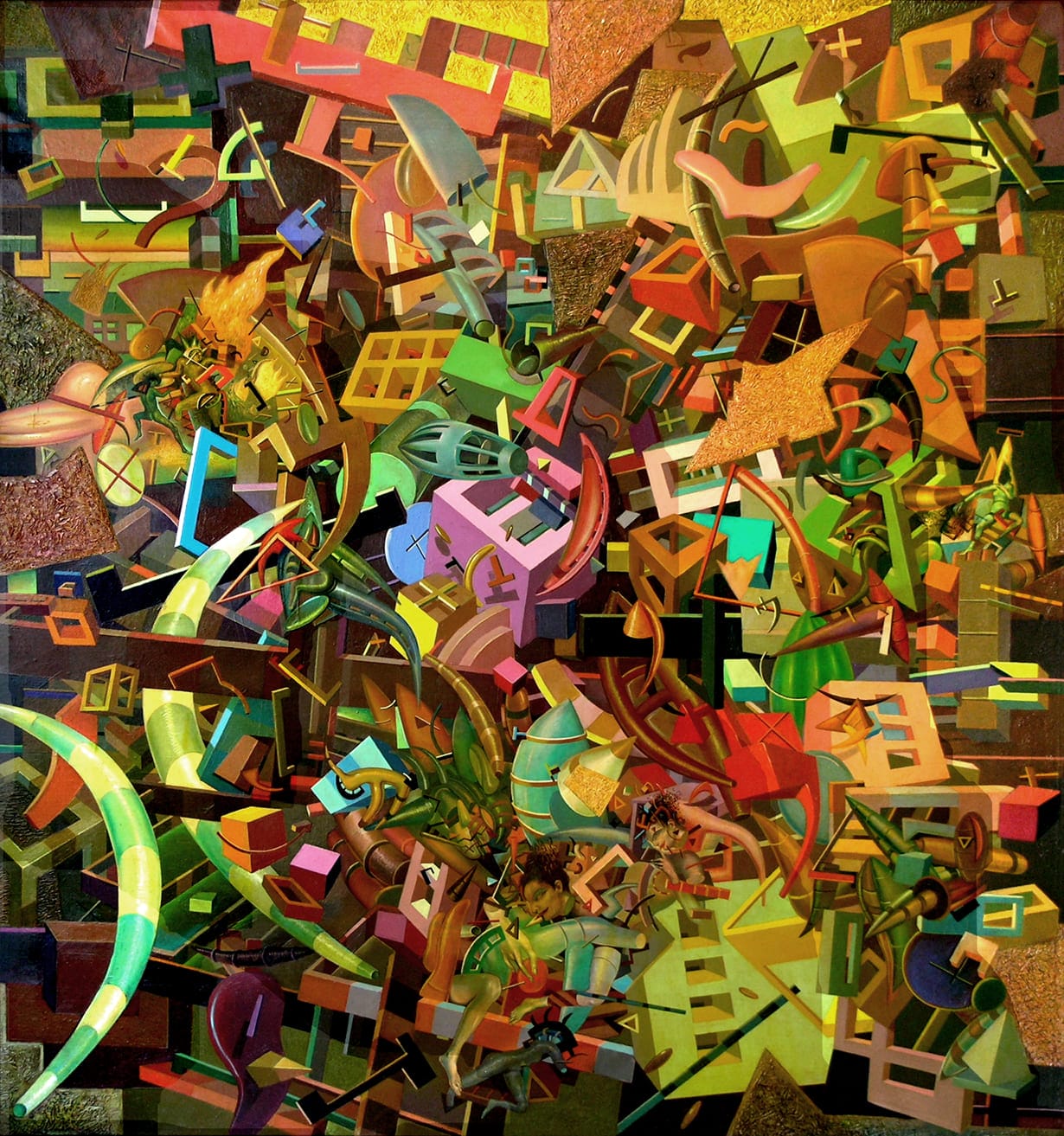
Walera Martynchik, born in 1948, is a contemporary artist whose life and work reflect a deep commitment to artistic freedom and intellectual independence. Originally from Belarus, Martynchik developed his artistic foundation within the highly controlled cultural environment of the Soviet Union. He graduated in 1972 from the State Academy of Fine Arts in Minsk, receiving a rigorous classical education that emphasized technical precision and academic discipline.
Despite this formal training, Martynchik quickly became disillusioned with the limitations imposed on artistic expression. Soviet doctrine demanded strict adherence to Social Realism, an approach that left no space for abstraction, experimentation, or personal interpretation. From the very beginning of his professional life, Martynchik felt compelled to challenge these restrictions and search for a visual language that aligned with his inner curiosity and creative instincts.
Revolt Against Social Realism
Soon after completing his studies, Martynchik openly revolted against compulsory Social Realism. This decision carried significant personal and professional risk. For artists working within the Soviet system, deviation from state-approved styles could result in censorship, loss of opportunities, or worse. Nevertheless, Martynchik chose resistance over conformity.
For nearly twenty years, he worked in secrecy, developing his own artistic style away from official exhibitions and institutions. During this period, his practice became an act of quiet defiance. The absence of public recognition did not slow his progress; instead, it allowed him to experiment freely, guided by intuition rather than ideology. These years of isolation became crucial in shaping his mature artistic voice, one rooted in abstraction, complexity, and philosophical inquiry.
The Soviet Underground Movement
Martynchik’s refusal to conform placed him within the Soviet Underground movement, a network of nonconformist artists who operated outside the boundaries of official culture. These artists shared a commitment to authenticity and creative autonomy, often working without validation or visibility.
Though hidden from the mainstream, the Soviet Underground played a vital role in preserving artistic innovation during a time of repression. Martynchik emerged as a significant figure within this movement, recognized for both his conceptual depth and technical mastery. His work from this era reflects an intense inward focus, shaped by intellectual resistance and the need to create under constraint.
A New Life in London
The fall of the Iron Curtain marked a turning point in Martynchik’s life. In 1990, he left the Soviet Union and settled in London, a city that offered artistic freedom and exposure to a global creative community. This relocation allowed him to bring decades of hidden work into the public sphere.
London became a space of renewal and expansion. Free from censorship, Martynchik was able to fully develop and present his artistic ideas. Over time, his work gained international recognition, and his paintings entered collections and museums around the world. The transition from underground artist to globally exhibited painter did not alter his core philosophy but rather strengthened his commitment to complexity and experimentation.
Complexity as an Artistic Philosophy
Central to Martynchik’s work is an enduring fascination with complexity. He views the twenty-first century as an era defined by layered systems, unpredictability, and constant transformation. Rather than simplifying reality, his art seeks to reflect its intricate nature.
Abstract art of the twentieth century often emphasized flatness and surface. Martynchik acknowledges this legacy while intentionally moving beyond it. He reintroduces volume, spatial tension, and a sense of gravity into abstraction. By engaging with three-dimensional thinking on a two-dimensional surface, he challenges conventional boundaries and invites viewers to experience abstraction as a living, evolving structure.
In Search of Gravity and Self-Developing Structures
The painting In Search of Gravity, executed in oil on canvas, embodies Martynchik’s mature approach to abstraction. The work explores balance not as a static condition, but as an outcome of growth, interaction, and complexity. Forms appear to emerge organically, interacting with one another in unpredictable ways before arriving at a state of visual equilibrium.
Influenced by figures such as Kandinsky and Pollock, Martynchik extends their visual languages into new dimensions. He adds volume to abstract shapes and depth to expressive splashes, allowing structures to grow and evolve across the canvas. These self-developing formations are not imposed but discovered through process, rewarding curiosity with unexpected outcomes.
Balance, Chaos, and Contemporary Meaning
While Martynchik’s work is nonrepresentational, it resonates strongly with contemporary experience. The tension between chaos and balance within his paintings mirrors the complexity of modern life. Rapid change, technological systems, and interconnected realities find visual expression in his layered compositions.
In Search of Gravity does not attempt to resolve complexity but embraces it. The painting suggests that balance is not achieved through control alone, but through engagement with disorder. Martynchik’s work invites viewers to reflect on their own relationship with uncertainty and transformation, offering abstraction not as an escape from reality but as a deeper way of understanding it.
Through decades of persistence, resistance, and innovation, Walera Martynchik has forged a distinctive place within contemporary abstraction. His work stands as both a personal triumph over repression and a thoughtful response to the evolving complexity of the modern world.

