


Vincent Monluc is an artist whose creative journey bridges the worlds of visual arts, cinema, and painting. His path into the arts began with formal studies in visual arts at the University of Bordeaux III, where he developed a strong foundation in artistic theory and practice. Driven by a curiosity for storytelling through moving images, he later pursued film studies at the prestigious École des Arts Décoratifs in Paris. This dual education shaped his artistic vision, blending narrative sensitivity with visual expression.
Monluc’s early success came through animation. His first 13-minute animated film, Parfum de Nuit (Night Scent), earned the Grand Jury Prize at the Marly-le-Roi National Animated Film Festival in 1983. This recognition was a pivotal moment, giving him both confidence and credibility as a young creator. With this achievement, he launched his professional career in animation as a director. Animation trained his eye for composition, rhythm, and storytelling, skills that would later influence his painting practice.
From Animation to Painting
Although animation opened the door to his artistic career, painting became the space where Monluc found a more personal and immediate form of expression. Unlike the collaborative and technical nature of filmmaking, painting allowed him a direct dialogue with the world around him. Over time, this medium became central to his identity as an artist.
Monluc has painted in diverse locations, including France, Florida with the Light Chasers group, and Vietnam. Each place contributed new visual experiences and cultural impressions. Exposure to different atmospheres, architectures, and qualities of light enriched his palette and expanded his artistic vocabulary.
Among all painting techniques, watercolor stands out as his preferred medium. For Monluc, watercolor offers a unique sense of freedom. He describes it as the ability to draw with color. The fluidity of watercolor requires both control and acceptance of unpredictability. Pigments flow, blend, and sometimes surprise the painter, creating effects that cannot be entirely planned. This balance between intention and chance resonates with Monluc’s creative philosophy.
Painting Outdoors: Capturing the Living World
A defining aspect of Monluc’s practice is his love for painting outdoors. Working en plein air allows him to engage directly with life as it unfolds. Streets, landscapes, and everyday scenes become his subjects. He is drawn to moments where light, color, and movement interact in dynamic ways.
Outdoor painting demands quick observation and decisive execution. Light changes rapidly, shadows shift, and scenes evolve as people and vehicles move. Monluc embraces these challenges. Rather than copying reality exactly, he composes and recomposes what he sees. He selects, simplifies, and organizes visual elements to create harmony on the paper.
This approach reflects his background in film, where framing and editing shape the viewer’s experience. In his paintings, composition guides the eye, while color conveys mood and atmosphere. The result is not just a record of a place, but an interpretation infused with the artist’s sensibility.
Old Hanoi Street: A Watercolor of Energy and Structure
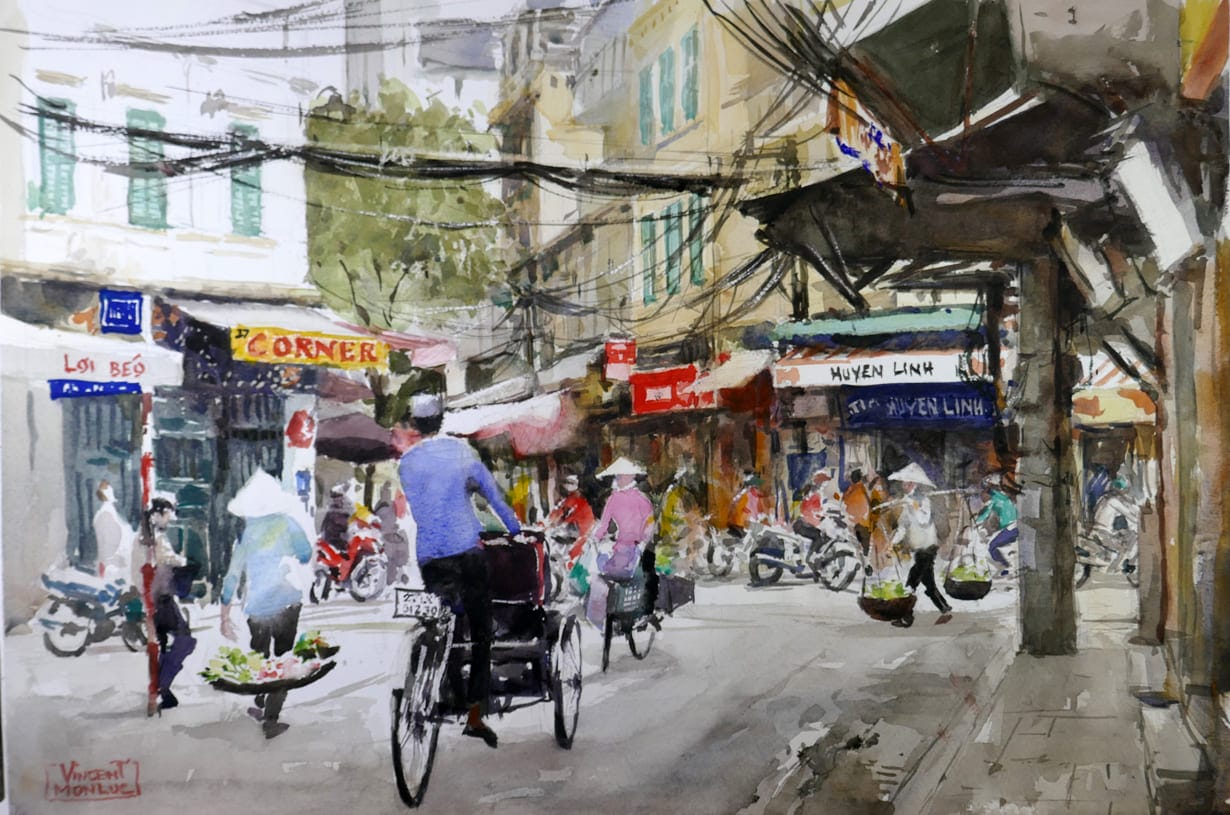
One of Monluc’s notable works is Old Hanoi street, a watercolor measuring 36 by 56 cm, created in Vietnam and now sold. This painting captures the vibrant spirit of Hanoi, a city known for its dense urban fabric and lively street life.
Vietnam offers rich subject matter for artists who enjoy painting outdoors. Daily life unfolds in public spaces, from street vendors and motorbikes to markets and gatherings. For a painter, this environment is both inspiring and demanding. The visual field can feel crowded, even chaotic. Turning such complexity into a coherent composition requires skill and sensitivity.
Monluc created Old Hanoi street on location over the course of four hours. Painting on site meant responding in real time to the environment. He had to observe quickly, choose his focal points, and build the composition step by step.
One striking feature of the scene was the network of tangled electrical wires crisscrossing the streets. Instead of seeing them as visual noise, Monluc recognized their compositional potential. The wires formed lines that structured the space, guiding the viewer’s eye across the painting. They added rhythm and geometry to the urban landscape, balancing the organic movement of street life below.
Through watercolor, he conveyed the atmosphere of Hanoi with freshness and immediacy. Transparent washes suggested light and air, while more defined strokes indicated architectural forms and activity. The painting communicates both the energy of the city and a sense of order within apparent disorder.
The Language of Color and Light
Color and light play a central role in Monluc’s work. His outdoor practice sharpens his awareness of subtle variations in tone and hue. Morning light differs from afternoon light; tropical climates differ from European ones. Each situation calls for a different response.
Watercolor is particularly suited to expressing luminosity. Its transparency allows white paper to shine through layers of pigment, creating a natural glow. Monluc uses this quality to evoke sunlight, reflections, and atmosphere. Rather than heavy detail, he often relies on suggestion, letting the viewer’s eye complete the image.
This sensitivity to light connects his painting to his cinematic background. In film, lighting shapes mood and directs attention. Similarly, in Monluc’s watercolors, light organizes the composition and sets the emotional tone.
Moving Toward the Imaginary
While much of Monluc’s work is rooted in observation, he is not limited to realism. He is currently developing a studio painting project that leans toward the imaginary. This direction suggests a shift from direct observation to inner vision.
Studio work allows for longer reflection, revision, and invention. Freed from the time pressure of changing light, the artist can explore ideas more deeply. Imaginary elements may enter the scene, blending memory, emotion, and creativity. This evolution shows Monluc’s desire to keep growing rather than repeating the same formulas.
His background in animation and storytelling may find new expression here. Imaginary painting opens space for narrative, symbolism, and dreamlike atmospheres. It is a natural extension for an artist who has always balanced observation with interpretation.
An Artist Between Worlds
Vincent Monluc’s career illustrates the richness of crossing disciplines and cultures. From animation to watercolor, from France to Florida to Vietnam, his journey reflects openness and curiosity. He observes the world carefully, then transforms it through composition and color.
Whether painting a busy Hanoi street or developing an imaginary studio project, he remains attentive to light, structure, and feeling. His works invite viewers to pause and look more closely at the environments we often pass by without noticing.
In a fast-paced world, Monluc’s watercolors offer moments of presence. They remind us that art can emerge from simply standing in a place, watching, and responding with honesty and skill. Through his paintings, everyday scenes become poetic, and fleeting impressions find lasting form.

