


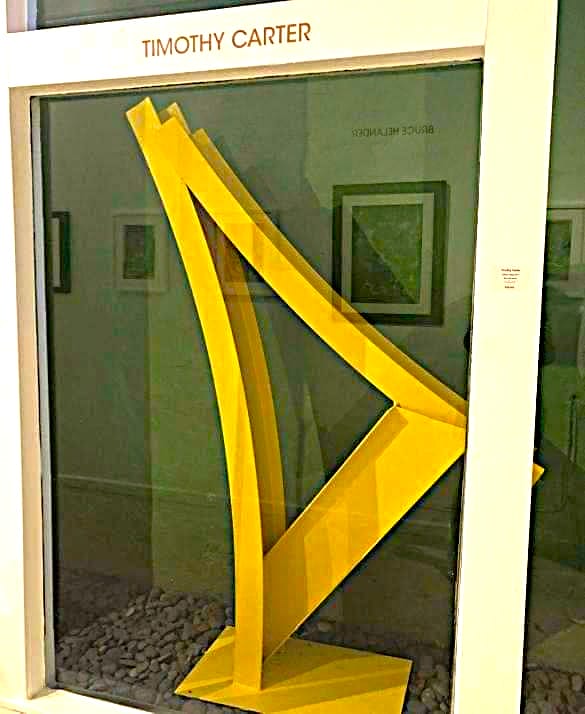
Timothy Carter is an abstract minimal steel sculptor whose work explores the balance between industrial strength and organic flow. Working primarily with curved I-beams, Carter transforms a material traditionally associated with architecture and infrastructure into sculptural forms that feel deliberate, rhythmic, and quietly expressive. His sculptures stand as meditations on form, weight, and spatial harmony, inviting viewers to reconsider steel not as a rigid, utilitarian element, but as a medium capable of subtlety and movement.
Rooted in abstraction and minimalism, Carter’s practice focuses on clarity of form rather than ornamentation. Each sculpture is composed with restraint, allowing the inherent qualities of steel such as its mass, surface, and structural logic to speak for themselves. Through repetition, curvature, and balance, Carter creates works that feel both grounded and dynamic, occupying space with calm authority.
Early Creative Foundations and a Lifelong Artistic Drive
Although Carter is now known for his steel sculptures, his artistic journey began long before he entered the world of metal. For many years, painting was his primary mode of expression, and visual art has always been a constant presence in his life. This early engagement with painting shaped his sensitivity to composition, rhythm, and negative space, elements that continue to influence his sculptural work today.
Even before committing fully to sculpture, Carter maintained an active creative practice, exploring different ways to translate ideas into tangible form. This broad artistic foundation allowed him to approach sculpture not merely as fabrication, but as a continuation of a deeper visual language developed over time. When he eventually transitioned from two-dimensional work to three-dimensional form, the shift felt like an expansion rather than a departure.
Discovering Sculpture and Finding a True Medium
Carter began working seriously with steel sculpture approximately eleven years ago. In 2015, he entered his first apprenticeship with a well-known steel sculptor, an experience that proved pivotal. It was during this period that he discovered a sense of belonging within the sculptural discipline. The physicality of steel, the demands of fabrication, and the direct engagement with material resonated deeply with him.
Following this initial apprenticeship, Carter pursued several additional internships, continuing to refine his technical skills and understanding of large-scale metal work until 2017. These formative years were essential in shaping both his craftsmanship and his confidence as a sculptor. Working alongside established artists allowed him to learn traditional techniques while also beginning to articulate his own creative direction.
The Emergence of Curved I-Beams as a Signature Language
The defining moment in Carter’s practice came in 2018, when he began experimenting with curved I-beams as a sculptural medium. Unlike flat steel or straight structural components, curved I-beams offered a unique visual tension, combining industrial precision with a sense of motion and elasticity. From the very first experiments, Carter recognized that he had found his comfort zone.
By working with I-beams that featured different curvatures, he discovered new possibilities for balance, repetition, and spatial dialogue. The curves softened the material’s industrial severity, allowing the sculptures to feel more fluid and contemplative. This approach marked a turning point, establishing the visual and conceptual foundation that continues to define his work.
Process: From Imagination to Industrial Precision
Carter’s creative process is both intuitive and methodical. Each sculpture begins as a mental image, an imagined form that exists long before steel is cut or welded. To better understand this vision, he creates a small-scale model, allowing him to study proportions, relationships, and overall structure in a tangible way.
Once the form is fully resolved, Carter moves into the fabrication phase. Traditionally, the I-beams used in his sculptures are curved using large hydraulic machines, which allow for precise and controlled shaping of the steel. After receiving the beams with the desired curvature, he cuts them to specific lengths and assembles them into clusters of three beams. This triadic structure has become a recurring motif in his work, offering both visual stability and compositional complexity.
Each cluster is carefully arranged to create a sense of cohesion, where individual elements remain distinct while contributing to a unified whole. The final sculpture reflects a careful balance between planning and material response, with the steel itself guiding certain decisions during assembly.
Evolving the Medium: Creating Curvature from Within
As Carter’s practice continues to evolve, so too does his relationship with the I-beam as a material. Rather than relying solely on premade curved beams, he is now actively working toward creating the I-beam shape entirely on his own. This involves welding steel together to form custom curvatures, granting him even greater control over form and structure.
This shift represents a significant step forward in his artistic independence. By constructing the curvature himself, Carter is no longer constrained by existing industrial limitations. Instead, the beam becomes a fully sculptural element from its inception, shaped directly by artistic intent rather than external fabrication processes.
Minimalism, Balance, and the Language of Steel
At the heart of Timothy Carter’s work is a commitment to minimalism, not as an aesthetic trend, but as a philosophy. His sculptures avoid excess, focusing instead on essential relationships between line, curve, mass, and space. The repetition of three beams, the controlled curvature, and the absence of decorative detail all contribute to a visual language that is disciplined and deliberate.
Yet within this restraint lies a quiet emotional resonance. The curves introduce softness and movement, suggesting growth, tension, and balance. Viewers are encouraged to walk around the sculptures, experiencing how form shifts with perspective and light. The work does not impose a narrative, but rather offers an open space for reflection.
A Continuing Exploration of Form and Possibility
Timothy Carter’s sculptural practice is defined by exploration of material, process, and personal vision. From early painting to large-scale steel work, his journey reflects a steady refinement of artistic purpose. With each new sculpture, he continues to push the boundaries of what industrial materials can express.
As he moves further into creating his own curved I-beam structures, Carter’s work stands poised at the intersection of engineering and abstraction. His sculptures serve as quiet yet powerful reminders that even the most utilitarian materials can be transformed into objects of contemplation, balance, and enduring presence.

