


Mona Ray’s artistic vision was shaped long before she ever stepped into a formal studio. Growing up on the high prairie of Wyoming, ten miles from the nearest town, she was immersed in a landscape defined by vastness, solitude, and elemental beauty. A self-described bookworm and daydreamer, she spent her childhood roaming freely through sagebrush plains and along sandstone bluffs, hunting for agates and lizards while keeping a cautious eye out for rattlesnakes.
The sensory impressions of that environment remain vivid. The wind pressing against her face, the dramatic violet turbulence of summer thunderclouds, and the earthy scent released after rain all left lasting imprints. This expansive terrain, unconfined and quietly powerful, later became the emotional and conceptual foundation of her work. Rather than depicting landscapes literally, Ray absorbed them as lived experiences, memories that continue to surface in her layered, semi-abstract paintings.
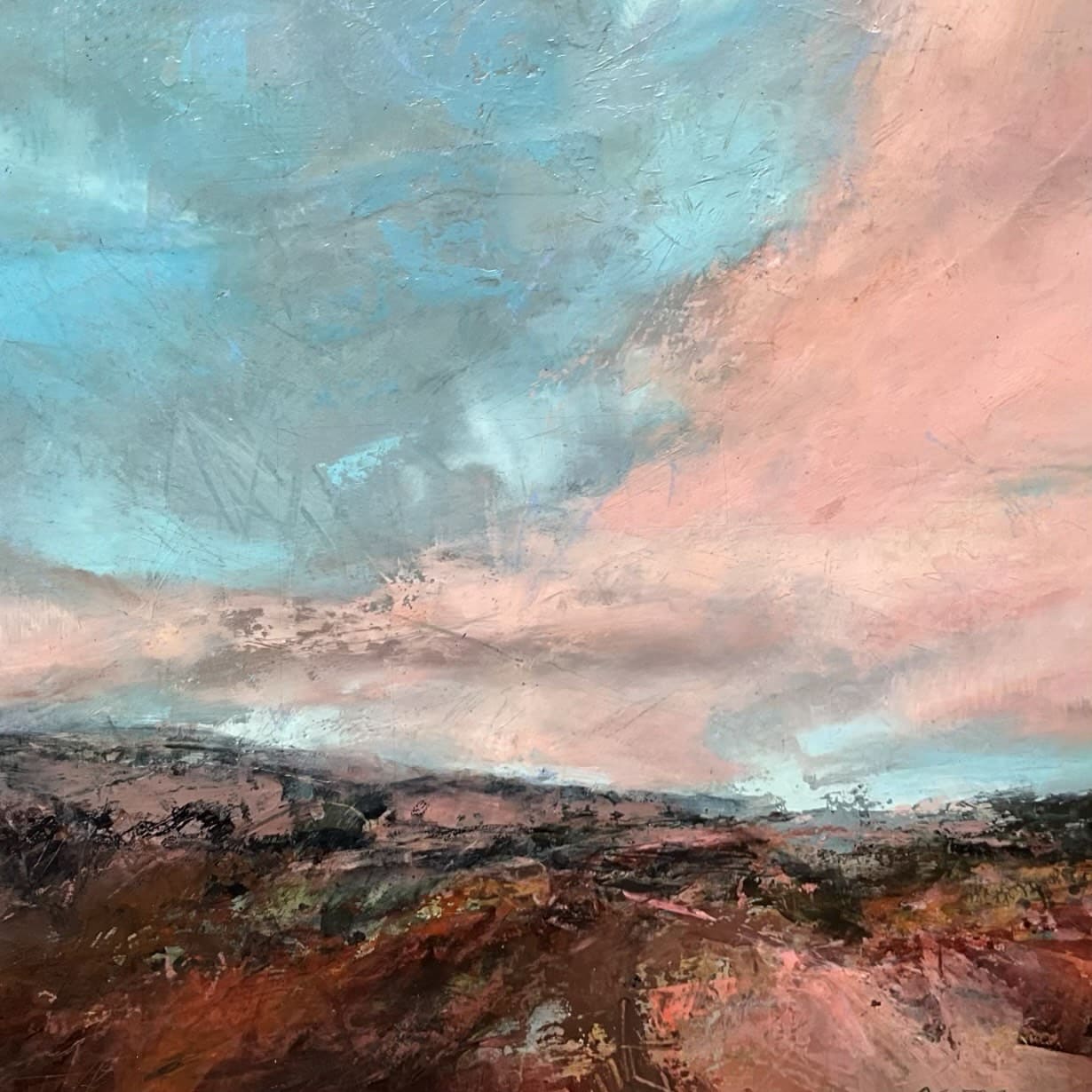
One such work, Falling Light, created using mixed media on wood, reflects this ongoing dialogue between memory, material, and place. Built through layered surfaces and subtle erosion, the piece evokes landscape not as a fixed location, but as an experience shaped by light, time, and the accumulation of gesture.
Finding Her Way to Art
Ray’s introduction to art came naturally and early. Because her father taught at a local college, she was able to take college-level classes as a teenager. Evening painting classes quickly became a sanctuary. Three uninterrupted hours of creative immersion offered space to spread out and the quiet camaraderie of others engaged in making. These moments showed her that art could be both disciplined and deeply personal.
Through a special high school program, she also studied watercolor privately with a professional artist who lived nearby. This one-on-one instruction strengthened her technical foundation while reinforcing the idea that art could be a viable and meaningful pursuit. Even then, painting felt essential, offering grounding and clarity.
False Starts and Necessary Detours
Despite this early passion, Ray’s path to becoming a professional artist was not a straight line. She pursued an MA in English, lived abroad for several years, and eventually entered the publishing industry. As responsibilities grew and expectations accumulated, art slowly receded into the background.
Looking back, Ray recognizes that she was postponing her artistic life. Painting became something she reserved as a future reward, something to fully embrace only after achieving traditional measures of success.
That mindset shifted dramatically in her early thirties when her marriage ended unexpectedly. The sudden rupture dismantled certainty and forced a reckoning. With little left to lose, she allowed painting to move from the margins to the center of her life. She supported herself by working evenings as a massage therapist and personal trainer, leaving her days free to paint with intensity and focus.
Claiming a Life in Paint
Ray’s dedication soon found public expression. Her first solo exhibition took place in 2001 and marked a decisive turning point. Since then, she has shown her work in a wide range of galleries, festivals, and alternative art spaces.
Her relationship with the art world has always been intentional. She has little interest in chasing juried shows or shipping work endlessly across the country. Instead, most of her exhibitions have taken place within driving distance in Southern California, where she is based, along with a five-year relationship with a gallery in Colorado. This approach reflects her preference for sustainable and meaningful engagement rather than constant expansion.
Continuing Explorations in Material and Process
Ray’s current practice centers on mixed media works on panel, though each series begins with hundreds of studies on paper. Landscape remains the conceptual anchor of her work, while materials shift depending on the direction of each body of work. Graphite, charcoal, ink, acrylic, collage, and oils all play important roles in her process.
She often creates small studies outdoors in direct response to place, but the heart of her practice unfolds in the studio. There, she works five to seven hours a day, and more when preparing for an exhibition. The process is slow and deliberate, focused on building surfaces through time and attention.
Her paintings are semi-abstract, grounded in observation without being bound by it. Layers of paint and drawing accumulate gradually, then are scratched, scraped, or sanded back. Ray thinks of the surface as land itself, where soil is deposited over time, transformed by heat and pressure, and eventually eroded. Like geological formations, her works carry evidence of change, with events embedded in strata and gestures recorded in paint.
Intuition, Meditation, and Letting Go
Each piece begins with a loosely held landscape reference, without a fixed idea of where the work will end. Ray’s daily meditation practice plays a central role in maintaining this openness. It allows her to remain unattached to outcomes while trusting intuition and still applying visual principles to guide composition.
This balance between control and release defines her work. The paintings evolve through attentiveness rather than force, shaped by observation, patience, and responsiveness. For Ray, painting is less about imposing an image and more about staying present long enough for the work to reveal itself.
Lifelong Practice and Ongoing Curiosity
At 56, Ray remains deeply committed to exploration and learning. She approaches her practice with curiosity and humility, hoping for many more decades working in paint. The process is rarely easy, but the challenge is part of its meaning.
Painting demands presence. It requires attention, patience, and a willingness to engage with uncertainty. For Ray, this discipline extends beyond the studio. It becomes preparation for a life lived with awareness, openness, and a readiness to embrace unforeseen possibilities.

