


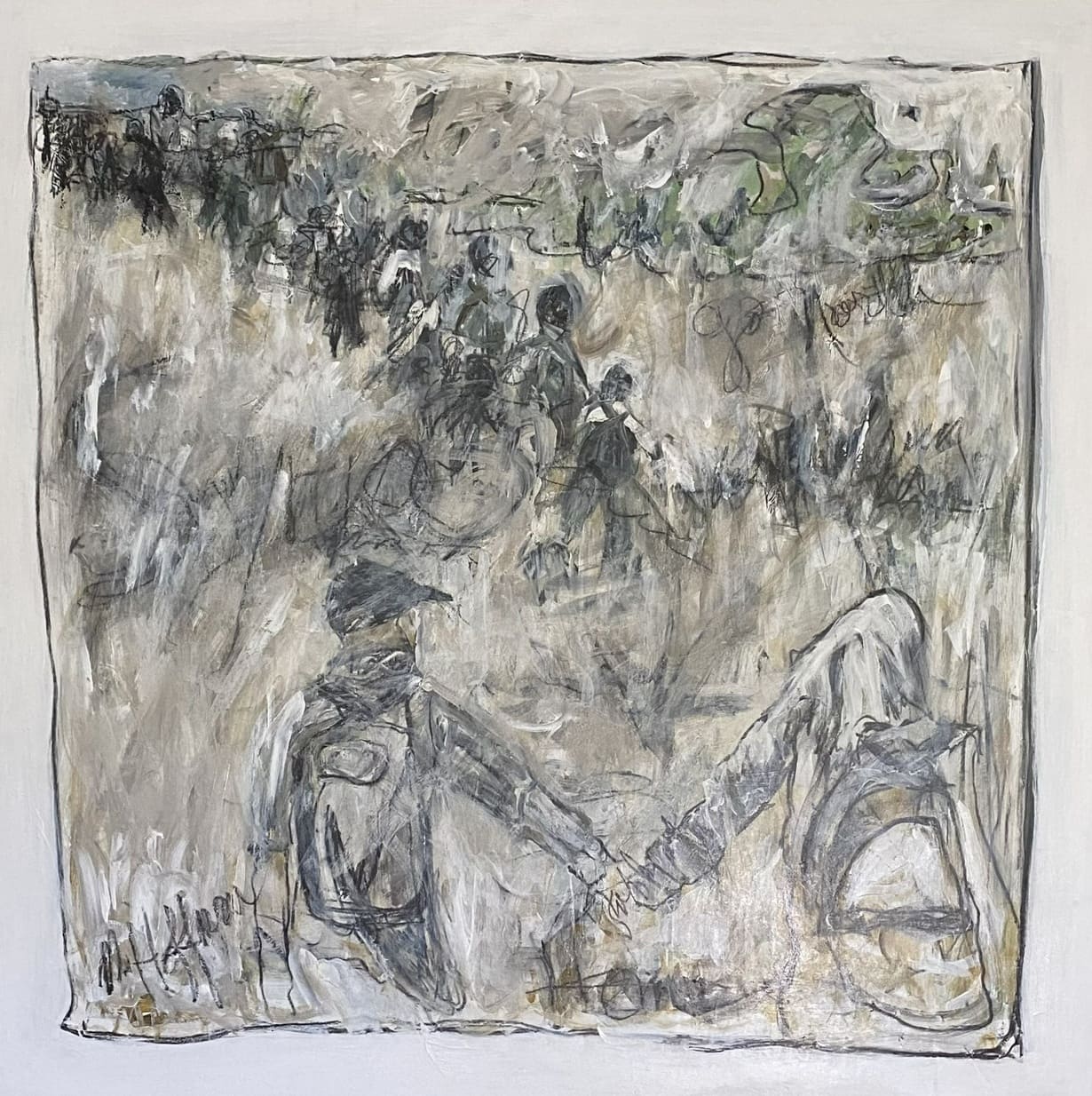
Melinda Hoffman is an artist whose work is guided by a strong sense of voice. For her, art is not only a visual experience but also a conversation with the viewer. Each piece becomes a way to speak about ideas she considers essential: the movement of water and wind, the power of seeds and migration, and the complexities of the human condition. Her practice reflects a desire to communicate, question, and connect.
Hoffman approaches art as a living dialogue. Rather than creating purely decorative objects, she builds works that carry intention and message. Whether through installation, printmaking, sculpture, or mixed media, her goal remains consistent: to reach her audience on both an emotional and intellectual level.
Education and Foundations
Hoffman’s artistic journey is supported by a diverse educational background. She studied Fine Arts and General Studies at Indiana University, building a broad foundation in creative thinking and visual expression. In 2012, she further refined her technical skills through printmaking coursework at Clemson University, an experience that contributed to her understanding of process, layering, and material exploration.
Earlier in her academic life, she also studied Radio and Television at Tri-County Technical College in 1988. This exposure to media and communication likely influenced her sensitivity to audience engagement and storytelling. Across these fields, a common thread emerges: a commitment to communication, whether through broadcast, print, or visual art.
Exhibitions and Recognition
Hoffman has participated in a wide range of exhibitions and public art events, steadily building a presence in the contemporary art scene. Her inclusion in the Clemson Print Biennial in 2018 highlights her engagement with printmaking as a serious discipline. Printmaking, with its emphasis on process and multiplicity, aligns well with her conceptual interests in repetition, distribution, and voice.
Her repeated participation in ArtFields, a prominent Southern art competition and exhibition, marks a significant aspect of her career. In 2016, she presented American Soldiers, Afghanistan, a body of five works that likely engaged with themes of conflict, humanity, and social reflection. In 2017, her installation Jumpers demonstrated her growing interest in immersive and spatial work. This trajectory continued with Seedly in 2018 and Whom Do We Save in 2019, both installations suggesting deep engagement with social and ethical questions.
These projects reveal Hoffman’s comfort with large-scale, concept-driven work. Installations allow her to create environments rather than isolated objects, inviting viewers to physically and mentally enter her ideas.
Her work has also appeared in group and gallery contexts, including the Women’s Show at Lyndon House in Athens, Georgia, and as a gallery artist at Center Stage in Greenville, South Carolina. In 2021, Senior Action Gallery presented a collection of seven major pieces from her political voice works, reinforcing her role as an artist unafraid to address civic and social themes.
Public Art and Community Presence
In recent years, Hoffman has expanded into public art sculpture, bringing her ideas into shared spaces. Her participation in Art Walk events in Tamarac, Florida (May 2025), Augusta, Georgia (February 2025), and Troy, Ohio (June 2025) demonstrates her commitment to engaging broader audiences outside traditional gallery walls.
Public art requires a different mindset. It must coexist with everyday life, architecture, and community movement. Hoffman’s interest in hanging forms and mobiles translates naturally into this realm. Suspended elements respond to air currents, light, and the presence of viewers, creating ever-changing experiences.
Her works in homes and offices throughout the region further extend her reach. These placements allow her art to become part of daily life, quietly influencing the environments where people live and work.
Themes: Nature, Movement, and the Human Condition
Nature plays a central role in Hoffman’s visual language. She frequently references water, wind, and seeds. These elements are not merely aesthetic choices but symbolic ones. Water can represent life, change, and continuity. Wind suggests movement and unseen forces. Seeds evoke potential, growth, and migration.
Migration itself is a recurring concept in her thinking. It connects natural cycles with human stories, touching on displacement, travel, and the search for belonging. Through these themes, Hoffman links the personal to the universal.
At the same time, she remains attentive to the human condition. Her political voice works indicate a willingness to confront difficult topics and social realities. Yet her practice is not limited to critique. She also embraces playfulness and joy, creating collections of works that are simply fun or culturally focused. This balance between gravity and lightness keeps her work approachable while still meaningful.
Materials and Methods
Hoffman works across multiple mediums, choosing materials that best serve her ideas. She sometimes works in steel, a material that offers strength, durability, and presence. Steel allows for structural experimentation, especially in suspended or hanging forms.
Her love for mobiles and hanging sculptures reflects an interest in movement and balance. These works are never fully static. They shift with air and environment, reminding viewers that art, like life, is in constant motion.
Installation art is another key component of her practice. Installations give her the freedom to combine materials, scale, and space into cohesive experiences. They also align with her desire to speak to audiences, as viewers must physically navigate the work.
Literary and Illustrative Work
Beyond visual art, Hoffman has also explored storytelling through books. She has written and illustrated two children’s books intended for adults: What’s A Friend For and Lots of People Love Lake City. These projects suggest a playful yet thoughtful engagement with narrative, community, and relationships.
Creating children’s books for adults is an intriguing choice. It points to layered communication, where simple imagery can carry deeper meaning. This mirrors her visual art practice, where accessible forms often hold complex ideas.
Inclusive Love and Connection
A subtle but important idea in Hoffman’s statement is inclusive love. This concept suggests openness, empathy, and recognition of shared humanity. In a world often marked by division, such a stance positions her art as a space for connection.
Her hanging forms, communal themes, and public installations all support this idea. They invite viewers to gather, reflect, and feel part of something larger. Rather than isolating the viewer, her work tends to draw people into shared experience.
An Evolving Conversation
Melinda Hoffman’s career reflects ongoing exploration. From printmaking to steel sculpture, from installations to illustrated books, she continues to expand her modes of expression. Yet the core remains steady: art as voice.
Her work speaks about nature, society, and human experience. It asks questions, offers reflections, and sometimes simply delights. By working in multiple mediums and contexts, she keeps the conversation open and evolving.
In this way, Hoffman’s art is less about final answers and more about dialogue. Each piece becomes an invitation to look, think, and feel. For an artist committed to voice, this ongoing exchange with the audience may be her most important creation of all.

