


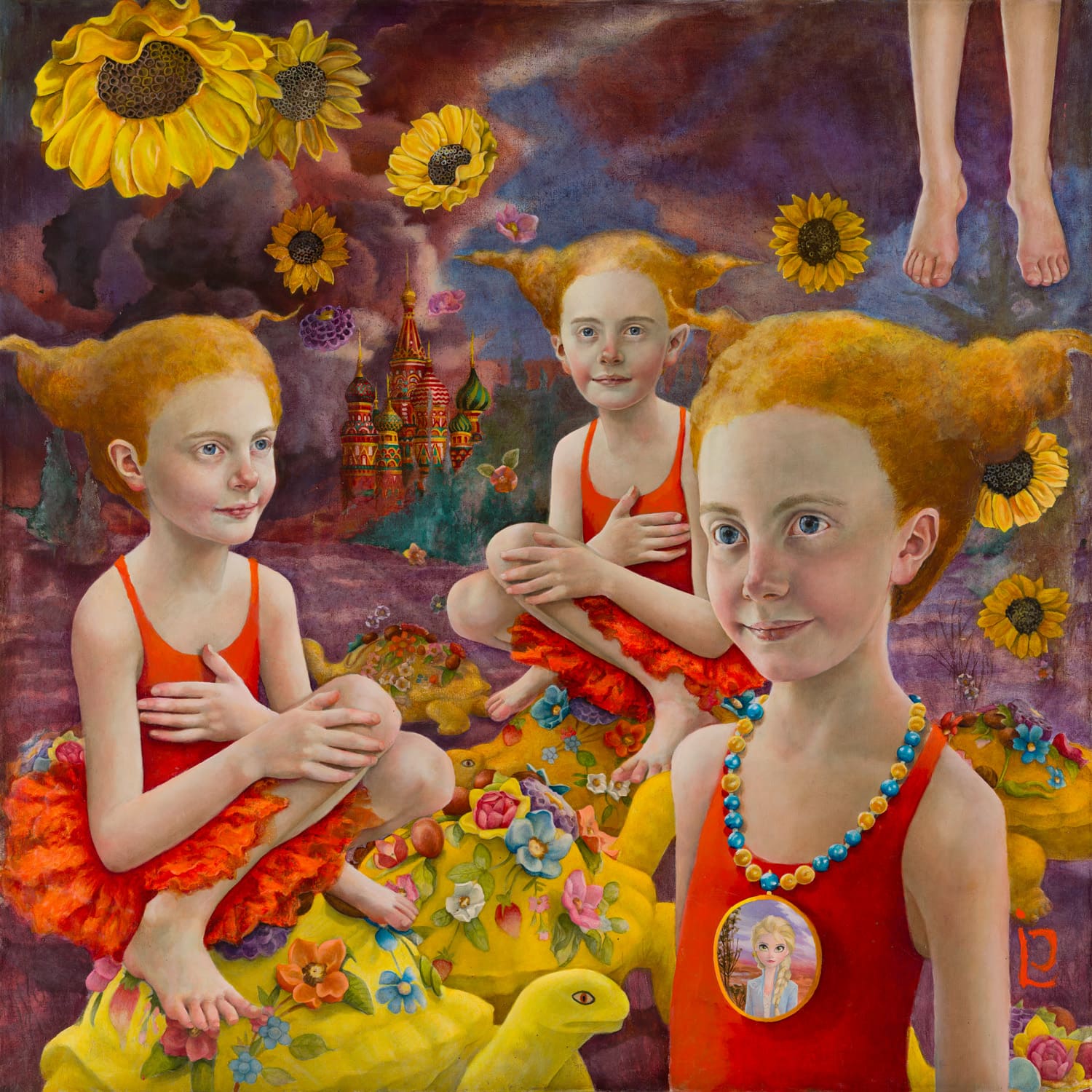
Lib Mason is an award-winning oil painter whose work inhabits the space between the real and the symbolic. Working in magic realism, she combines meticulous technique with layered meaning, creating paintings that feel at once historical and urgently contemporary. Her chosen approach, the Flemish method, is known for its precision, slow build-up of translucent layers, and luminous finish. In Mason’s hands, this method becomes more than a technical preference. It is a conceptual tool that mirrors the depth and complexity of her subjects.
Magic realism in painting often suggests subtle departures from ordinary reality, and Mason uses it to powerful effect. Her images are grounded in recognizable figures and events, yet they carry an otherworldly clarity. Light glows, surfaces gleam, and symbols quietly accumulate. The result is work that invites prolonged looking, where meaning unfolds gradually rather than announcing itself at once.
From Illustration to Fine Art
A graduate of the Rhode Island School of Design, Mason developed a strong visual foundation early in her career. RISD’s rigorous training in drawing, design, and critical thinking shaped her sensitivity to composition and narrative. After graduating, she began working as an editorial illustrator in New York City, a field that demands clarity, speed, and the ability to translate complex ideas into compelling images.
Her client list included major media names such as Rolling Stone and Time Warner. In that environment, images must compete with headlines, layouts, and tight deadlines. Mason learned to communicate visually with precision and impact. She also learned how images can frame public conversations, influence perception, and distill political or cultural moments into single, memorable visuals.
This background remains visible in her fine art. Her paintings often feel like expanded editorials. They are less constrained by format and more layered in meaning, yet still sharply attuned to current events and cultural tensions. Where illustration often simplifies, her paintings complicate. They open questions instead of closing them.
The Language of Symbolic Portraiture
Central to Mason’s practice is symbolic portraiture. Her figures are not only individuals but also carriers of ideas. They stand in for collective experiences, moral dilemmas, and social realities. In her work, portraiture becomes a site where private identity and public meaning intersect.
She is particularly interested in how contemporary cultural and political events shape personal lives. Rather than depicting these events directly as documentary scenes, she filters them through symbols, allegory, and carefully staged imagery. Flowers, ornaments, patterns, and recurring motifs populate her canvases. These elements soften the entry point into the work, offering visual pleasure, yet they also carry coded meanings.
Mason has described her strategy as engineering beauty to disarm, then implicate. The viewer is first attracted by harmony, color, and craft. Only after entering the image does the underlying tension reveal itself. Beauty becomes a kind of threshold. It lowers defenses and allows difficult realities to surface.
Painting as Witness
One of Mason’s works begins with a stark news story. A girl tells her mother that Ukraine did not attack Russia and that the opposite is true. For stating this, she is arrested. When told she must be the only girl brave enough to speak that way, she replies that there are many girls like her.
This exchange becomes the structural core of the painting. Rather than illustrating the scene literally, Mason translates the idea into visual form. The child appears repeatedly across the canvas. She multiplies into a chorus of figures that act as witnesses, echoes, and possibilities. Each repetition reinforces the notion that truth-telling is not isolated, even when it is punished.
The logic of the painting draws from both religious iconography and fairy tales. There is ornament, emblematic clarity, and floating blooms that suggest purity, innocence, and mythic storytelling. At the same time, the atmosphere is unsettled. Colors may bruise, tones may darken, and the visual harmony carries a quiet strain. The political dimension is never far from the surface.
In this work, beauty is not comfort. It is a mechanism. It draws the viewer close enough to confront the stakes of honesty under pressure. The painting asks what it costs to say what is true, and who bears that cost. By centering a child, Mason highlights vulnerability but also moral clarity. Children in her work can function as truth-bearers, unfiltered by propaganda or fear.
The Ethics of Aesthetic Pleasure
A notable tension in Mason’s work is the relationship between aesthetic pleasure and ethical content. Her paintings are undeniably beautiful. They are carefully composed, luminous, and materially rich. Yet they deal with themes that can be unsettling, including political conflict, misinformation, power, and personal risk.
This tension is not accidental. Mason uses it to question the viewer’s role. If one is drawn in by beauty, what responsibility follows? Can visual pleasure coexist with political awareness? Her paintings do not preach, but they do implicate. They suggest that looking is not neutral and that images can shape moral attention.
By working in oil and using traditional techniques, Mason also places herself in dialogue with art history. The Flemish method connects her to centuries of painters who used similar techniques to depict religious, mythological, and historical subjects. Mason extends that lineage into the present and applies old methods to new realities. The result is a bridge between past and present, craft and concept, surface and depth.
Relevance in a Contemporary World
In a time of rapid news cycles and digital overload, Mason’s slow, layered paintings offer a different mode of engagement. They require time, both to make and to view. This slowness becomes a form of resistance against simplification. Complex issues are given space to breathe.
Her work resonates in a global context where information is contested and narratives compete. By focusing on individual figures and symbolic storytelling, she humanizes large-scale political issues. She reminds viewers that behind headlines are lived experiences, moral choices, and personal courage.
Conclusion: Luminous Confrontations
Lib Mason’s art operates in the space where beauty meets accountability. Her paintings glow, but their light reveals more than it hides. Through magic realism, symbolic portraiture, and masterful technique, she transforms current events into images that linger in the mind.
She does not offer easy answers. Instead, she creates luminous confrontations, moments where viewers must reckon with what they see and what it means. In doing so, Mason affirms the continuing power of painting to engage with the world, to question it, and to bear witness to truth.

