


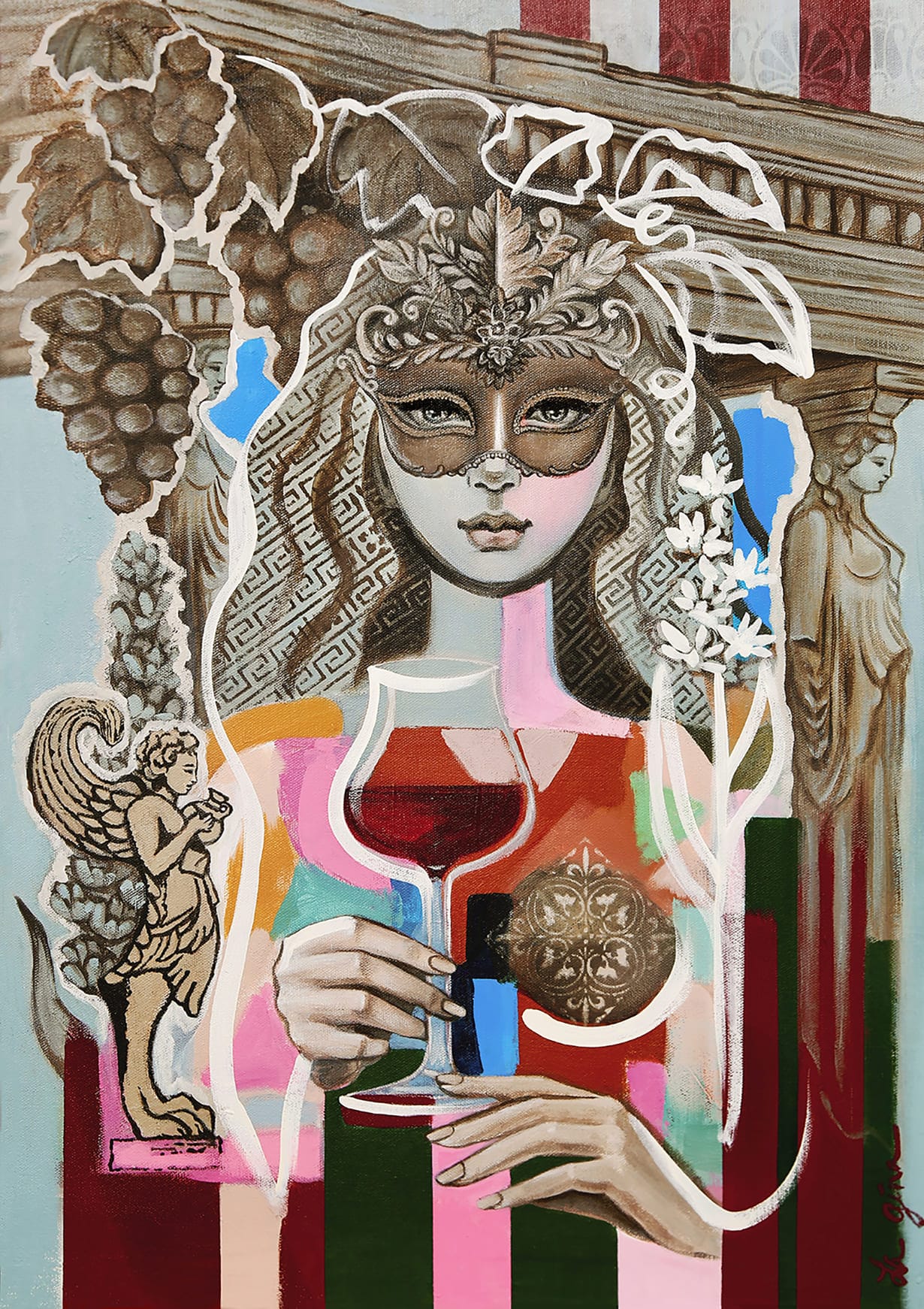
La Gina, also known as Gina Palmerin, is a Los Angeles based contemporary painter whose work lives at the intersection of emotion and design. Her abstract figurative paintings are instantly recognizable for their expressive faces, sculpted lines, and bold patterning that feels both architectural and deeply human. In her hands, the figure becomes a vessel for story, memory, and symbolism, while color and pattern create a visual language that is as refined as it is emotive.
Working primarily in acrylic and often layering with oil paint and oil pastels, Palmerin creates tactile surfaces that invite close looking. Her paintings balance modern clarity with a sense of timelessness, merging classical influences with contemporary aesthetics. The result is a body of work that feels grounded in art history yet fully present in today’s visual culture.
A Signature Style Rooted in Contrast
One of the defining qualities of Palmerin’s art is contrast. She pairs softness with structure, raw mark making with elegant design, and intimate emotion with bold visual statements. Her faces and figures are stylized and distilled, yet they carry a strong psychological presence. A tilt of the head, a steady gaze, or a carefully shaped negative space can hold as much narrative weight as a detailed scene.
Her compositions often feature refined details set against earthy fields and saturated color accents. These backgrounds are not mere backdrops but active components of the work, creating rhythm and structure. Architectural patterns, repeated motifs, and sculpted contours frame her subjects, giving them a sense of place within a designed world.
This interplay between figure and design reflects Palmerin’s interest in how identity is shaped by culture, by memory, and by environment. The figure is never isolated. It exists within a system of symbols, colors, and forms that hint at a larger story.
Influences: From Classical Art to Muralism
Palmerin draws inspiration from a wide range of sources, including classical art, modern design, Mexican muralism, and Art Nouveau. From classical traditions, she borrows a respect for the human figure and the power of composition. From modern design, she embraces clarity, pattern, and intentional use of space. Mexican muralism contributes a sense of cultural storytelling and social presence, while Art Nouveau informs her love of line, ornament, and organic flow.
These influences do not appear as direct quotations but as undercurrents in her visual language. A viewer might sense the monumentality of mural traditions in the calm authority of her figures, or the decorative elegance of Art Nouveau in the curves and patterns that surround a face. Yet the final work is distinctly her own, edited, distilled, and contemporary.
Storytelling, Memory, and Spiritual Symbolism
At the heart of Palmerin’s practice is storytelling. Her paintings are not literal narratives but emotional and symbolic ones. She explores cultural memory and spiritual symbolism, using the figure as a site where personal and collective histories can meet.
Spiritual references often appear subtly through symbols, titles, or compositional choices. Rather than illustrating doctrine or myth directly, she evokes a mood of reverence, introspection, or ritual. This gives her work a quiet depth. Viewers may feel that there is more beneath the surface, even if it is not fully explained.
Cultural memory also plays a role in her choice of motifs and inspirations. By engaging with traditions such as muralism and by referencing iconic figures, she situates her work within broader cultural conversations while maintaining an intimate, personal tone.
Intimacy and Identity in Portraiture
Palmerin’s current body of work focuses strongly on intimacy and identity through stylized portraiture. Her faces and figures are reduced to essential forms, yet they remain expressive. She is particularly interested in how subtle visual elements such as posture, gaze, and negative space can communicate emotion.
There is often a quiet drama in her portraits. A figure may look away, lost in thought, or meet the viewer with a calm but steady presence. The emotional read is immediate, even when the surface is highly designed and intentional. This duality between designed surface and direct emotion creates a compelling tension.
Her exploration of identity is not limited to likeness. Instead, she investigates how a person can be suggested through shape, color, and mood. Identity becomes fluid, shaped by visual cues rather than strict realism. This allows viewers to project their own experiences and interpretations onto the work.
Materiality and Process
Material plays an important role in Palmerin’s art. Acrylic provides a versatile base, allowing for both flat fields of color and layered textures. Oil paint and oil pastels add richness, depth, and a sense of touch. The layering process builds surfaces that feel worked and considered, with sculpted lines that guide the eye.
These tactile qualities reinforce the emotional content of the work. A thick line or a textured patch of color can carry as much feeling as a facial expression. Her process is both controlled and intuitive. Designed compositions coexist with spontaneous marks.
This balance mirrors the conceptual contrasts in her work, including structure and freedom, design and emotion. The physical act of building the painting becomes part of its meaning.
Exhibitions and Recognition
Palmerin’s work has reached significant audiences through both group and solo exhibitions. She has been exhibited in À Gogo III at Mash Gallery at the Pacific Design Center during Frieze Los Angeles 2025, placing her within a high-profile contemporary art context. She has also held solo exhibitions, including Icons and Legends at Sparks Gallery.
These exhibitions highlight the growing recognition of her distinctive voice. Showing in design-forward and contemporary spaces aligns naturally with her aesthetic, which bridges fine art and design sensibilities.
Ceres: A Painting of Cycles and Community
A strong example of Palmerin’s thematic and visual concerns is her painting Ceres (20”x28”, acrylic and oil on canvas mounted on wood). The work traces cycles of planting, patience, and renewal through grounded color and sculpted line. Inspired by the goddess of grain and harvest, the painting connects mythological symbolism with a contemporary context.
The composition echoes terrain, ridges, parcels, and mapped rhythms, mirroring the landscapes that shape wine. Rather than depicting a literal landscape, Palmerin abstracts these elements into patterns and forms that suggest cultivation and care. The painting becomes a meditation on seasonality and the passage of time.
Created for Fallbrook’s inaugural Wine Festival 2025, Ceres also honors the community. It recognizes the growers, makers, and shared labor that transform fields into celebration, from field to glass. In this sense, the painting operates on multiple levels: mythic, environmental, and social.
A Contemporary Voice with Timeless Resonance
La Gina (Gina Palmerin) represents a compelling contemporary voice, one that merges design awareness with emotional depth. Her abstract figurative paintings invite viewers to slow down, to read posture and pattern, and to sense the stories embedded in color and line.
By weaving together classical references, cultural memory, and modern aesthetics, she creates work that feels both current and enduring. Her focus on intimacy and identity ensures that, despite the stylization, the human presence remains central.
As her career continues to grow through exhibitions and new bodies of work, Palmerin stands out as an artist who understands that design and emotion are not opposites. In her paintings, they are partners. Each sharpens and deepens the other, and together they create images that linger in the viewer’s mind.

