


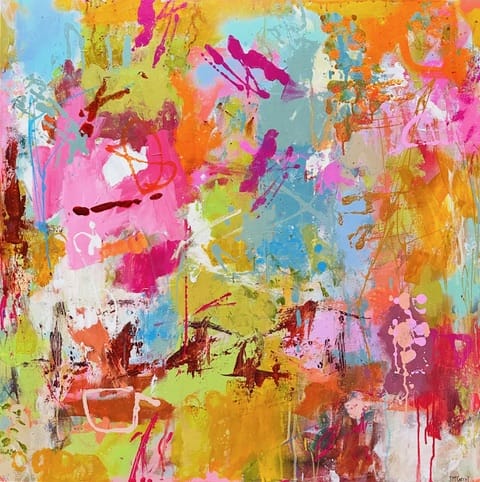
John McCarthy is an abstract artist whose work reflects a dynamic dialogue between environment, culture, and personal expression. Dividing his time between New York City and the Hudson Valley in upstate New York, McCarthy has developed a distinctive visual language that merges movement, color, and emotion. His art embodies the rhythm of both urban life and nature, creating compositions that feel alive with energy and depth.
Working primarily with oil, acrylic, and collage, McCarthy approaches painting as an exploratory process. Each canvas becomes a space where experimentation and intuition meet. His works are not simply static images but visual experiences that capture motion, atmosphere, and feeling. Through bold gestures and layered materials, McCarthy constructs paintings that invite viewers to engage with color and form in new and unexpected ways.
Influences from Landscape and Travel
The environments surrounding McCarthy play a significant role in shaping his artistic vision. The Hudson Valley, known for its sweeping landscapes, rolling hills, and dramatic seasonal changes, provides a constant source of inspiration. The natural palette of the region, from the deep greens of summer forests to the fiery oranges and reds of autumn foliage, often finds its way into his compositions.
Equally influential are McCarthy’s travels throughout Japan and other parts of Asia. Exposure to different artistic traditions and visual philosophies has broadened his approach to abstraction. In particular, Japanese aesthetics, which emphasize harmony, balance, and the expressive power of minimal gestures, have deeply informed his work.
These cultural influences are not directly replicated but rather interpreted through McCarthy’s own artistic lens. The result is a body of work that feels both globally inspired and uniquely personal, merging Western abstract traditions with subtle references to Eastern artistic practices.
The Color Legacy of Sanzo Wada
One of the most significant inspirations behind McCarthy’s color choices is the work of Japanese color theorist and artist Sanzo Wada. Wada is renowned for developing sophisticated color palettes that explore harmony and contrast in innovative ways. His color combinations were designed to evoke emotional responses and create visual balance.
McCarthy draws from these palettes as a foundational element in many of his paintings. Rather than using color randomly, he carefully builds compositions where tones interact with one another to create rhythm and tension. Soft, muted hues may sit beside vibrant, saturated colors, creating a sense of movement across the canvas.
This thoughtful approach to color allows McCarthy to achieve a balance between spontaneity and structure. The result is artwork that feels both energetic and intentional, where every shade contributes to the overall visual narrative.
Dynamic Techniques and Materials
McCarthy’s work is notable for its rich layering of materials and techniques. His acrylic and collage paintings often incorporate elements such as rice paper and sumi-e ink, two materials closely associated with traditional Japanese art forms.
Rice paper introduces texture and translucency, allowing layers beneath the surface to remain visible and interact with the paint applied above. This creates depth within the painting and gives the surface a tactile quality.
Sumi-e ink, traditionally used in Japanese brush painting, brings a sense of fluid movement to McCarthy’s compositions. The ink’s natural flow and variation in tone allow him to produce expressive marks that feel spontaneous and alive.
Combined with bold acrylic strokes and collage elements, these materials contribute to the energetic character of his work. Each layer adds complexity, inviting viewers to look more closely and discover subtle variations in texture, line, and color.
The Intersection of Art and Music
Music also plays an important role in McCarthy’s creative process. He often draws inspiration from lyrics, rhythm, and the emotional atmosphere of musical compositions. This influence can be felt in the structure of his paintings, which frequently resemble visual interpretations of sound.
Just as a musical piece builds through tempo and harmony, McCarthy’s paintings develop through layers of color and gesture. Broad strokes may function like powerful chords, while delicate lines act as softer notes that guide the viewer’s eye across the canvas.
This relationship between art and music allows McCarthy to explore abstraction in a multisensory way. Rather than depicting recognizable subjects, his paintings communicate through mood, movement, and visual rhythm.
Reimagination II: Exploring New Possibilities in Abstract Art
A striking example of McCarthy’s artistic exploration can be seen in his work Reimagination II, part of the Reimagination series. This series represents the artist’s ongoing investigation into new techniques and approaches within abstract painting.
Reimagination II embodies the core philosophy behind the series: the idea that artistic processes and visual languages can continually evolve. Instead of repeating familiar methods, McCarthy challenges himself to rethink how materials, color, and gesture interact on the canvas.
The painting is characterized by its bold use of color and expressive application of medium. Dynamic brushstrokes sweep across the surface, creating a sense of motion and vitality. Layers of paint and collage interact in ways that produce both depth and visual excitement.
The result is a work that commands attention while maintaining an open-ended quality. Viewers are encouraged to interpret the forms and movements in their own way, allowing each person to experience the painting differently.
Energizing the Space
One of the defining qualities of McCarthy’s work is its ability to transform the atmosphere of a space. The bold compositions and vibrant palettes of his paintings bring energy and movement to their surroundings.
Reimagination II, like many of McCarthy’s works, has a presence that goes beyond its physical dimensions. The expressive gestures and layered textures create a sense of expansion, as if the painting’s motion extends beyond the edges of the canvas.
Whether displayed in a modern home, gallery, or public setting, the artwork acts as a focal point that invites viewers to pause and engage with its dynamic forms.
A Continuing Journey of Exploration
John McCarthy’s artistic practice is rooted in curiosity and experimentation. By drawing from diverse influences such as landscape, travel, Japanese aesthetics, music, and color theory, he continues to expand the possibilities of abstract art.
His paintings do not aim to provide fixed meanings or narratives. Instead, they create spaces where color, movement, and emotion interact freely. Each work becomes an invitation for viewers to explore their own interpretations and connections.
Through works like Reimagination II, McCarthy demonstrates that abstraction remains a powerful and evolving form of artistic expression. His art celebrates the freedom to experiment, the beauty of cultural exchange, and the endless potential of color and movement within the contemporary art world.

