


John David Burch’s journey into the art world is anything but conventional. Unlike many artists who begin their creative paths early in life, Burch discovered painting in his fifties, proving that artistic awakening can happen at any stage. His entry into art was not born from a traditional studio environment, but from a life deeply rooted in science and international research.
In 1995, Burch moved from Toronto to New York City to join a scientific team at Columbia University studying the health effects of the Chernobyl disaster. This significant professional shift placed him at the center of one of the world’s most dynamic cultural capitals. While his work focused on science and public health, New York City quietly opened another door for him, one that would redefine his life.
Shortly after arriving, Burch enrolled as a student at the Art Students League of New York, one of the most respected independent art schools in the United States. It was here that he encountered abstract painting and found himself deeply drawn to it. What began as curiosity quickly evolved into passion.
Mentorship and the Influence of Ronnie Landfield
A defining moment in Burch’s artistic development was his mentorship under Ronnie Landfield. Landfield is widely regarded as a leading figure in American abstract expressionism and lyrical abstraction. Studying under him gave Burch not only technical guidance but also a philosophical framework for understanding abstraction.
Landfield’s approach to colour and spatial relationships left a lasting impression on Burch. Through this mentorship, Burch developed a fascination with how colours interact, contrast, and harmonize. He became increasingly absorbed in the emotional and intellectual potential of colour itself.
Rather than focusing on representational imagery, Burch gravitated toward colour as a primary language. Landfield’s influence encouraged him to explore painting as a field of sensation and perception, where colour relationships could evoke feeling without relying on literal subjects.
New York City as an Expanding Classroom
Living in New York City dramatically expanded Burch’s exposure to art. He immersed himself in the city’s museum culture, becoming a regular visitor to major institutions and galleries. The Metropolitan Museum of Art, the Museum of Modern Art, and the Guggenheim became part of his extended education.
These experiences allowed him to study modern and contemporary masters firsthand. Observing how artists across generations approached abstraction deepened his understanding of visual language. The city itself, with its energy, diversity, and constant movement, also influenced his perception of colour and space.
For Burch, New York was not just a place to live but a continuous classroom where he absorbed visual culture daily.
Influence from the Former Soviet Union
Another important layer of influence came from Burch’s travels in the former Soviet Union. His scientific work on the Chernobyl Project required frequent visits over a ten-year period. These trips exposed him to Eastern European art traditions that many Western artists rarely encounter directly.
A particularly meaningful discovery was the work of Robert Rafailovich Falk, which Burch first encountered at the New Tretyakov Museum in Moscow. Falk, associated with Russian modernism, is known for his expressive use of colour and painterly depth. Seeing Falk’s work in person left a strong impression on Burch and reinforced his belief in colour as a carrier of emotion and meaning.
These cross-cultural experiences broadened his artistic vocabulary and contributed to the layered sensitivity seen in his paintings.
Colour as the Central Language
At the core of John David Burch’s work is a deep exploration of colour. His paintings in oil and acrylic on canvas are driven by colour in both real and imagined forms. For Burch, colour is not decorative but conceptual. It is the foundation of the work.
Abstract art provides him with the freedom to investigate colour relationships without the constraints of literal representation. He studies how colours influence one another, how subtle shifts can change mood, and how tonal variations can create depth and movement.
His work invites viewers to engage with colour on multiple levels. There is a sensory experience in the immediate visual impact, but also an intellectual dimension. Burch encourages viewers to think about what they see and feel. The reaction can be emotional, contemplative, or analytical, but it is never passive.
In this way, his paintings function as visual conversations between artist and audience.
“Sailors’ Delight”: A Study in Atmosphere
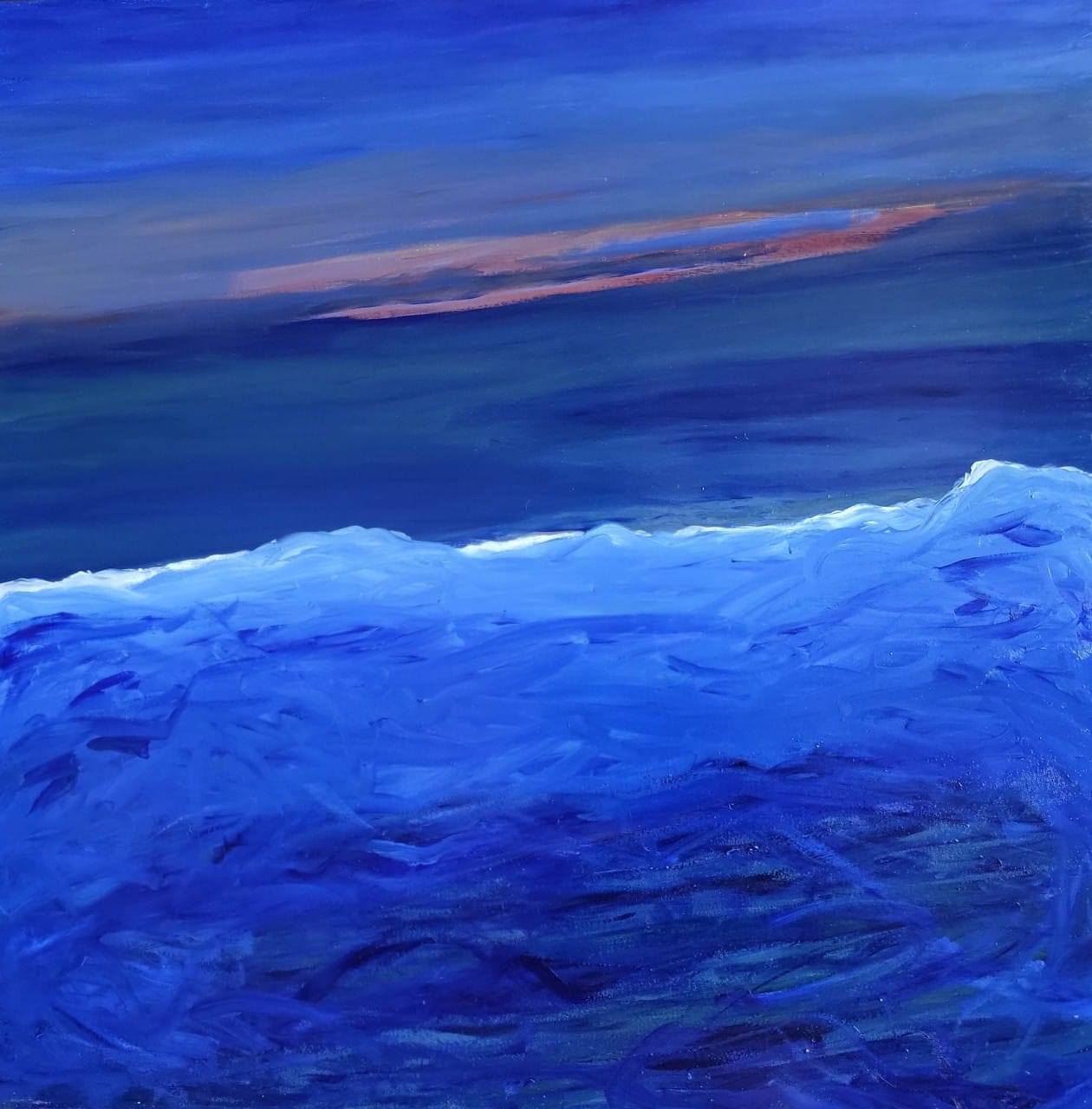
One notable example of Burch’s approach is his painting Sailors’ Delight, an oil on canvas measuring 36 by 36 inches. The work can be described as an abstract seascape, yet it avoids literal depiction. Instead, it captures the essence of a maritime atmosphere through colour relationships.
A subtle presence of red in the sky references the old saying “red skies at night, sailors’ delight,” suggesting calm weather and safe sailing ahead. Rather than illustrating a scene, Burch evokes it. The viewer senses the sea, the horizon, and the sky through gradients, transitions, and tonal contrasts.
The red element acts as both a visual anchor and an emotional signal. It introduces warmth into cooler tones and creates a dynamic balance across the canvas. This painting demonstrates Burch’s ability to use minimal cues to trigger recognition while maintaining abstract integrity.
Artistic Philosophy and Viewer Engagement
Burch’s artistic philosophy centers on engagement. He does not aim to provide fixed meanings. Instead, he creates conditions for viewers to experience colour in personal ways. Each painting becomes a space for interpretation.
He believes that colour can communicate beyond language. It can stimulate memory, mood, and thought. By focusing on colour relationships, he invites viewers to slow down and observe nuance. The experience becomes reflective rather than narrative.
This approach aligns with traditions in abstract expressionism while remaining distinctly his own. His work is not about grand gestures but about careful attention to chromatic dialogue.
A Continuing Exploration
John David Burch’s story is a reminder that creativity can emerge at any time in life. His transition from science to art illustrates how analytical and creative thinking can coexist. In fact, his scientific background may contribute to his methodical exploration of colour relationships.
His journey from Toronto to New York, from laboratories to studios, and from research trips to museum visits has shaped a unique artistic voice. Each phase of his life added a layer to his understanding of perception, culture, and expression.
Today, his paintings stand as explorations of colour’s emotional and intellectual power. They reflect a lifetime of observation, travel, mentorship, and curiosity.
Burch continues to paint with the same sense of discovery that first drew him to the canvas. For viewers, his work offers not just images but experiences, invitations to see colour as something alive, relational, and full of possibility.

