


Jayanto Tan is a Gadigal/Sydney-based visual artist whose multidisciplinary practice bridges personal history and collective memory. Originally from North Sumatra, Indonesia, Tan brings together mythologies, intimate narratives, and cultural traditions to construct a body of work that reflects on identity, queer perspectives, hierarchy, colonial histories, and the search for belonging. As an immigrant artist navigating life as what he describes as a “minority in minority,” Tan’s practice is both deeply personal and profoundly political.
Working across ceramics, installation, cooking, performance, and community workshops, Tan transforms lived experience into shared ritual. His work resists rigid categorization, instead embracing hybridity as both a method and a message. Through this fluidity of form, he creates spaces where marginalized voices can be heard, seen, and celebrated within mainstream cultural discourse.
Origins and Cultural Foundations
Born in North Sumatra, Indonesia, Tan’s early life was shaped by layered cultural traditions, communal rituals, and the sensory richness of family gatherings. Migration to Australia introduced a new terrain of identity negotiation. Living and working on Gadigal land in Sydney, Tan occupies multiple cultural positions simultaneously: Indonesian and Australian, queer and diasporic, traditional and contemporary.
This intersectionality forms the foundation of his artistic inquiry. Tan draws from inherited mythologies and family histories, weaving them together with contemporary concerns around colonialism and hierarchy. His work asks how one preserves cultural memory while adapting to new environments. How does one maintain tradition in a society that often marginalizes difference?
Rather than treating these questions as abstract theory, Tan approaches them through material and embodied processes. He builds, cooks, performs, and collaborates, allowing art to function as a lived experience rather than a static object.
Memory as Material
At the core of Tan’s practice is a deep engagement with memory and ritual. He frequently turns to family archives and personal histories, revisiting fragments of the past in order to preserve and honor traditions that have shaped his identity. Food, color, and symbol recur throughout his work as vessels for memory.
Food in particular becomes a powerful medium. It carries taste, scent, texture, and communal history. It connects generations and geographies. In Tan’s work, culinary traditions are elevated into performative and sculptural gestures, becoming metaphors for nourishment, migration, and care. Through cooking and sharing meals, he invites audiences into an intimate exchange that collapses the distance between artist and viewer.
The use of vibrant color and carefully crafted forms amplifies this sensory storytelling. These visual elements evoke celebration while simultaneously acknowledging the labor embedded within cultural preservation. Tan often employs extensive, repetitive processes in his ceramics and installations. This deliberate labor becomes an act of devotion, echoing the time-intensive rituals practiced by elders and ancestors.
Humor, Labor, and Homage
While Tan’s themes address complex issues such as colonial power structures and social hierarchies, his work is frequently infused with humor. This humor does not diminish the gravity of his subject matter; rather, it opens an accessible entry point for dialogue.
By presenting traditions in playful or unexpected ways, Tan disrupts stereotypical perceptions of cultural identity. He transforms ritual into spectacle, ornament into critique, and domestic practices into public performance. The labor embedded in his work becomes both visible and celebrated.
This combination of humor and dedication serves as homage to loved ones and cultural predecessors. Each meticulously crafted ceramic piece or participatory performance operates as a gift, offered not only to audiences but to future generations. Tan’s art becomes an intergenerational bridge, carrying stories forward while adapting them to contemporary contexts.
Community and Collaboration
Tan’s commitment to representation extends beyond the gallery wall. Community workshops and interactive performances are central to his practice. By inviting participation, he transforms art into a shared experience. These gatherings allow minority communities to see their narratives reflected and validated in public cultural spaces.
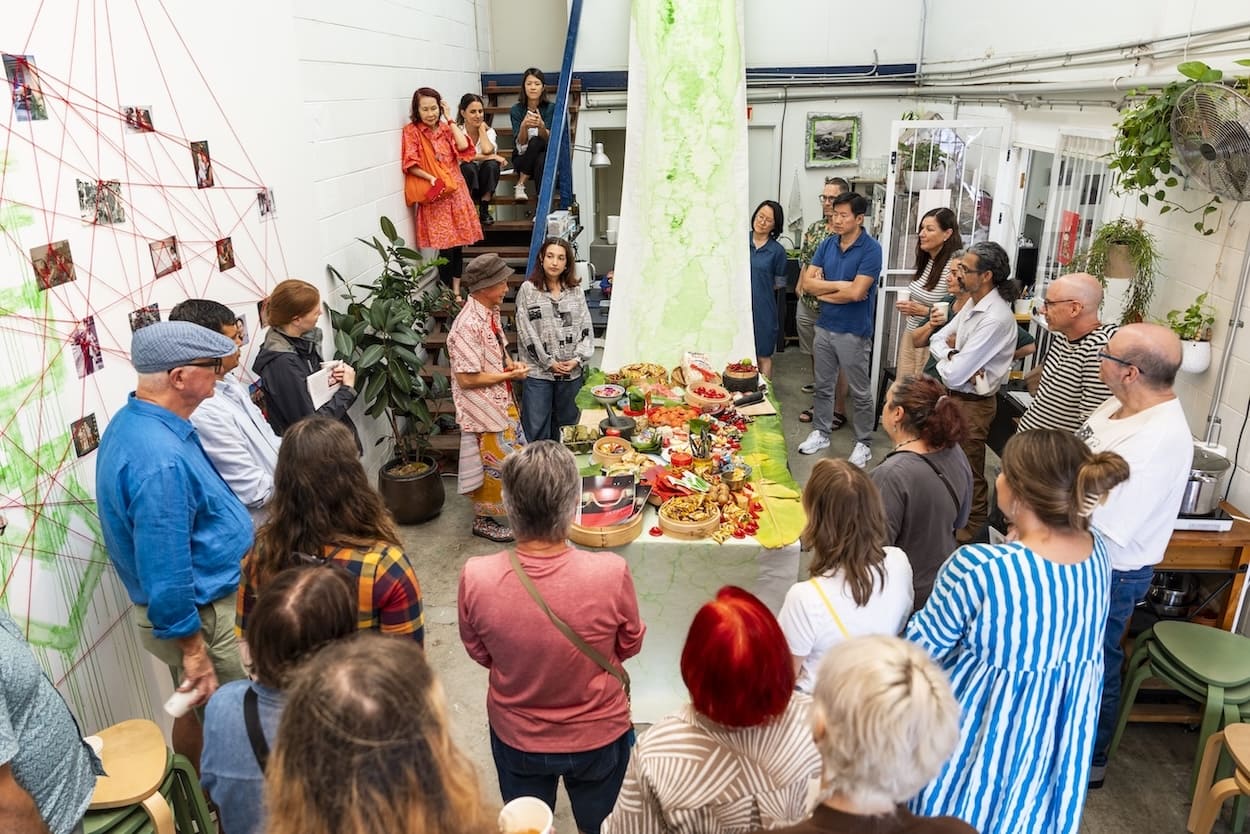
His interactive performance Lontong Cap Go Meh (2026), presented at Loupe Studio, Meijin Brisbane, in collaboration with the Museum of Brisbane, exemplifies this approach. Documented in a photograph by Louis Lim, the work brought audiences together through culinary ritual and embodied storytelling. The performance drew from Indonesian Chinese New Year traditions, highlighting how diasporic celebrations evolve across time and geography.
In projects like this, Tan positions himself not only as an artist but as a host and facilitator. The act of sharing food becomes symbolic of sharing voice. Participation becomes a quiet act of resistance against cultural erasure.
Recognition and Achievement
Tan’s innovative approach has earned significant recognition within Australia’s contemporary art landscape. In 2021, he won the Georges River Sculpture Art Prize, affirming his impact within the field of sculptural practice. His work was also highly commended in the contemporary category of the Fisher’s Ghost Award in 2023 and in the Dobell Drawing Prize #23, demonstrating the versatility of his practice across mediums.
Represented by Art Atrium Gallery, Tan continues to exhibit extensively throughout Australia. These accolades underscore the resonance of his work while highlighting the importance of diverse representation within institutional art spaces.
A Minority Within Minority
Tan often describes himself as a “minority in minority” immigrant artist. This layered marginality informs his perspective and fuels his determination to create visibility for those whose stories are frequently overlooked. His art does not merely depict identity; it performs it, negotiates it, and reimagines it.
Queer perspectives intersect with diasporic narratives, challenging fixed categories of culture and belonging. Hierarchies rooted in colonial histories are gently yet firmly questioned. Through symbolic gestures and communal acts, Tan proposes alternative structures built on empathy, generosity, and shared memory.
Art as Gift and Continuum
Ultimately, Jayanto Tan’s work operates as an offering. Whether through ceramic forms shaped by hours of labor, installations rich with symbolic detail, or communal meals that gather strangers around a table, his practice centers on care and continuity.
By honoring the past while embracing transformation, Tan constructs a living archive of cultural resilience. His art invites audiences to reconsider how traditions travel, how identities evolve, and how communities sustain themselves across borders.
In transforming memory into ritual and ritual into contemporary art, Jayanto Tan not only preserves fragments of his heritage but reanimates them. Through humor, devotion, and collaboration, he ensures that voices from the margins are not only heard but celebrated.

