


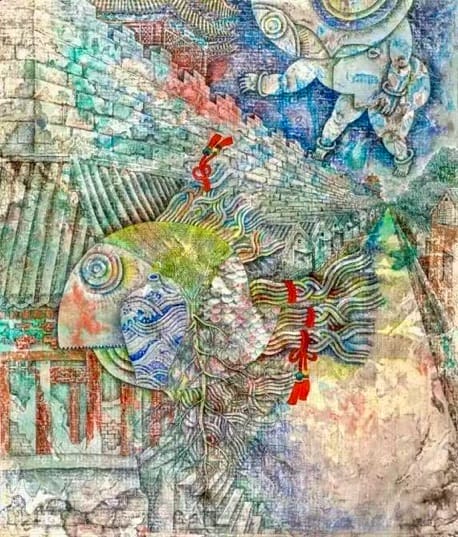
Huang Yi Min is a visual artist whose work bridges personal memory, cultural heritage, and surreal imagination. Born in Shanghai, China, in 1950, Huang has lived through some of the most dramatic cultural and political transformations of modern Chinese history. Her paintings are not only artistic expressions but also visual records of lived experience, capturing moments of history that no longer exist while transforming them through abstraction and emotional depth. Today, she works and lives between New York and Beijing, continuing a decades-long exploration of reality, memory, and artistic freedom.
Early Life and Artistic Awakening in Beijing
Originally named Chen MiMi, Huang Yi Min moved with her parents from Nanjing to Beijing at the age of three. Growing up in China’s historic capital placed her in direct contact with centuries of imperial culture, architecture, and tradition. This environment would later become central to her artistic identity.
At the age of ten, Huang was selected to join the painting group at the Beijing Youth Palace. For nearly a decade, she studied art under the guidance of teachers with exceptional academic and humanistic backgrounds, many of whom were graduates of China’s most prestigious universities. Her classroom was located in the Shou Huang Palace within Jing Shan Park, directly across from the Forbidden City. Surrounded daily by Ming Dynasty architecture, she developed a powerful visual memory shaped by history, space, and atmosphere. These early experiences formed the foundation of her artistic language long before she received formal academic training.
The Cultural Revolution and Art as Persistence
In August 1966, the Cultural Revolution erupted in China, bringing with it a widespread rejection of knowledge, intellectual life, and traditional culture. At the age of sixteen, Huang Yi Min was forced to stop her formal education and was sent to work as a farmer. Like countless young people of her generation, she was deprived of the opportunity to continue structured learning.
Despite these circumstances, Huang’s dedication to art deepened rather than diminished. During this period, she devoted herself entirely to painting and drawing. She wandered through Beijing, painting streets, people, shops, restaurants, bus stations, parks, and historic sites. These locations became her primary subjects and her classroom. Carrying an oil painting box and often traveling by bicycle, she returned repeatedly to the same places, painting them again and again.
This period of self-guided practice became one of the most formative phases of her artistic development. She later reflected that this experience surpassed even her university education, as it taught her to observe life directly and to paint not only what she saw but what she felt. Each work from this time contains physical memory, emotion, atmosphere, and sound, freezing historical moments through the slow and deliberate act of painting rather than instantaneous photography.
Academic Training and Professional Development
After the Cultural Revolution, Huang Yi Min resumed formal education and graduated from the Fine Arts Department of Beijing Normal University. She later worked as an art editor at China Children’s Publishing House, where she continued to refine her skills through constant drawing and painting. During this time, she produced character sketches and landscapes that gradually evolved into a distinctive surrealist style rooted in traditional aesthetics.
Her compositions often placed imagined scenes at the intersection of the Forbidden City and ordinary residential buildings. These hybrid spaces allowed her to explore emotional expression and imagination while remaining grounded in recognizable environments. Over nearly twenty years, she developed this approach into a coherent visual language that resonated with both Eastern and Western audiences.
Her work received international attention, including reviews from The New York Times, and she was awarded the Anna Walinska Academic Achievement Award in the United States. In 1997, she immigrated to the United States as an outstanding talent, expanding her artistic presence on a global stage.
Reality and Surrealism as Parallel Paths
Huang Yi Min’s body of work can be broadly understood through two interconnected directions: reality-based landscapes and surreal, symbolic compositions.
Her realist landscapes, primarily created between the 1970s and 1990s, are infused with a lyrical, impressionistic quality that borders on abstraction. These paintings faithfully document everyday life in China during periods of profound social change. Many of the streets and buildings she painted have since been demolished or rebuilt, making these works invaluable historical records. Unlike photography, her paintings carry the physical presence of time spent on site, repeated observation, and emotional engagement.
At the same time, her surreal works move beyond documentation into a poetic reconstruction of reality. These paintings do not attempt to reproduce the world as it appears but rather as it is remembered and reimagined.
The Free Forbidden City Series
In the 1990s, Huang Yi Min began developing her most significant and enduring body of work, the Free Forbidden City series. Over more than two decades, she expanded this series using different scales, materials, and compositional strategies. Through this process, she gradually refined a theory of abstract language intervention within realistic environments.
Geometric forms such as circles, triangles, squares, rectangles, trapezoids, points, lines, and planes appear throughout the series. Their proportions, density, and relationships create subtle emotional shifts within each composition. Rather than focusing on basic emotions such as happiness or sadness, Huang seeks a more refined emotional language that elevates human feeling beyond its initial, instinctive responses.
The Free Forbidden City series presents a powerful visual tension. The works feel warm yet sorrowful, gentle yet harsh, calm yet filled with noise. History and reality coexist with imagination and symbolism. People, animals, and totems intertwine within dreamlike spaces, creating an alternate vision of Beijing that can only exist through art.
Contemporary Practice and Lasting Legacy
As time passes, Huang Yi Min’s way of observing and thinking continues to evolve. Her psychological landscape shifts alongside historical change, and the Free Forbidden City series remains an ongoing exploration rather than a closed chapter. Through continuous experimentation, she seeks to define its place within art history while remaining responsive to the present.
Her works are held in major public and private collections, including the Singapore Museum of Art, Hong Kong Museum of Art, Singapore Simin Art Gallery, the New York Crystal Art Foundation, the New York Chinese Gallery, the Director of the Newark Museum of Art, and numerous private collections worldwide.
Huang Yi Min’s art stands as a testament to endurance, memory, and creative freedom. Through decades of persistence and transformation, she has created a visual language that preserves history while transcending it, offering viewers a deeply human vision shaped by lived experience and imagination.

