


Horus Artwork is an artist whose creative journey began in early childhood. From a young age, he drew constantly, using art as a natural language to explore the world around him. What started as an instinctive practice gradually revealed itself as a deeper calling. Recognizing his artistic vocation, he chose to pursue formal training and attended art school, where his talent and commitment to painting took clearer shape.
He later received his academic education at the Kazakh National Academy of Arts in Almaty, one of the leading art institutions in the region. Graduating with a diploma, he built a strong technical and theoretical foundation that would support his later explorations. This period of study not only refined his skills but also exposed him to a wide range of artistic traditions, disciplines, and philosophies that continue to resonate in his work.
Since the mid-1990s, Horus Artwork has primarily devoted himself to oil painting. His first exhibitions in Kazakhstan also date from this formative period, marking his entry into the professional art world. These early exhibitions established him as a serious painter with a personal vision and laid the groundwork for an evolving international presence.
Life and Work Across Cultures
Now living and working in Germany, Horus Artwork has further developed his painterly style in dialogue with new cultural environments. This geographical and cultural shift has enriched his perspective, allowing him to blend influences from different traditions into a distinctive visual language. His works have been shown in exhibitions in Germany and Italy, reflecting a growing recognition beyond his country of origin.
Working across multiple media, he favors oil and acrylic painting, as well as chalk and charcoal drawings. Each medium serves a particular expressive purpose. Oil allows for depth, luminosity, and subtle layering. Acrylic offers versatility and immediacy. Chalk and charcoal bring a direct, tactile quality that connects drawing to thought and gesture. Together, these techniques form a flexible toolkit through which he translates complex ideas into visual form.
Despite this technical diversity, a unifying thread runs through his work. He shows a strong sensitivity to color and atmosphere. His paintings rely on color not merely as decoration but as a carrier of emotion and meaning. Color becomes a spiritual and symbolic force that shapes how the viewer experiences space, time, and mood within the painting.
Themes of History and Spirituality
Thematically, Horus Artwork’s paintings revolve around historically and spiritually shaped moments of eternity. Rather than focusing on everyday scenes or purely formal concerns, he engages with questions that reach beyond the immediate present. His art explores memory, belief, transcendence, and the human search for meaning.
History in his work is not just a record of the past but a reservoir of symbols and narratives that still speak to contemporary viewers. Spirituality is also not limited to any single doctrine. It appears as a universal dimension of human experience, expressing the sense that life extends beyond material reality into realms of hope, faith, and inner transformation.
This orientation gives his paintings a contemplative quality. They invite viewers to pause, reflect, and enter a quieter mental space. Instead of overwhelming the audience with visual noise, he often constructs images that balance intensity and restraint, allowing meaning to unfold gradually.
Jacob’s Ladder: A Vision Between Darkness and Promise
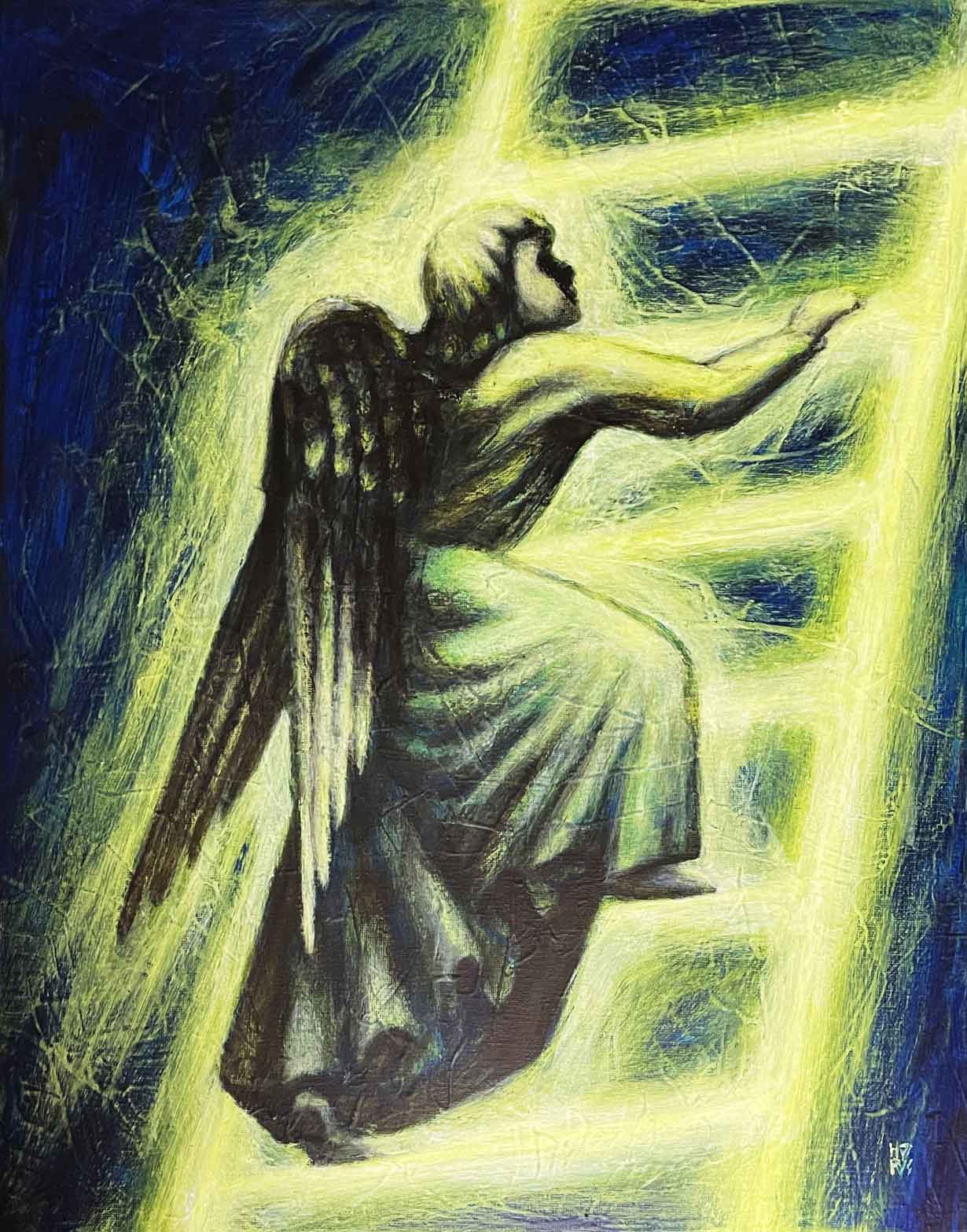
One of the most compelling examples of Horus Artwork’s approach is the painting Jacob’s Ladder. This work unfolds a powerful visual language between darkness and promise, translating a biblical narrative into a reflective and contemporary image.
The composition is set against a deep blue, cool-toned background reminiscent of a star-filled night. This nocturnal atmosphere immediately situates the viewer in a space of stillness and mystery. From within this darkness, an angel appears in ascent. Both the figure and the heavenly ladder are immersed in a gentle, radiant gold. The gold seems to glow, creating the impression of continuous movement. The ascent feels ongoing and not completed, as if the transition between worlds is always in progress.
The emotional core of the painting lies in the contrast between cool and warm tones. The blue background suggests distance, silence, and infinity. It evokes the vastness of the unknown and the limits of human perception. In contrast, the golden angel and ladder embody warmth, closeness, and divine presence. Through this interplay, the painting generates a tension between human limitation and transcendent hope.
The angel is particularly striking because it is not depicted as triumphant or distant. Instead, it appears focused and searching. The ascent reads as an act of trust rather than a display of power. This subtle choice shifts the emphasis from spectacle to inner experience.
A Reflective Approach to Biblical Narrative
Conceptually, Jacob’s Ladder refers to the Old Testament narrative in Genesis 28:10 to 19, where Jacob dreams of a ladder reaching from earth to heaven, with angels ascending and descending upon it. Above this vision stands God’s promise of protection, companionship, and future blessing. Traditionally, the ladder symbolizes the connection between the earthly and the divine.
Horus Artwork does not reproduce this story literally. Rather than showing multiple angels and a detailed narrative setting, he centers the composition on a single figure. This decision moves the focus from the external event to the internal experience of ascent. The angel can be read as a messenger of God, but also as a symbol of a human being seeking meaning, comfort, and spiritual elevation.
The ladder itself is rendered as luminous and almost immaterial. In Scripture, the ladder is a place of transition and encounter, not just a physical structure. The painting echoes this idea. The ladder appears unfixed and filled with light, as if sustained by grace rather than weight. It suggests that the path toward transcendence is carried by trust and hope.
The Space Between Dream and Waking
The nocturnal setting deepens the painting’s interpretation. In the biblical account, Jacob receives his vision in sleep, in a state between consciousness and dream. The artwork inhabits a similar threshold. Darkness represents uncertainty and earthly limitation, while the ladder’s glow suggests a divine response. Hope emerges not as a loud proclamation but as a quiet and radiant promise.
This in-between state is central to the painting’s power. It mirrors the human condition. People often live between doubt and belief, fear and trust, earth and aspiration. By visually articulating this threshold, Horus Artwork makes the ancient story psychologically and emotionally accessible to contemporary viewers.
A Universal Message
Ultimately, Jacob’s Ladder opens a timeless space of meaning. The painting speaks not only about a religious narrative but about a universal human longing for connection, orientation, and transcendence. The angel’s ascent becomes a metaphor for inner transformation and for trusting a path that extends beyond what is immediately visible.
Through biblical symbolism, symbolic color composition, and spiritual sensitivity, Horus Artwork conveys a quiet yet powerful message. Between earth and heaven there exists a bridge of light. Every step on this bridge is at once a search, a hope, and a promise.
Continuing the Journey
Horus Artwork stands as an artist who unites technical skill, cultural experience, and spiritual inquiry. From his early beginnings in Kazakhstan to his mature practice in Germany, he has remained committed to exploring deeper dimensions of human experience through painting. His work reminds viewers that art can be more than visual pleasure. It can be a space for reflection, meaning, and connection to something greater than ourselves.

