


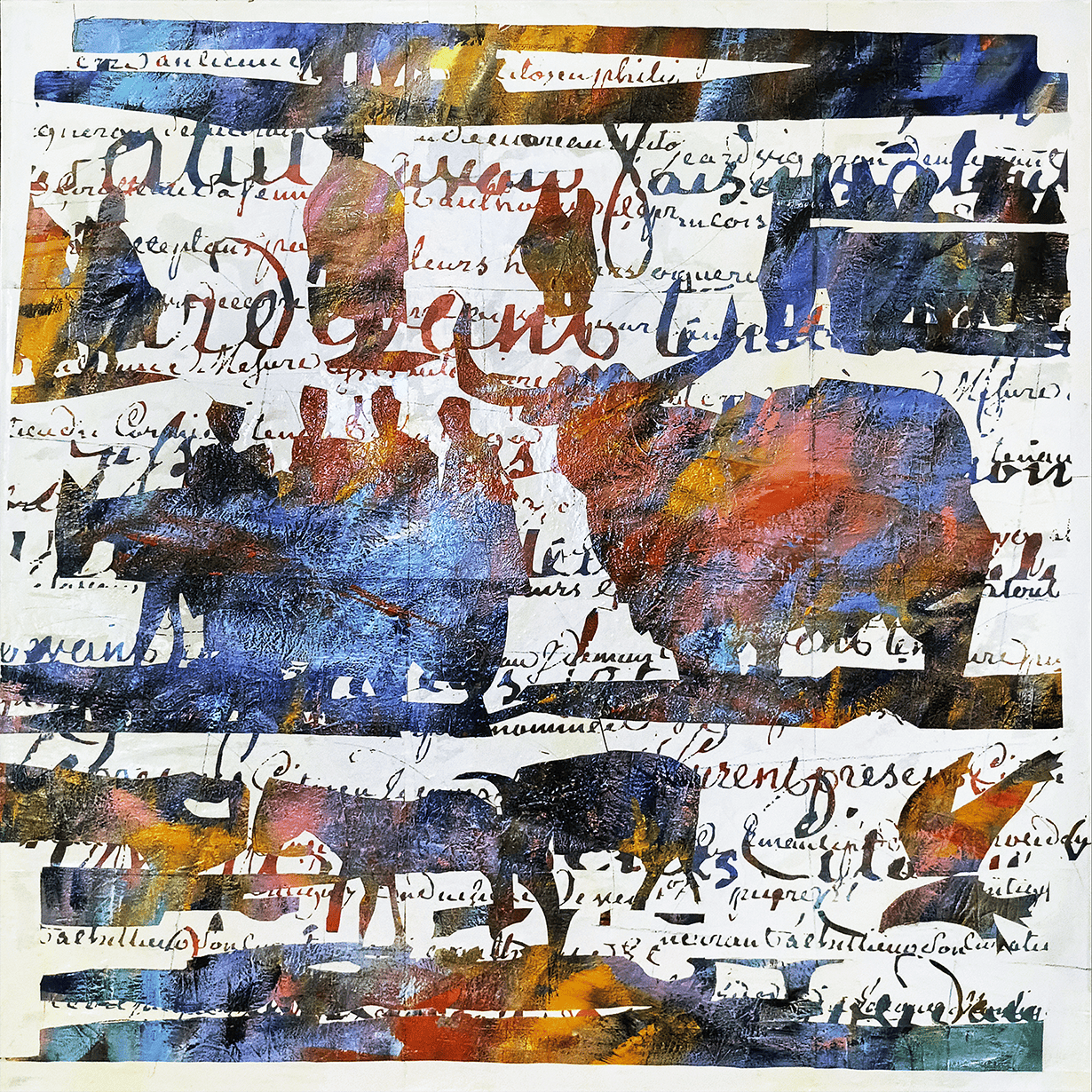
Claude De Luca is an artist who navigates the vibrant space between Urban Art and Pop Art, between figuration and abstraction, between text and image, and between reality and imagination. His work exists at the crossroads of cultures, stories, and visual languages. By blending handwritten or typographic text with imaginary worlds, he creates artworks that feel both deeply personal and universally resonant. Each piece invites the viewer to read, to look, and to reflect, as if entering a visual narrative that unfolds in layers.
Rooted in a strong academic background in Fine Arts, Claude De Luca’s creative path has also been shaped by his professional experiences in advertising and journalism. These fields sharpened his sense of communication, symbolism, and visual impact. They taught him how images and words can work together to convey complex ideas quickly and powerfully. Today, this dual sensitivity to text and image is a defining feature of his artistic language.
A Visual Language Shaped by Color and Contrast
Color plays a central role in Claude De Luca’s artistic universe. He is particularly sensitive to the strength, luminosity, and complementarity of colors. His compositions often pulse with chromatic energy, where bold tones interact with subtle hues to create balance and tension. Rather than using color merely as decoration, he uses it as a narrative tool. Colors become emotional signals, guiding the viewer’s response and shaping the atmosphere of each work.
His experimentation spans multiple mediums, including painting, drawing, photomontage, digital manipulation, and collage. This multidisciplinary approach allows him to remain in constant dialogue with his materials. He does not limit himself to a single technique but instead chooses the method that best serves the idea. In this way, the process itself becomes part of the meaning.
The presence of text, sometimes handwritten and sometimes typographic, adds another layer to his visual language. Words in his work are not simply captions; they are visual elements that interact with shapes, figures, and colors. They can suggest fragments of stories, echoes of memory, or traces of identity. Sometimes they are legible and sometimes partially obscured, inviting viewers to fill in the gaps with their own interpretations.
Themes of Humanity, Movement, and Identity
Claude De Luca draws inspiration from a wide range of human experiences. His roots and exposure to cultural diversity inform his worldview and, consequently, his art. Recurring themes in his work include immigration, exodus, crowds, exile, and humanity at large. These are not treated as abstract political topics but as lived realities and emotional journeys.
Migration and movement appear in his work as metaphors for the human condition. People move across borders, across cities, and across stages of life. They carry memories, languages, and identities with them. In De Luca’s art, this sense of movement is often suggested through layered imagery, overlapping forms, and fragmented texts. The viewer senses a story of passage, transition, and transformation.
Crowds and collective presence also play a role in his imagery. They can symbolize society, anonymity, or shared destiny. At the same time, his works retain a strong sense of individuality, reminding us that every crowd is made up of singular lives and stories. This tension between the individual and the collective gives his art emotional depth.
Materiality and the Power of Layers
One of the most distinctive aspects of Claude De Luca’s practice is his attention to materiality. He works with paint in its thickness and texture, allowing the surface to become alive. The tactile quality of his paintings invites close viewing. One can almost feel the gestures, the buildup, and the history embedded in the layers.
His collages are often applied in a stencil-like manner, creating sharp contrasts between forms and backgrounds. The support itself is worked in a multitude of layers, turning the canvas into a site of accumulation. Each layer can hide or reveal what came before, much like memory or history. This layered construction mirrors the complexity of the themes he explores. Identity, migration, and cultural memory are never simple or singular; they are built over time.
Engravings, newspapers, and old documents frequently find their way into his work. These materials are repurposed and reworked, becoming more than visual textures. They are carriers of meaning and symbolism. Old newspapers can evoke collective memory or historical context. Documents can suggest identity, bureaucracy, or the traces of lives lived. By integrating these elements, De Luca bridges personal expression with broader social and historical narratives.
Nomads: An Imaginary Vision of Wandering
A compelling example of Claude De Luca’s artistic concerns can be found in his 2019 work Nomads, an acrylic painting with collage on canvas. In this piece, he set out to represent signs of an imaginary vision of wandering and migration. Rather than depicting a literal scene, he constructed a symbolic landscape of movement.
The mixed media approach allows different visual voices to coexist. Acrylic paint provides depth and intensity, while collage elements introduce fragments of reality such as pieces of text, textures, and references that hint at journeys and stories. The result is a work that feels both grounded and dreamlike.
In Nomads, wandering is not only physical but also psychological and cultural. It can be read as the journey of people across territories, but also as the inner journey of identity in a globalized world. The imaginary vision he refers to opens the door to interpretation. Viewers might see reflections of contemporary migration, historical exoduses, or their own personal experiences of displacement and belonging.
The artwork resonates because it does not impose a single message. Instead, it offers signs, symbols, and sensations. It trusts the viewer to complete the narrative. This openness is characteristic of De Luca’s broader practice.
An Art of Dialogue and Reflection
Claude De Luca’s work ultimately functions as a dialogue between image and text, between past and present, and between personal and collective histories. His background in advertising and journalism has given him an acute awareness of how visuals communicate, but his fine arts training and personal sensibility push that communication toward poetry and reflection rather than pure information.
His art asks questions rather than giving answers. Who are we in a world of movement and migration? How do our roots shape us? What do we carry with us when we move across cultures and places? How do memory and history live on in materials and images?
By blending Urban Art and Pop Art influences with deeply human themes, Claude De Luca creates works that are accessible yet layered, contemporary yet timeless. His canvases are spaces where color, text, and texture converge to tell stories about humanity in motion.
In a world increasingly defined by mobility and cultural exchange, his art feels particularly relevant. It reminds us that behind every movement, every migration, every crowd, and every exile, there are human stories. Through his layered, luminous, and thoughtful creations, Claude De Luca gives those stories a powerful visual form.

