


Cécile Batillat is a French artist whose work emerges from a rich intersection of visual arts, literature, philosophy, and moving image. A graduate of the University of Paris I Panthéon-Sorbonne, where she studied visual arts, video, and new technologies, Batillat’s early formation already placed her at the crossroads of tradition and experimentation. Rather than following a linear artistic path, she built a career that moved fluidly between disciplines, each stage deepening her inquiry into perception, meaning, and reality.
She began her professional journey collaborating with the Experimental Academy of Theaters in Paris, an environment that encouraged exploration, performance, and conceptual thinking. This experience sharpened her sensitivity to staging, symbolism, and the power of images to evoke layered narratives. She later directed independent documentaries, a practice that further trained her eye to observe the world closely and to frame fragments of reality in ways that reveal deeper truths.
For a time, Batillat stepped into academia as a professor of literature and philosophy. Far from distancing her from art, this period enriched her intellectual and symbolic vocabulary. When she returned more fully to painting and drawing, she did so with a renewed sense of purpose. These mediums became not only forms of expression but also tools of investigation, ways to explore what she calls The Real.
Art as a Search for The Real
At the heart of Batillat’s practice lies a philosophical quest. Her works are not mere representations of visible reality; they are attempts to question and probe it. She draws on the collective unconscious found in folktales, myths, and shared symbolic traditions. These narratives, passed through generations, carry archetypes that resonate across cultures and eras. By referencing them, Batillat situates her work in a timeless psychological landscape.
Her research-driven approach also examines differences and dialogues between Eastern and Western conceptions of representation. Western art history has often emphasized perspective, realism, and the illusion of depth, while many Eastern traditions have valued suggestion, emptiness, and symbolic resonance. Batillat’s work quietly navigates between these poles, sometimes presenting detailed figurative elements, sometimes allowing space, minimalism, and poetry to carry meaning.
Importantly, her art does not dictate a single interpretation. Instead, it opens a symbolic field in which viewers can project their own memories, fears, and hopes. In this sense, her works function like visual riddles or meditative spaces. They ask questions rather than deliver answers.
The Role of Poetry and Haiku
A distinctive aspect of Cécile Batillat’s oeuvre is her integration of haikus into her artworks. These short poetic forms, rooted in Japanese tradition, are known for their brevity, precision, and capacity to capture a fleeting moment or insight. For Batillat, the haiku is not a caption or an explanation; it is an extension of the artwork itself.
The haikus accompanying her images often transcend simple sensory description. They point toward a symbolic or inner reality that cannot be fully depicted. By pairing image and poem, Batillat creates a dialogue between seeing and reading, between immediate perception and reflective thought. The viewer oscillates between the visual and the verbal, constructing meaning in the space between them.
This fusion also reflects her background in literature and philosophy. Words and images are not separate domains in her practice but complementary paths toward understanding.
International Presence and Recognition
Batillat’s work has reached audiences far beyond France. She has exhibited in Europe, America, and Asia, demonstrating the cross-cultural resonance of her themes. Because she draws on universal symbols such as boats, waves, animals, and mythic figures, her art can be approached from multiple cultural perspectives.
Her numerous international awards further attest to the impact and quality of her work. Yet what stands out most is not prestige but coherence. Wherever her work is shown, it retains its contemplative, questioning spirit. It invites viewers into a reflective encounter rather than a purely aesthetic one.
La Foi médusée (Faith turned to stone) as a Symbolic Landscape
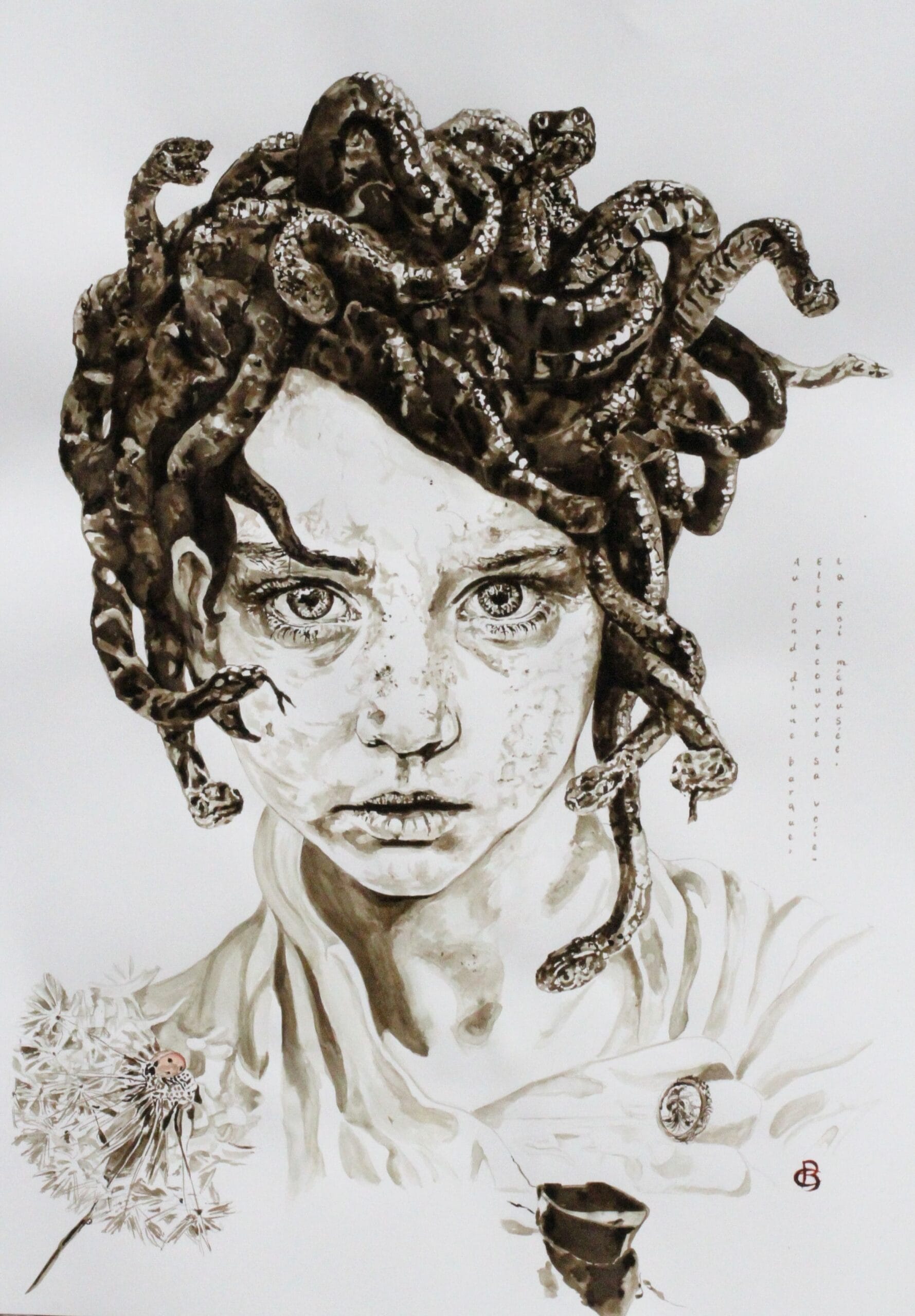
One of her notable works, La Foi médusée (Faith turned to stone) from 2023, exemplifies her poetic and symbolic approach. Executed in sepia inks on 200 gsm Canson paper, the piece measures 59.7 × 84.1 cm and 70 × 100 cm framed. The choice of sepia immediately evokes memory, antiquity, and a sense of time suspended. Sepia tones can recall old manuscripts, archival photographs, or dreamlike recollections, placing the viewer in a space between past and present.
The composition presents a young woman with serpentine hair who gazes intently at the viewer. The serpentine hair recalls the figure of Medusa from Greek mythology, whose gaze could turn onlookers to stone. Yet Batillat’s interpretation is not a literal retelling. The woman’s gaze is steady and introspective, suggesting not only danger but also awareness and transformation.
The integrated haiku reads:
At the boat’s bottom,
She covers her own way
Faith turned to stone
This poem introduces the theme of faith, obstruction, and self-imposed limitation. She covers her own way can be read as a metaphor for blocking one’s own path, whether through fear, doubt, or rigid belief. Faith turned to stone may suggest dogma hardened into immobility or belief that has lost its living, dynamic quality.
Reading the Symbols
Other elements in the image enrich this symbolic network. A boat appears beached on the sand, slightly off-center to the right. Boats often symbolize journeys, transitions, or passages between states of being. A beached boat is a journey paused or prevented. It echoes the idea of a path obstructed, aligning with the haiku’s suggestion.
Above the boat, a wave is set within a ring. The wave can signify movement, change, or emotional force, while the ring may represent cycles, unity, or enclosure. A wave contained within a ring can imply motion constrained, energy held within limits, or time caught in repetition.
In the lower left corner, a ladybug sits on a dandelion whose seeds are half scattered. The dandelion is a powerful symbol of fragility, wishes, and the passage of time. Its drifting seeds evoke dispersion and impermanence. The ladybug, often associated with luck or gentle protection in many cultures, introduces a subtle counterpoint of hope. Even in a landscape of halted journeys and petrified faith, a small sign of renewal remains.
An Invitation to Inner Reflection
La Foi médusée does not tell a single story; it offers a symbolic constellation. The Medusa-like figure, the halted boat, the contained wave, the dispersing dandelion, and the quiet ladybug together form a meditation on belief, doubt, and transformation. The viewer is invited to ask when faith sustains us and when it immobilizes us, and when we become the ones who block our own path.
This openness is characteristic of Cécile Batillat’s work. She trusts the viewer to enter the symbolic space and complete the meaning through personal reflection. Her art operates like a visual and philosophical poem that is layered, suggestive, and resonant.
A Contemporary Voice Rooted in Timeless Questions
Cécile Batillat stands as a contemporary artist deeply engaged with timeless human questions. Through her multidisciplinary background, philosophical inquiry, and poetic sensitivity, she creates works that go beyond surface beauty. They function as mirrors for the inner world, drawing on myths and folktales not as relics of the past but as living reservoirs of meaning.
In a fast-paced visual culture saturated with images, Batillat’s art asks us to slow down, to look, to read, and to contemplate. In doing so, she reminds us that art can still be a space for thought, mystery, and quiet revelation.

