


Carol Hartman is an American visual artist whose work has been exhibited nationally and internationally, earning recognition for its conceptual depth and immersive scale. Through large-scale oil paintings and installations, she transforms visual art into a space for dialogue about humanity’s impact on the natural world. Her work does not merely depict environmental disruption; it confronts it, inviting audiences to reflect on shared responsibility and sustainable futures.
Hartman’s paintings operate at the intersection of aesthetics and ethics. She uses scale, fragmentation, and atmosphere to immerse viewers physically and emotionally, encouraging them to engage with urgent ecological concerns. For Hartman, art is not passive decoration but an active force capable of inspiring awareness and collective discussion.
Academic Foundations and Intellectual Influence
Hartman’s intellectual approach to art was strengthened during her time teaching at California State University, Fresno. In this academic setting, she led deep discussions about art theory, conceptual practice, and the social responsibilities of artists. Teaching sharpened her ability to articulate complex ideas while reinforcing her belief that art must extend beyond the studio and into public discourse.
Her attendance at the Royal College of Art in London significantly broadened her global perspective. Immersed in an international community of artists and thinkers, she expanded her conceptual framework and developed a practice grounded in critical inquiry. Exposure to diverse cultural viewpoints strengthened her conviction that environmental issues transcend national boundaries and demand collective awareness.
Further extending her international presence, Hartman maintains membership with Vedica Art Gallery in Mumbai. This connection underscores the global relevance of her themes, situating her work within conversations that reach far beyond the United States.
Monumental Scale and Immersive Environments
Working primarily in large-scale oil paintings, Hartman creates works that envelop the viewer. Scale functions as a conceptual device, reflecting the magnitude of environmental crises while echoing the vastness of natural landscapes. Her installations often transform traditional gallery spaces into immersive environments, encouraging viewers to move within and around the work.
Atmosphere plays a critical role in her compositions. Through layered brushwork, fractured imagery, and shifting perspectives, she evokes instability and tension. These visual strategies mirror ecological imbalance, making the viewer physically aware of disruption. Rather than presenting simple narratives, Hartman constructs complex visual fields that require contemplation and interpretation.
Participation is central to her philosophy. By encouraging viewers to step into the spatial presence of her paintings, she transforms passive observation into active engagement. The artwork becomes a site of encounter, fostering dialogue about environmental awareness and collective responsibility.
DISRUPTION: A Response to Ecological Crisis
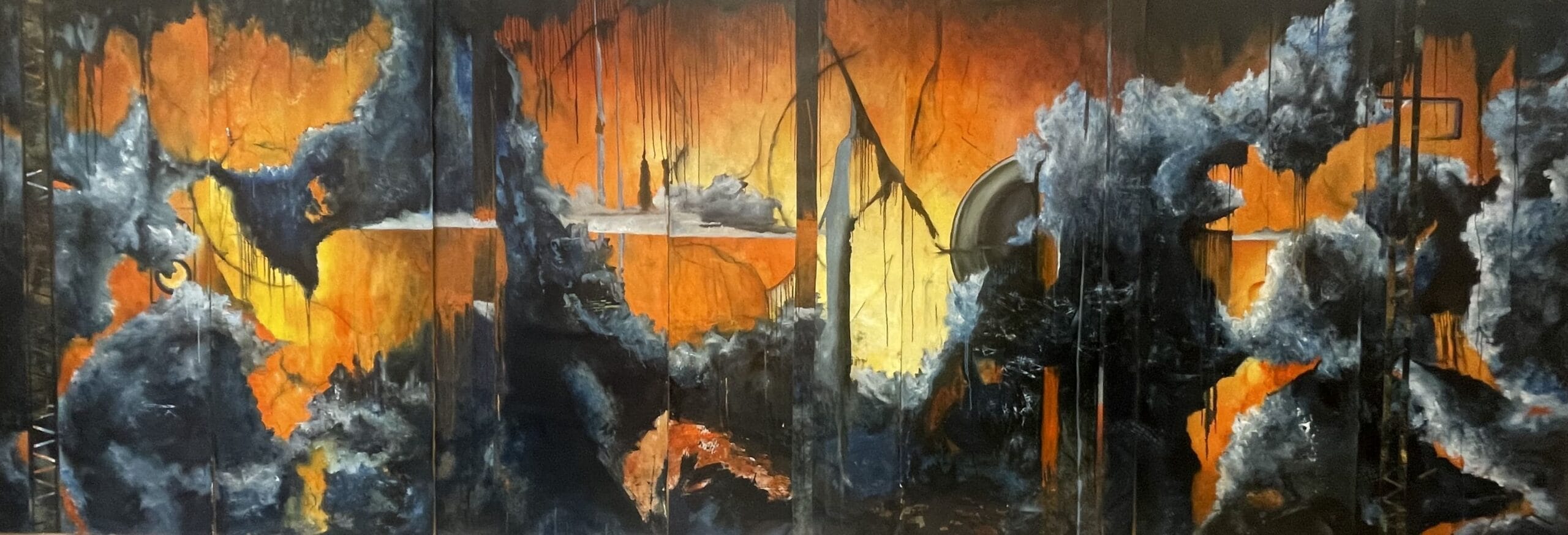
One of Hartman’s most powerful works, DISRUPTION, exemplifies her commitment to addressing environmental realities. Created in oil across seven canvas panels and measuring 84 by 230 inches, the work commands attention through both its scale and structure.
Inspired by a catastrophic train derailment over Montana’s Yellowstone River, the painting confronts the fragile balance between industrial systems and natural ecosystems. The derailment becomes a symbol of the broader tensions between progress and preservation. Industrial development, while central to modern life, can leave profound scars on vulnerable environments.
The seven-panel configuration reinforces the concept of fragmentation. Imagery appears ruptured and unsettled, echoing ecological breakdown. Hartman’s layered brushwork and dynamic composition create a sense of instability that reflects the emotional and environmental shock of such disasters. The painting resists visual harmony, compelling viewers to confront disruption rather than look away from it.
Fragmentation, Tension, and Visual Language
In DISRUPTION, fragmentation is not only a structural choice but also a metaphor. Broken forms and interrupted visual rhythms mirror the fracture between human ambition and environmental sustainability. Sweeping gestures of oil paint collide with abrupt shifts in tone and texture, suggesting both natural forces and mechanical intrusion.
The surface becomes a terrain of conflict where beauty and devastation coexist. Hartman’s use of abstraction allows viewers to interpret the imagery personally, encouraging reflection rather than prescribing a singular narrative. This open-ended quality strengthens the painting’s impact, inviting ongoing dialogue.
Through tension and scale, Hartman transforms environmental catastrophe into a visual experience that cannot be easily dismissed. The viewer is confronted not with distant reportage but with immersive immediacy.
Art as Collective Responsibility
At its core, Hartman’s work calls for accountability. The Yellowstone River serves as more than a geographical reference; it symbolizes the countless ecosystems affected by industrial expansion. Rather than assigning blame to a single entity, Hartman emphasizes collective responsibility. Modern systems of production and consumption involve all of us, directly or indirectly.
By immersing viewers within the expansive scale of her painting, Hartman positions them within the conversation about environmental impact. Reflection becomes participatory. The artwork acts as a catalyst for dialogue, urging audiences to consider their own roles in shaping sustainable futures.
Hartman does not present simplistic solutions. Instead, she opens space for awareness and shared discussion. Through her immersive environments, painting becomes an arena for conversation, bridging emotional response and ethical consideration.
Transforming Painting into Dialogue
Carol Hartman’s artistic vision redefines what painting can achieve. Through monumental scale, conceptual depth, and immersive presentation, she transforms traditional canvas into a platform for environmental consciousness. Her work bridges aesthetic experience and social reflection, reminding audiences that art has the power to influence perception and inspire change.
In an era marked by ecological uncertainty, Hartman’s practice resonates with urgency. DISRUPTION stands as both a warning and an invitation. It warns of the fragile balance between industry and nature, while inviting viewers to participate in conversations that lead toward sustainable solutions.
Through scale, atmosphere, and engagement, Hartman creates more than paintings. She creates spaces for awareness, dialogue, and collective responsibility—spaces where art becomes an active force in shaping a more thoughtful and sustainable world.

