


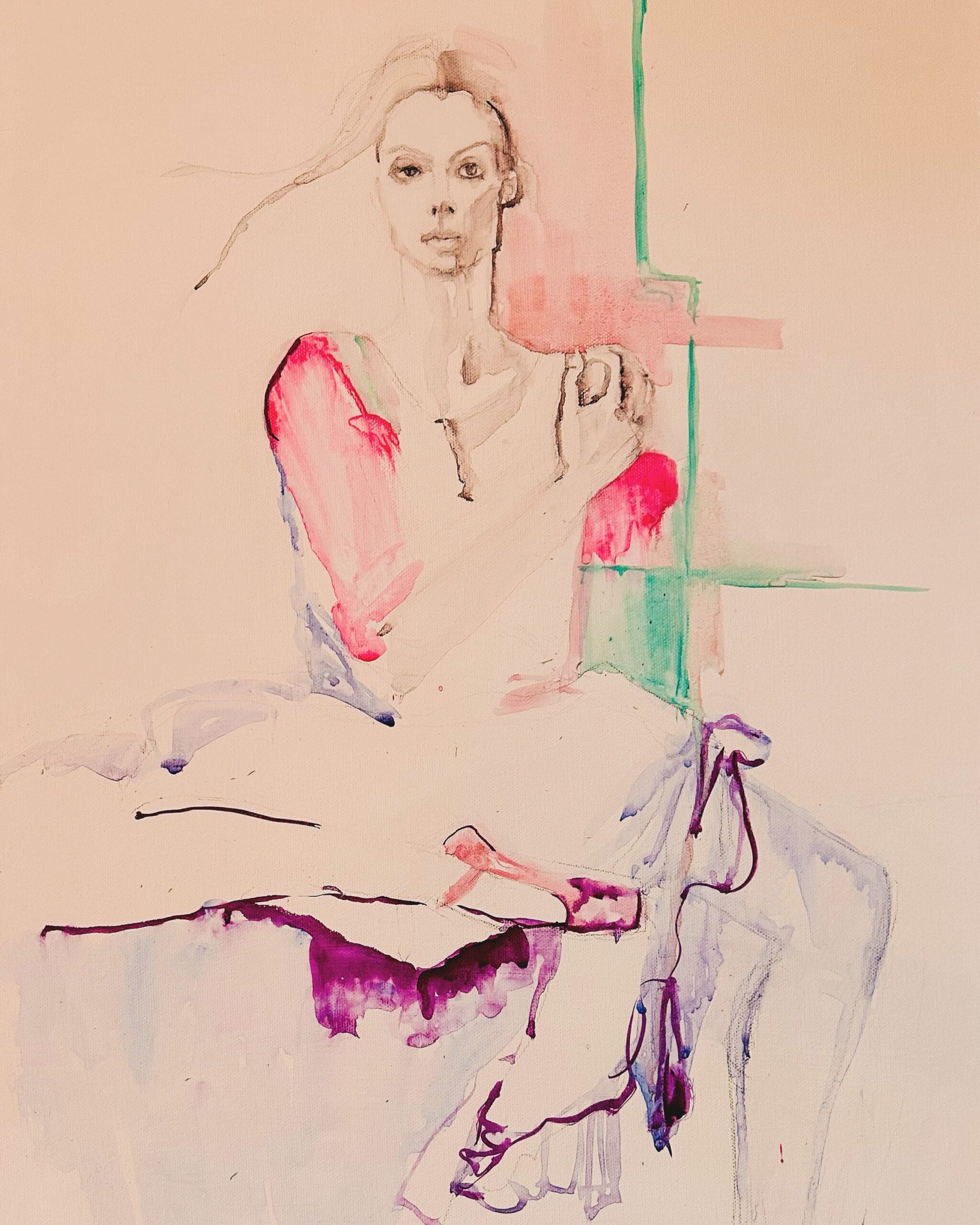
Barbara Simonson’s artistic journey is anything but linear. It is a path shaped by discipline, reinvention, and a lifelong devotion to the arts. From the rigorous world of classical dance to the structured demands of international law, and finally to the expressive freedom of visual art, Simonson’s career reflects a rare fusion of intellect and creativity. Each chapter of her life has contributed to the depth, sensitivity, and technical mastery visible in her work today.
Her story is one of returning to one’s true calling. While many artists follow a direct route into the art world, Simonson’s path demonstrates that creative identity can evolve, pause, and reemerge stronger than before. The experiences she gathered outside the studio did not distract from her art; they enriched it.
From the Stage to the Studio
Simonson’s first artistic language was dance. As a classical dancer and a disciple of the legendary Robert Joffrey, she was immersed in a world where movement, discipline, and emotional expression were inseparable. Dance trained her eye to understand the human figure not as a static object, but as a living form in motion. She learned to appreciate balance, timing, and the subtle communication of the body.
This early foundation continues to inform her visual art. In many ways, her paintings can be seen as choreography on paper or canvas. The gestures of her brush echo the gestures of a dancer. The flow of pigment mirrors the flow of a performance. Movement is not simply depicted in her work; it is felt.
Her deep connection to dance gives her a unique sensitivity to posture, tension, and grace. Rather than merely representing the human figure, she captures its energy. Viewers often sense a moment unfolding, as if the subject might shift position at any second.
An Unexpected Interlude in International Law
Before fully returning to art, Simonson spent significant time working as an international attorney. At first glance, law and art may appear worlds apart, yet both demand precision, discipline, and intense focus. Her legal career required analytical thinking, attention to detail, and an understanding of complex systems. These qualities later translated into her artistic process.
Law also exposed her to diverse cultures, perspectives, and human experiences. This global awareness subtly informs her work, giving it a universal quality that resonates with audiences from different backgrounds. Her art does not feel confined to one place or viewpoint; it carries a broader human sensitivity.
Ultimately, however, the pull of creative expression proved stronger. Returning to art was not a rejection of her past but a continuation of it, integrating all she had learned along the way.
The Language of Water and Light
Simonson’s preferred media are water-based and transparent. She gravitates toward materials that allow fluidity, layering, and luminosity. These qualities align naturally with her interest in movement and the human figure. Transparent washes can suggest motion, atmosphere, and emotion without rigid boundaries.
Water-based media demand both control and surrender. The artist guides the pigment, yet must also respond to how water flows and settles. This balance mirrors dance itself, where technique meets spontaneity. Simonson embraces this dialogue between intention and chance, allowing the medium to participate in the creative act.
Her works often reveal a delicate interplay between technical structure and aesthetic freedom. She connects sound artistic principles with intuitive expression, creating pieces that feel both grounded and alive. The transparency of her materials allows light to play a role in the final image, giving her paintings a sense of breath and space.
Connecting Technique and Emotion
One of Simonson’s central goals is to connect technical and aesthetic principles so that the art can speak directly to the viewer. She does not create merely for visual accuracy or decorative appeal. Instead, she seeks communication. Her paintings invite viewers to feel something, to recall a memory, or to sense the beauty of the human form and its expressive potential.
Her background in both dance and law contributes to this balance. Dance taught her emotional storytelling through movement. Law taught her structure and clarity. In her art, these influences merge. The result is work that is both expressive and thoughtfully composed.
Rather than overwhelming the viewer with detail, she often allows suggestion and nuance to carry meaning. A tilt of the head, a curve of the spine, or the flow of a garment can convey an entire narrative. This restraint gives her work elegance and depth.
Recognition and Professional Community
Barbara Simonson’s artistic achievements are reflected in her extensive exhibition history in the United States and abroad. Her work is held in many private collections, a testament to its appeal and emotional resonance. Collectors are drawn to the vitality and refinement that characterize her pieces.
She is also deeply engaged in the professional art community. Simonson is an invited member of the exhibiting committee of the National Arts Club in New York City, a respected institution with a long history of supporting artists. Her memberships include the Catharine Lorillard Wolfe Art Club, the Northeast Watercolor Society, the National Organization of Women, the Connecticut Academy of Fine Arts, Connecticut Women Artists, and Artsy.
These affiliations reflect both recognition and active participation. They place her within networks of artists who value excellence, dialogue, and continued growth. Being part of such communities allows her to contribute to and benefit from the evolving art world.
Current Exhibitions and Ongoing Vision
Simonson is currently exhibiting at the Hugo Rivera Gallery in Laguna Beach, California, a location known for its vibrant art scene and appreciation for figurative and contemporary work. Showing in such a setting connects her art with audiences who value craftsmanship and expressive depth.
Yet for Simonson, art is not only about exhibitions or accolades. It is an ongoing exploration of beauty, movement, and human presence. Her journey from dancer to attorney to visual artist has given her a multidimensional perspective that few artists possess.
The Art of Returning
Perhaps the most inspiring aspect of Barbara Simonson’s story is the idea of return. She returned to art after a demanding career in another field. She returned to the language of movement, this time through paint instead of choreography. She returned to her creative core with greater wisdom and life experience.
Her work reminds us that an artist’s path does not need to be straight to be meaningful. Detours can deepen vision. Other careers can sharpen skills. Life itself becomes part of the palette.
In Simonson’s paintings, movement continues, water flows, and the human figure speaks in quiet yet powerful ways. Her art stands as a testament to lifelong creativity and the enduring dialogue between discipline and expression.

