


Alice Wisden is an artist who refuses to separate life from art. Her work emerges directly from lived experience, vulnerability, contradiction, and a constant questioning of language, identity, and perception. At 42, she openly describes herself as single, childless, living in her parents’ basement, and still in school. On the surface, that description may sound like a temporary phase of early adulthood. In her case, it is a reality shaped by profound health challenges and an unfiltered honesty about circumstance. Rather than hide from these truths, Wisden incorporates them into the emotional and conceptual framework of her practice.
In 2008, she developed severe unexplained epilepsy. The seizures dramatically altered the course of her life and, consequently, her relationship with art. What could have silenced creativity instead deepened it. The unpredictability of seizures, the fragility of mental and physical stability, and the constant negotiation with medical and social labels introduced new layers of awareness to her work. Art became not only a means of expression but also a method of survival and reflection.
The Language of Disability and Identity
One of the central tensions in Wisden’s artistic philosophy revolves around language. Since her diagnosis, she has been confronted by terminology that attempts to categorize her condition. Is she mentally impaired? Mentally disabled? Living with a mental disorder? Experiencing a mental health problem? Each phrase carries different implications, histories, and social weight.
Wisden does not passively accept these labels. Instead, she interrogates them. She recognizes how disability language is often unstable, politically charged, and shaped by shifting cultural narratives. The boundaries around disability justice, medical diagnosis, and identity politics are constantly moving. For Wisden, this creates a space of both empowerment and confusion. She acknowledges moments of misidentification and misinterpretation, not only of herself but of the broader discourse surrounding disability and mental health.
This intellectual and emotional friction feeds her creative process. Rather than seeking definitive answers, she explores ambiguity. Her art becomes a site where contradictions can coexist. She questions whether art is truly subjective and whether the experience of the viewer can ever be fully separated from social justice frameworks and cultural conditioning. Through this inquiry, Wisden positions herself as a reactionary artist, responsive to her own ongoing anxiety and to the societal structures that attempt to define it.
Thriving as a Reactionary Artist
Wisden describes herself as eternally passionate about creating thought provoking and engaging work. Her drive is not merely aesthetic but conceptual. She aims to confront perceptions of mental stability and instability, challenging the viewer to reconsider what is deemed normal, healthy, or acceptable.
Her seizures have not only altered her daily life but have also intensified her sensory and emotional awareness. The experience of losing control, of navigating fear and unpredictability, informs the atmosphere of her pieces. There is often an undercurrent of tension in her work, a sense that stability is provisional and perception is unreliable.
Yet this is not art rooted in despair. Wisden seeks to thrive. Her dynamism lies in her ability to transform anxiety into visual inquiry. She does not present mental health as a neatly resolved narrative. Instead, she portrays it as ongoing, layered, and deeply subjective. In doing so, she invites viewers to confront their own assumptions about mental stability, vulnerability, and resilience.
Brotherly Love: Memory, Masculinity, and Misunderstanding
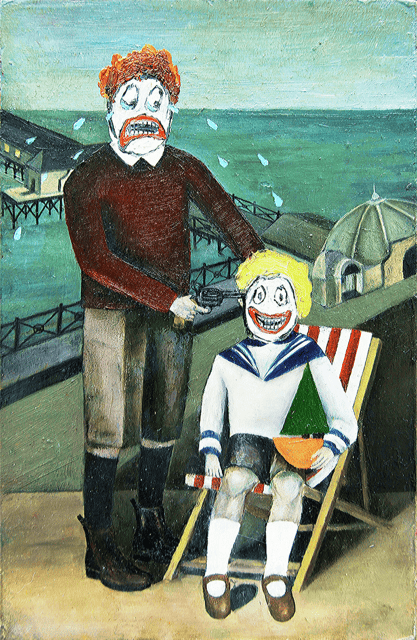
One of Wisden’s most poignant works, Brotherly Love, demonstrates her ability to merge personal history with broader social themes. The painting was inspired by an old photograph she discovered of her Grandad Stanley and her Great Uncle Jack. The image captures a dynamic that feels instantly recognizable: an embarrassed, annoyed older brother and an oblivious, giggling younger sibling who simply wants attention and play.
In this case, the emotional narrative runs deeper. Jack, the younger brother, liked playing with dolls. Stanley, the older brother, did not like Jack and reportedly hated visiting him. According to family recollections, Stanley’s rejection left a lasting emotional impact. Jack eventually lived alone until his death. Wisden’s mother later revealed that Jack was gay but too confused to fully understand or articulate his identity, possibly shaped by the disapproval and emotional distance of his brother.
In Brotherly Love, Wisden captures not just a childhood moment but a generational story of repression, misunderstanding, and silent suffering. The painting subtly interrogates traditional notions of masculinity. The embarrassed older brother embodies social expectations: toughness, emotional restraint, conformity. The giggling younger brother, with his dolls and uninhibited joy, represents difference and vulnerability.
Wisden does not reduce the story to a simple moral lesson. Instead, she presents it with emotional complexity. Stanley’s annoyance may reflect his own internalized pressures. Jack’s confusion may stem not only from his sexuality but from a lack of affirmation in a time and culture that offered little language for difference. The painting becomes a meditation on how family dynamics shape identity and how small gestures of rejection can echo across a lifetime.
Art as a Space for Reconsideration
In Brotherly Love and throughout her wider body of work, Wisden uses personal narrative to explore universal themes. She examines how perception is formed and how it can distort or limit understanding. Just as she questions the labels applied to her own condition, she questions the assumptions placed on gender roles, sexuality, and mental stability.
Her lived experience with epilepsy informs her sensitivity to fragility. Life, identity, and relationships can shift abruptly. A seizure can interrupt consciousness without warning. A careless word can alter a relationship permanently. This awareness permeates her compositions, giving them emotional weight.
Wisden also continually revisits the question of subjectivity in art. Is a painting defined by the artist’s intention or by the viewer’s interpretation? Can art ever be separated from the social and political contexts in which it is created and viewed? Through her exploration of mental health and family memory, she suggests that art is both deeply personal and inevitably collective.
Embracing Contradiction and Complexity
Alice Wisden’s work stands at the intersection of vulnerability and defiance. She acknowledges her circumstances without self-pity. She recognizes the contradictions in disability language without claiming mastery over them. She paints family histories without simplifying them into heroes and villains.
By confronting perceptions of mental stability, masculinity, and social justice, Wisden challenges viewers to examine their own frameworks of understanding. Her art does not offer comfort in certainty. Instead, it opens space for reflection, discomfort, empathy, and dialogue.
Through seizures, anxiety, and relentless questioning, she has cultivated a practice that is both intimate and provocative. In embracing contradiction, she reveals the profound complexity of human experience. Her work reminds us that identity is rarely fixed, that language is imperfect, and that art remains one of the few spaces where uncertainty can be held without immediate resolution.

