


Natalia Wüst is a contemporary artist living and working in Switzerland, whose practice brings together expressive figurative painting, intricate textures, and luminous gold surfaces. Born in Moldova, she developed her artistic foundations through a classical education at the Republican College of Fine Arts, where she acquired a strong understanding of traditional techniques, composition, and visual expression. This early training continues to inform her approach, providing a technical foundation upon which she has built an increasingly distinctive contemporary visual language.
Over time, Wüst has developed an artistic vocabulary that balances the recognizable human figure with expressive abstraction and ornamental complexity. Her paintings are characterized by a thoughtful interplay between form, texture, color, and surface, creating compositions that are both visually captivating and emotionally suggestive. Rather than treating the canvas as a simple representation of the visible world, she approaches it as a space in which physical presence and inner experience can coexist.
Her work has been exhibited in Switzerland and internationally, finding its way into private collections across Europe and the United States. These international connections reflect the accessibility of her visual language, which communicates through gestures, atmosphere, and the universal experiences of beauty, vulnerability, and transformation.
The Human Figure as a Language of Emotion
At the heart of Wüst’s artistic practice is an enduring interest in the human experience. Her figurative compositions explore the relationship between outward appearance and inner feeling, using the body as a vehicle for expressing emotions that often resist direct verbal description. Movement, posture, and physical presence become essential elements of her storytelling, allowing the figures in her paintings to communicate through their relationship with the surrounding space.
Her approach is particularly compelling in the way she combines expressive figures with richly developed surfaces. Textural passages introduce depth and complexity, while luminous gold elements create a distinctive visual atmosphere. These surfaces do more than decorate the composition; they contribute to its emotional character, suggesting something beyond the immediate physical world.
Gold, with its historical associations with permanence, spirituality, and preciousness, introduces another dimension to her work. Against this reflective material presence, the human figure appears both monumental and fragile. The contrast encourages viewers to consider the relationship between the enduring and the temporary, the external and the internal.
Blue Silence – The Dancers: Movement Between Strength and Fragility
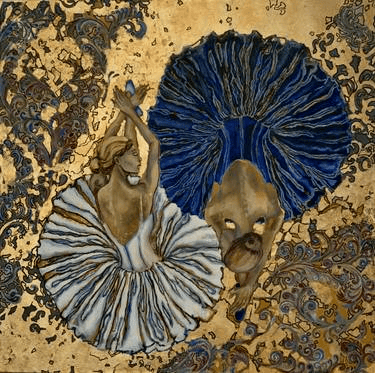
In Blue Silence – The Dancers, measuring 120 × 120 cm (47 × 47 inches), Wüst brings her interest in the expressive potential of the human body into a composition inspired by the language of dance. The painting explores elegance, intensity, and vulnerability through the visual relationship between two contrasting figures: a graceful ballerina dressed in white and a dramatic figure rendered in deep blue.
The juxtaposition establishes the central tension of the composition. White introduces a sense of lightness, delicacy, and visual openness, while the deep blue figure carries a more intense and dramatic presence. Their contrasting appearances create a dialogue that extends beyond color, suggesting different emotional states and dimensions of human identity. Together, they evoke the complexity of a shared experience in which strength and fragility are not opposing qualities but interconnected aspects of being human.
Dance provides a particularly rich subject for this exploration. It is an art form built upon discipline and freedom, physical control and emotional release. A dancer’s movement may appear effortless to an audience, yet it emerges from extraordinary concentration, endurance, and an intimate understanding of the body. Wüst draws upon this duality, presenting the human form as something simultaneously controlled and expressive.
The figures in Blue Silence – The Dancers appear within an intricate golden background that gives the composition much of its visual character. Rather than functioning as a passive backdrop, the ornamental surface establishes an environment of its own, surrounding the figures with layers of detail and visual energy. The gold introduces a sense of richness and timelessness, while its complexity creates a striking contrast with the physical presence of the dancers.
Texture, Ornament, and the Power of Contrast
One of the defining qualities of Wüst’s approach is her ability to bring together contrasting visual elements without allowing them to lose their individual identities. In this painting, the relationship between the smooth, recognizable forms of the dancers and the richly textured background creates a compelling sense of depth. Ornamental details draw the eye across the canvas, while the figures provide a central point of emotional focus.
The interplay of texture and color also contributes to the painting’s sense of movement. The golden surface appears to extend the expressive atmosphere beyond the figures themselves, suggesting that the dancers exist within a world shaped by emotion, memory, and imagination. The composition therefore operates on more than one level: it presents the recognizable subject of dance while inviting a broader interpretation of its emotional significance.
The contrast between white, deep blue, and gold is particularly effective. Each color carries a different visual weight, allowing the composition to move between delicacy, intensity, and radiance. This carefully balanced relationship gives the work a distinctive presence, making its decorative richness inseparable from its figurative expression.
Dance as a Metaphor for the Human Condition
Beyond its immediate reference to ballet, Blue Silence – The Dancers can be understood as a reflection on the delicate balance that defines human existence. The dancers suggest a world in which beauty is inseparable from effort, strength exists alongside vulnerability, and moments of apparent perfection conceal complex emotional realities.
The painting also invites consideration of transformation. Dance is never entirely static; even when a dancer pauses, the body retains the memory of movement and the anticipation of what comes next. Similarly, Wüst’s figures seem to occupy a space between stillness and motion, giving the composition an atmosphere of suspended energy. The title, Blue Silence, reinforces this impression, suggesting a quiet intensity in which emotion is present even without overt action.
This ability to create an expressive atmosphere through visual contrasts reflects a broader concern within Wüst’s practice: the desire to move beyond surface appearances and establish a personal connection between artwork and viewer. Her paintings do not insist upon a single interpretation. Instead, they offer visual and emotional possibilities that allow individual experiences to shape the act of looking.
A Contemporary Practice with a Distinctive Visual Identity
Natalia Wüst’s artistic practice brings together the discipline of classical training and the expressive possibilities of contemporary figurative painting. Her combination of human forms, rich textures, and luminous gold surfaces creates a recognizable visual identity, one that moves between representation and ornament while maintaining a strong emotional focus.
Through works such as Blue Silence – The Dancers, she demonstrates how familiar subjects can become starting points for deeper reflection. Dance becomes more than a depiction of physical movement; it becomes a metaphor for the tensions, contradictions, and transformations that shape human life.
Ultimately, Wüst’s paintings invite viewers to look beyond what is immediately visible. Through the expressive presence of the human figure and the layered richness of her surfaces, she creates spaces where beauty and vulnerability, stillness and movement, and strength and delicacy exist in meaningful dialogue. Her work reminds us that art’s lasting power often lies not in providing definitive answers, but in creating experiences that continue to resonate long after the initial encounter.

