


Mike Katende, known artistically as Mikefineartist, is a London-based visual artist whose practice brings together hyperrealistic pencil drawing and conceptual surrealism. With a creative journey that began in childhood, Mike has developed a distinctive approach to art that combines meticulous observation with imaginative ideas and symbolic storytelling.
His drawings are not created simply to reproduce what the eye sees. Instead, Mike uses realism as a foundation from which he can explore questions that are often invisible. Spirituality, consciousness, technology, identity, perception and the human condition are recurring areas of interest within his work. By combining precise pencil techniques with surreal and conceptual imagery, he encourages viewers to look beyond the immediate appearance of an artwork and consider the ideas concealed within it.
From Childhood Drawing to Conceptual Art
Drawing has been part of Mike Katende’s life since childhood, giving him a long-standing relationship with the discipline of observation and visual expression. Over time, this early interest developed into a more focused artistic practice in which technical precision became closely connected with conceptual exploration.
His hyperrealistic pencil drawings demonstrate patience and attention to detail. Every line, texture and tonal transition can contribute to the overall atmosphere of an image. Yet the technical skill is not the final objective. Mike uses realism to create an immediately recognisable visual language before introducing unexpected elements that encourage the viewer to question what they are seeing.
This combination gives his work a distinctive tension. The imagery may initially appear familiar because of its realistic execution, but its underlying concepts can lead the viewer toward much more ambiguous territory. Reality and imagination become closely connected, allowing the artwork to operate on several levels at once.
The Influence of Surrealism
Mike’s artistic development has been influenced by surrealist artists such as Salvador Dalí and Vladimir Kush. Their approaches demonstrate how familiar objects and realistic imagery can be transformed into visual metaphors, creating new relationships between seemingly unrelated ideas.
This influence can be seen in Mike’s interest in using symbolism to communicate concepts that cannot always be expressed directly. Rather than presenting an idea as a straightforward statement, he allows images to function as clues. Objects, figures and visual relationships can carry meanings that gradually reveal themselves through contemplation.
At the same time, Mike’s work remains grounded in his own interests and observations. His combination of hyperrealistic drawing and conceptual surrealism creates a visual language through which he examines the relationship between internal thought and the outside world.
Questioning What Shapes Our Perception
A central concern within Mike Katende’s practice is the relationship between what people see, what they believe and the external forces that influence their understanding of reality.
Human perception is rarely isolated. People encounter information through technology, culture, social environments, media and the opinions of others. These influences can affect the way individuals understand themselves and the world around them. Mike’s artwork explores this complicated relationship without reducing it to a single interpretation.
His images encourage viewers to pause and consider the possibility that perception is not always as independent as it appears. What shapes a person’s beliefs? Which ideas come from personal experience, and which have been absorbed from the surrounding environment? Where does individual thought end and collective influence begin?
These questions form an important conceptual foundation for his practice.
Another Voice: Individuality in a Crowded World
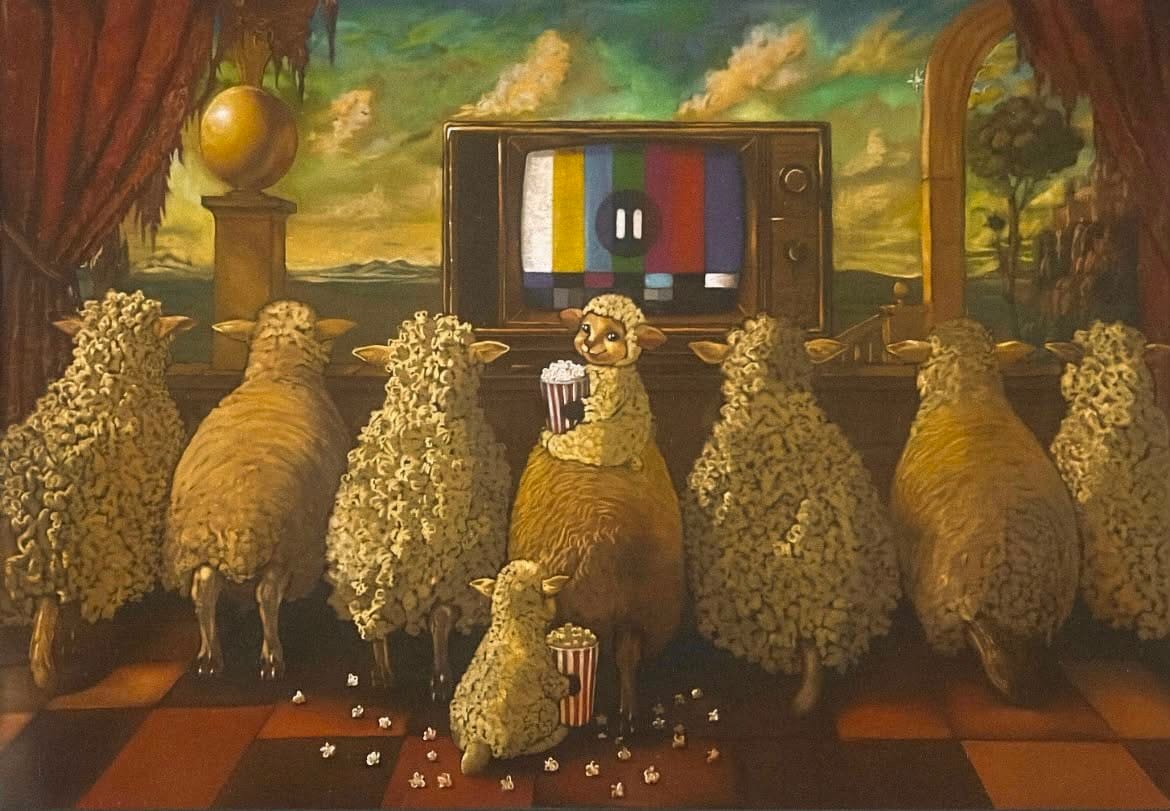
Another Voice explores the tension between individuality and collective influence in a world filled with competing voices. The work uses surreal symbolism to consider how people navigate information, expectations and distractions while attempting to identify what they genuinely believe.
Rather than presenting a simple distinction between individuality and conformity, the drawing creates a visual space in which the two ideas can exist simultaneously. Its symbolism points toward the difficulty of maintaining an independent perspective when countless external messages compete for attention.
The title, Another Voice, reinforces this central idea. A voice can represent an individual perspective, but it can also suggest influence, persuasion, authority or collective thinking. Within the context of the artwork, the concept becomes open-ended. The viewer is encouraged to ask whose voice is being heard and where that voice originated.
The Struggle to Recognise Truth
One of the most compelling aspects of Another Voice is its exploration of truth and perception. In an environment saturated with information, determining what deserves attention can become increasingly difficult. Cultural expectations, social pressures, technological influences and constant communication can create a form of visual and mental noise.
Mike transforms these ideas into surreal imagery, allowing the viewer to experience the subject conceptually rather than simply reading an explanation. Each element contributes to a broader visual conversation, encouraging the audience to examine the relationship between distraction and awareness.
The artwork does not provide a single answer to the questions it raises. Instead, it places the viewer in a position of reflection. The meaning can develop through personal interpretation, making the experience of looking at the work part of the artwork itself.
Art as a Tool for Self-Reflection
For Mike Katende, hyperrealism and surrealism serve complementary purposes. His technical approach draws the viewer into the image, while his conceptual approach gives them reasons to stay and think.
This relationship between appearance and meaning is central to his artistic identity. The precision of his pencil work demonstrates control and observation, while the surreal elements introduce uncertainty and imagination. Together, they create a balance between what is visible and what is suggested.
Through this process, Mike’s art becomes an invitation to self-reflection. Viewers are encouraged not only to interpret the artwork but also to consider their own relationship with the ideas it presents.
Looking Beyond What Is Visible
Mike Katende’s work demonstrates how detailed drawing can become a vehicle for exploring complex contemporary questions. His practice moves beyond technical representation to investigate consciousness, identity, belief and the forces that shape human perception.
With Another Voice, he turns attention toward the challenge of maintaining individuality within a world of competing influences. The artwork asks viewers to consider whether the thoughts they hold are entirely their own, while leaving enough space for each person to reach their own interpretation.
By combining hyperrealistic pencil drawing with conceptual surrealism, Mikefineartist creates work that rewards both close observation and deeper reflection. His images may begin with what the eye can see, but their real questions emerge beneath the surface. In that space between appearance and meaning, Mike Katende continues to explore one of art’s enduring possibilities: using an image to make us reconsider the way we understand ourselves and the world around us.

