


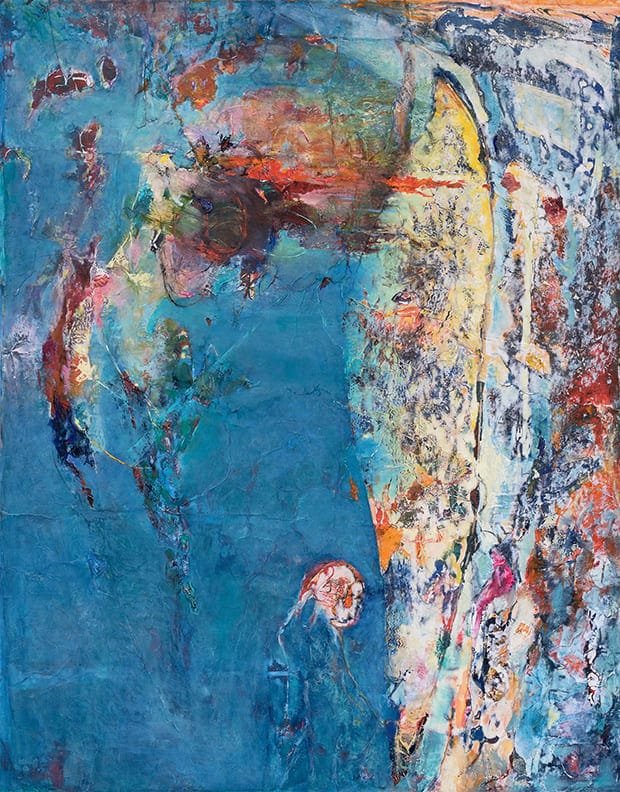
Nurit Avesar is a mixed media artist and painter whose work explores the complex relationship between history, memory, the present moment, and the uncertain future. Working through an intensely physical and process-driven approach, Avesar creates layered surfaces in which images appear weathered, fragmented, buried, and then rediscovered. Her paintings often carry the visual character of remnants from another time, while their brighter and more dynamic final layers suggest that the past is never truly separated from the present.
Born on a kibbutz in Israel, Avesar moved to Los Angeles in her early twenties. Her early professional experience as a graphic designer and illustrator provided her with a strong foundation in visual communication, composition, and image-making. In 2010, she completed a Master of Arts in Studio Art at California State University, Northridge. Today, she lives and works in Los Angeles, where she continues to develop a body of work that brings together painting, collage, material experimentation, and social reflection.
At the center of Avesar’s artistic philosophy is the belief that history does not move in a simple, straight line. Instead, it remains connected to everything that comes after it. History is interwoven with the present and future, and this idea is fundamental to understanding the physical and conceptual structure of her paintings.
A Process Built Through Layers
Avesar’s artistic process is deliberately cumulative. Rather than beginning with a single image and moving toward a predetermined conclusion, she allows the artwork to develop through repeated acts of construction, concealment, destruction, and reconstruction.
Her process begins with painting on paper. She then adheres the paper to canvas, introducing thread and other materials to establish an initial layer. A new sheet of paper is subsequently added to the surface before she begins sanding, painting, and incorporating additional materials. The resulting surface is sanded again, creating a cycle in which each stage partially conceals and alters what came before.
She may tear away sections of the accumulated surface, revealing fragments of earlier layers beneath. Thread, rust, graphite, fabric, paper, sand, window screens, plastic sheeting, wood fragments, and tar can all become part of this evolving visual language. Through repetition, the canvas becomes less like a flat picture and more like a physical record of time.
This method is important because the finished work retains traces of its own history. Earlier marks are not simply erased. They remain partially visible beneath later interventions, creating a tension between what has disappeared and what has survived.
The Beauty of Distressed Surfaces
One of the defining qualities of Avesar’s work is the contrast between faded, ghostly imagery and the stronger, brighter elements that emerge in the final stages. The distressed portions of the paintings can appear fragile and uncertain, while the more pronounced layers introduce energy and visual force.
This contrast creates a sense of vulnerability juxtaposed with dynamism. The artwork seems to exist between states of decay and renewal, destruction and creation. Its surface becomes a metaphor for memory itself: incomplete, altered by time, and constantly influenced by what happens afterward.
The physical act of tearing, sanding, covering, and rebuilding also carries a deeper conceptual meaning. Avesar’s process of manipulating and destroying in order to create something new evokes the reexamination of cultural legacies and historical events. Her paintings therefore do not simply depict history; they physically embody the process through which history is remembered, questioned, obscured, and reconsidered.
History as a Living Presence
Avesar’s interest in history is not limited to looking backward. Instead, she considers how historical events continue to influence contemporary life and how present decisions can shape the experiences of future generations.
Her paintings encourage viewers to think about the layers of circumstances that produce the world around us. Cultural memories, collective experiences, political decisions, environmental changes, and human actions all become part of a larger continuum.
This perspective gives her work a particularly contemporary relevance. The damaged and reconstructed surfaces can be read as metaphors for societies carrying the marks of previous generations while attempting to determine what comes next. Nothing exists entirely on its own. Every new layer is influenced by what lies beneath it.
Confronting the Reality of Global Warming
Avesar’s work also addresses one of the defining issues of the present era: global warming and its consequences for future generations.
Her environmental concerns emerge from a difficult recognition that familiar landscapes, ecosystems, communities, and patterns of life may not remain as they have been known. She reflects on the collapse of ecological systems, rising sea levels, changing weather and wind patterns, mass migration, resource conflicts, inequality, and the potential loss of countless species.
For Avesar, climate change is not an abstract future scenario. Its effects are already visible. This awareness creates an emotional tension within her paintings. There is grief for what may be lost, anxiety about what lies ahead, and an acknowledgment that human decisions are actively shaping the conditions future generations will inherit.
Her layered process becomes especially meaningful in this context. Just as the artist repeatedly covers, damages, removes, and rebuilds the surface of her canvases, the natural world is also being transformed by forces that are both gradual and catastrophic. Landscapes that once appeared permanent can become unstable, while familiar ecological relationships can be disrupted.
Fallout: A Reflection on Consequence and Change
A powerful example of Avesar’s exploration of these ideas is Fallout, a mixed media work on canvas created in 2023. Measuring 65 by 50 inches, the piece reflects the artist’s interest in transformation, vulnerability, and the consequences of human actions.
The title Fallout immediately introduces associations with aftermath and consequence. It suggests a world dealing with the results of events that have already taken place, while also leaving room for broader interpretations surrounding environmental destruction, social disruption, and the lasting effects of decisions made in the present.
The physical construction of Avesar’s work makes this concept especially compelling. Layers can suggest accumulated histories, while torn and distressed passages evoke damage, disappearance, and instability. At the same time, stronger visual elements can imply resilience and the possibility of transformation.
Rather than presenting an easy resolution, Fallout invites viewers to sit with uncertainty. It asks us to consider what remains after profound change and what can still be reconstructed from damaged foundations.
Exhibiting Across Southern California
Avesar’s work has been presented extensively through solo and group exhibitions in Southern California. Her solo exhibitions include the Antelope Valley College Art Gallery in Lancaster from 2024 to 2025 and LAUNCH LA in Los Angeles in 2024. Earlier solo presentations include exhibitions at Beyond Baroque in Los Angeles in 2019, Monica Film Center in Santa Monica in 2018, and the Neutra Institute Museum in Silver Lake in 2016.
Her group exhibition history includes presentations at Wonzimer Gallery in Los Angeles and Studio Channel Islands in Camarillo in 2023, as well as exhibitions at Keystone Gallery, the Carnegie Museum in Oxnard, California State University Dominguez Hills, and Brand Library Art Gallery in Glendale.
Her work has received recognition through several achievements. In 2010, Avesar was the recipient of the Cal State University Dean Art Purchase Award. She was selected as the National Women’s Caucus for the Arts Featured Artist in July 2024, while her work was featured in Artillery Magazine in the November–December 2022 issue. She is represented by Janssen Artspace in Palm Springs, California.
Looking Toward the Future
Avesar’s practice asks viewers to reconsider the relationship between what has been, what is happening now, and what may come next. Her paintings are constructed through layers, but those layers represent more than material experimentation. They become records of transformation and metaphors for the way memory, culture, history, and environmental change accumulate over time.
Her upcoming solo exhibition at MOAH/CEDAR Museum in Lancaster, California, scheduled for 2027, will provide another opportunity to encounter her evolving artistic practice.
Through painting and mixed media, Nurit Avesar transforms the canvas into a site of excavation. Her surfaces reveal traces of what came before while making space for something new. In works such as Fallout, this approach becomes a powerful way to contemplate the environmental and social challenges facing the world today.
Ultimately, Avesar’s work reminds us that the future is not separate from the past. Every decision creates another layer, every action leaves a trace, and the world inherited by future generations is being shaped through what we choose to preserve, change, or destroy today.
Follow Nurit Avesar on Instagram: @nuritavesar.

