


Antares is a Mexican visual artist based in San Diego, California, whose artistic practice explores the powerful intersection of mythology, spirituality, ancient religions, and the darker symbolic dimensions of human experience. Working primarily across painting and sculpture, Antares creates dramatic figurative compositions inspired by biblical traditions, Mesopotamian mythology, Egyptian deities, apocryphal literature, and stories of exile, desire, loss, and transformation.
Rather than treating ancient stories as distant historical subjects, Antares brings their figures and themes into contemporary emotional spaces. His work considers how stories created thousands of years ago can still speak to modern audiences, particularly when they address universal experiences such as longing, conflict, vulnerability, grief, power, and the search for meaning.
His approach combines historical research with a deeply personal visual language. Ancient characters become more than representations of mythology or religion. They become vessels through which Antares examines the complexities of human identity and the enduring questions that continue to shape our understanding of existence.
A Dialogue Between Antiquity and the Present
A central element of Antares’ practice is his interest in creating a dialogue between antiquity and contemporary life. The characters that populate his paintings and sculptures may come from ancient traditions, but they are presented with an emotional immediacy that encourages viewers to consider their stories from a new perspective.
For Antares, mythology provides an expansive vocabulary for exploring the human condition. Ancient narratives are filled with characters who experience ambition, temptation, devotion, betrayal, desire, isolation, and transformation. These emotional experiences remain recognizable regardless of the century in which they were first recorded.
This connection between the past and present allows his work to occupy a space between historical interpretation and personal expression. His paintings do not simply illustrate stories from mythology. Instead, they reinterpret those stories through atmosphere, gesture, symbolism, color, and emotional tension.
The result is an artistic language in which the distant past feels unexpectedly close.
The Forgotten and Marginalized Figures of Myth
Antares is particularly drawn to characters who exist at the margins of traditional narratives. Angels, demons, forgotten queens, goddesses, and other mythic beings frequently become central figures within his artistic world.
These characters offer an opportunity to explore perspectives that may have been overlooked, misunderstood, or simplified over generations of storytelling. By placing them at the center of his compositions, Antares gives them renewed presence and invites viewers to reconsider what they represent.
His fascination with these figures also reflects a broader interest in the unknown. Throughout human history, people have used myths, religious stories, and supernatural figures to give form to experiences that are difficult to explain. Angels and demons, gods and goddesses, heroes and tragic rulers can all represent forces that exist beyond ordinary human understanding.
Antares uses these symbolic figures to explore that same uncertainty. His work asks viewers to look beyond the familiar version of a story and consider the emotions, contradictions, and vulnerabilities hidden within it.
Queen Dido: Power, Passion, and Tragic Destiny
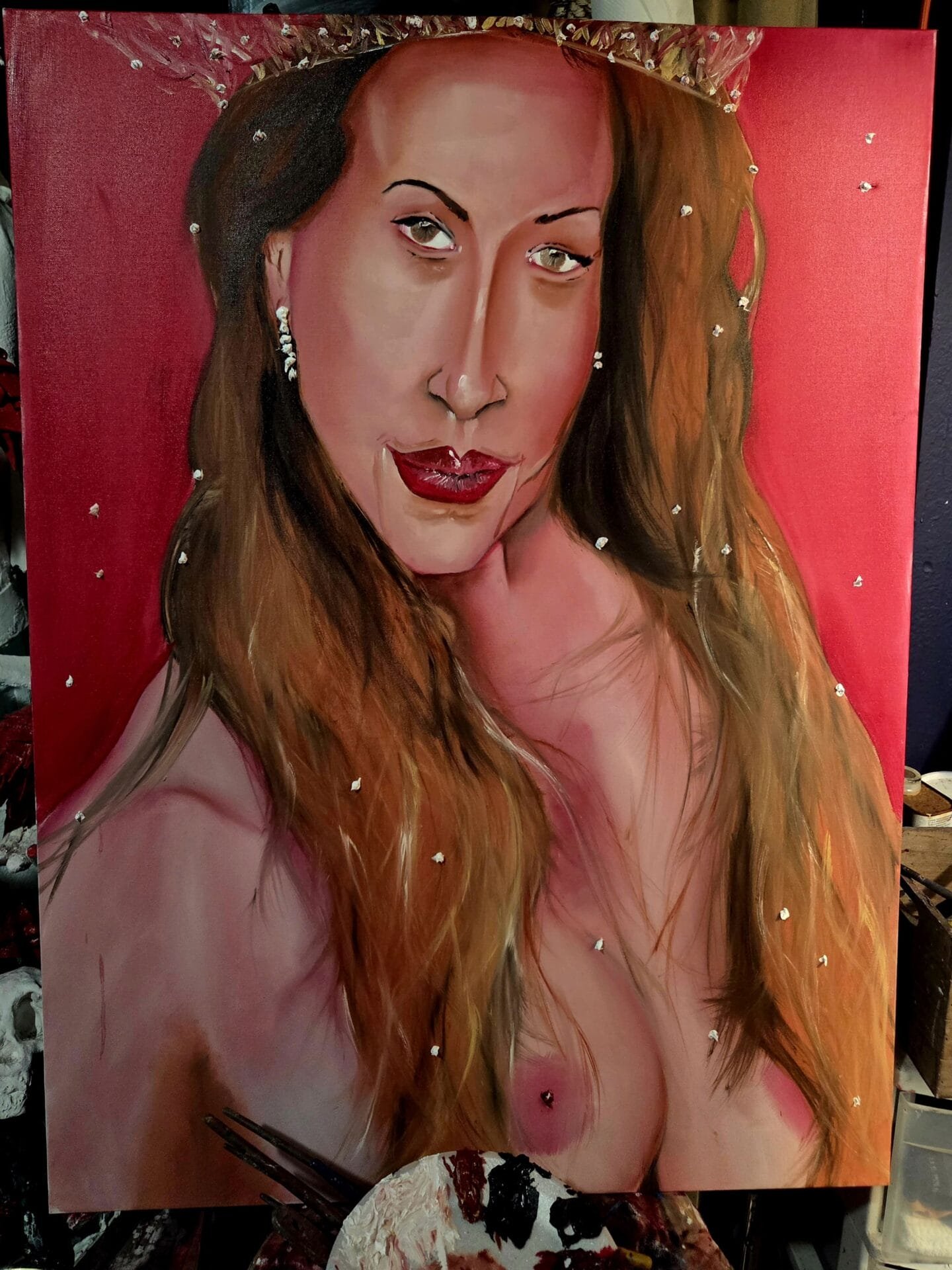
One of the works that reflects these interests is Queen Dido, an oil painting on canvas created in 2026. Measuring 30 x 40 inches, the work presents the legendary ruler of Carthage through an interpretation that balances authority with emotional vulnerability.
Dido is one of mythology’s most compelling figures, remembered as a powerful queen whose story has long been associated with love, ambition, sacrifice, and tragedy. Antares approaches this legendary character not simply as a historical or mythological subject, but as a figure through whom contemporary emotions can be explored.
In Queen Dido, the ruler appears with a commanding yet intimate presence. Deep crimson tones surround her, establishing an atmosphere that feels simultaneously luxurious, passionate, and ominous. The color becomes more than a visual choice, contributing to the emotional intensity of the composition.
Her jeweled crown reinforces her position and authority, while the scattered highlights introduce a sense of delicacy and fragility. This contrast is central to the painting. Dido appears powerful, yet there is an emotional distance within her presence that suggests the burden beneath that power.
The work brings together beauty and tragedy, sensuality and restraint, authority and vulnerability. Through these opposing qualities, Antares creates a portrait that encourages viewers to consider the emotional complexity behind the legendary queen.
A Contemporary Interpretation of an Ancient Queen
Antares’ interpretation of Dido demonstrates his broader approach to mythology. Rather than reproducing a familiar image of the legendary queen, he creates a more psychologically charged representation.
The viewer is encouraged to consider Dido not only as a queen from an ancient story but also as an individual confronting complicated emotions. Her regal appearance communicates strength, while the surrounding atmosphere suggests isolation and emotional tension.
This duality gives the painting its contemporary relevance. Modern audiences may not share the same historical circumstances as Dido, but they can recognize the emotional experiences associated with her story. Love can become complicated by power. Authority can coexist with loneliness. Desire can lead to vulnerability. Strength does not necessarily protect a person from loss.
Through these tensions, Queen Dido becomes more than a depiction of a mythological figure. It becomes an exploration of the emotional complexity contained within her legend.
Painting as a Way of Exploring Spirituality and the Unknown
Across Antares’ wider practice, spirituality and mythology provide a means of investigating questions that have fascinated humanity for centuries. His references to biblical traditions, ancient religions, apocryphal literature, and mythological cultures reveal an interest in how civilizations have attempted to understand forces beyond the visible world.
Art becomes a space where these different traditions can meet.
Rather than providing straightforward answers, Antares allows ambiguity to remain part of the experience. His dramatic figures can evoke questions about belief, morality, identity, mortality, and the unknown without reducing these subjects to a single interpretation.
This openness gives viewers room to bring their own experiences to the work. A mythological figure may represent a spiritual presence to one viewer, while another may see psychological conflict, historical memory, or personal tragedy.
The Emotional Power of Figurative Art
Figuration plays an important role in Antares’ visual language because the human figure provides an immediate connection between the viewer and the narrative. Expression, posture, costume, gesture, and surrounding atmosphere can communicate emotions that transcend historical and cultural boundaries.
In Queen Dido, the figure’s presence carries much of the painting’s emotional weight. The combination of her regal appearance and emotional distance encourages the viewer to look beyond her outward status.
This approach reflects Antares’ broader interest in vulnerability. Even characters who appear powerful can contain uncertainty and pain. By emphasizing this contradiction, he transforms mythological figures into emotionally complex subjects.
His use of dramatic compositions further strengthens this connection. Instead of presenting mythology as something remote and untouchable, Antares gives his figures a human quality that allows viewers to engage with them emotionally.
The Relationship Between Beauty and Darkness
Another important characteristic of Antares’ work is the tension between beauty and darker themes. His subjects often emerge from stories involving loss, exile, desire, spiritual conflict, death, transformation, and the supernatural.
Yet darkness in his work is not simply about creating an ominous atmosphere. It becomes a way of examining the complicated sides of human existence. Beauty and suffering can exist within the same story, just as strength and vulnerability can exist within the same person.
Queen Dido embodies this relationship. Her crown and commanding presence suggest grandeur and authority, while the deep crimson atmosphere and emotional distance hint at the tragic dimension of her story.
By bringing these opposing qualities together, Antares creates a visual experience that is both aesthetically compelling and emotionally layered.
Keeping Ancient Stories Alive Through Contemporary Art
Antares’ work demonstrates how ancient narratives can continue to evolve through contemporary artistic interpretation. Mythology is not fixed. Every generation can return to these stories, discover different meanings within them, and reinterpret their characters according to its own concerns.
Through painting and sculpture, Antares contributes to that ongoing conversation. His works connect research into ancient traditions with personal expression, allowing forgotten or familiar figures to appear in new emotional contexts.
Queen Dido is a strong example of this approach. The painting takes a legendary queen associated with power, passion, and tragedy and presents her through a contemporary visual language marked by dramatic color, symbolism, and psychological depth.
Ultimately, Antares’ practice is concerned with the enduring relationship between humanity and the stories it creates. His mythological figures remind us that although civilizations change, many of the questions at the heart of human experience remain remarkably constant.
Through his art, the ancient and contemporary meet. Biblical traditions, ancient religions, mythology, and forgotten characters are transformed into opportunities for reflection on memory, spirituality, conflict, desire, vulnerability, and the unknown.
With works such as Queen Dido, Antares invites viewers to look again at the figures who have survived through centuries of storytelling and to consider what their stories might reveal about the present. His art does not simply preserve the past. It gives the past another voice, allowing ancient characters to enter contemporary visual culture with renewed emotional power and relevance.

