


Paul Lewey is a Brighton-based artist whose practice has developed through a long and personal journey of persistence, experimentation, and self-discovery. His paintings explore the space between observation and imagination, drawing on photographs, sketches, memories, and fragments of everyday experience to create scenes that feel familiar while remaining deliberately open to interpretation.
Paul’s relationship with art began during his teenage years, when he received lessons from a family friend who was an artist. Although he always felt that creating art was something he was meant to pursue, the process did not come easily to him. He understood his desire to make art, but finding his own direction proved considerably more difficult.
His path into formal art education was equally unconventional. Paul applied several times for a degree course but was unsuccessful. Eventually, as a mature student, he gained a place on the BA Hons Art and Design course in Bradford, graduating with a 2:1 in 1999.
After completing his degree, Paul spent many years creating watercolour portraits. He occasionally submitted work to exhibitions, but these opportunities did not develop into a sustainable artistic career. For financial security, he continued working full-time and created artwork during his spare time. Although the desire to become more deeply involved with art remained, he never felt sufficiently secure to rely entirely on his artwork for a living.
Finding a Way Forward Through Collage
For Paul, one of the biggest obstacles was not learning how to paint but deciding what to paint. He understood the technical side of making images, yet struggled with generating ideas and constructing subjects from nothing.
The discovery of collage offered a way through this difficulty.
Rather than requiring him to invent an entire story before beginning, collage allowed existing images and fragments to suggest possibilities. The scenes could become invitations to imagine rather than fixed narratives. Instead of telling a story himself, Paul could create an image that encouraged a story to emerge in the mind of the viewer.
This became particularly important when his mother began sending him copies of old family photographs. She also gave him a DVD containing Cine Films recorded by his grandfather when Paul was a child. These personal archives provided a rich collection of visual references connected to memory, family, and the passage of time.
Paul also began searching for old photographs in antique shops and online. These found images, together with his family photographs and film footage, became important references for his developing practice and later for his MA coursework.
The Influence of Frank Auerbach
Paul’s approach to developing an image has been influenced by the work of one of his favourite artists, Frank Auerbach. He was particularly interested in Auerbach’s method of repeatedly applying and removing his medium while gradually building the form of his subject.
This idea of repetition became an important part of Paul’s own process.
Rather than attempting to reproduce a photograph directly, Paul begins with a drawn study of the photographed scene. He then creates another study by referring only to the previous drawing instead of returning to the original photograph. He repeats this process, allowing the image to gradually change as it moves from one version to another.
The result can be compared to a visual version of the “Broken Telephone Game”. Each stage carries information from the previous one, but small changes accumulate. Forms shift, details disappear, and the image slowly moves away from the original photographic source.
Despite this transformation, something of the original scene remains. Its essence, atmosphere, or arrangement survives within the increasingly independent image.
Paul also experimented with using different media for each individual study, further encouraging the image to develop through successive stages rather than remaining tied to its original form.
From Photographs to Sketches and Doodles
Following the completion of his MA, Paul’s practice has continued to evolve. He has increasingly incorporated sketching into his everyday life, drawing while spending weekends socialising and dancing with friends.
These spontaneous sketches have become starting points for new studies and paintings. Rather than relying exclusively on photographs, Paul is now able to capture moments directly through quick observational drawings.
Another important part of his current process is doodling. Paul may loosely construct a scene using simple figurative shapes before erasing it and beginning again. He concentrates on identifying and developing the shapes of the figures rather than worrying about creating a fully resolved narrative.
The process is repeated several times. Each round allows him to redefine the figures, alter their relationships, and discover new possibilities within the composition.
This approach has helped Paul move away from the pressure of having to know exactly what a painting should represent before he begins.
A Play Of Two Halves
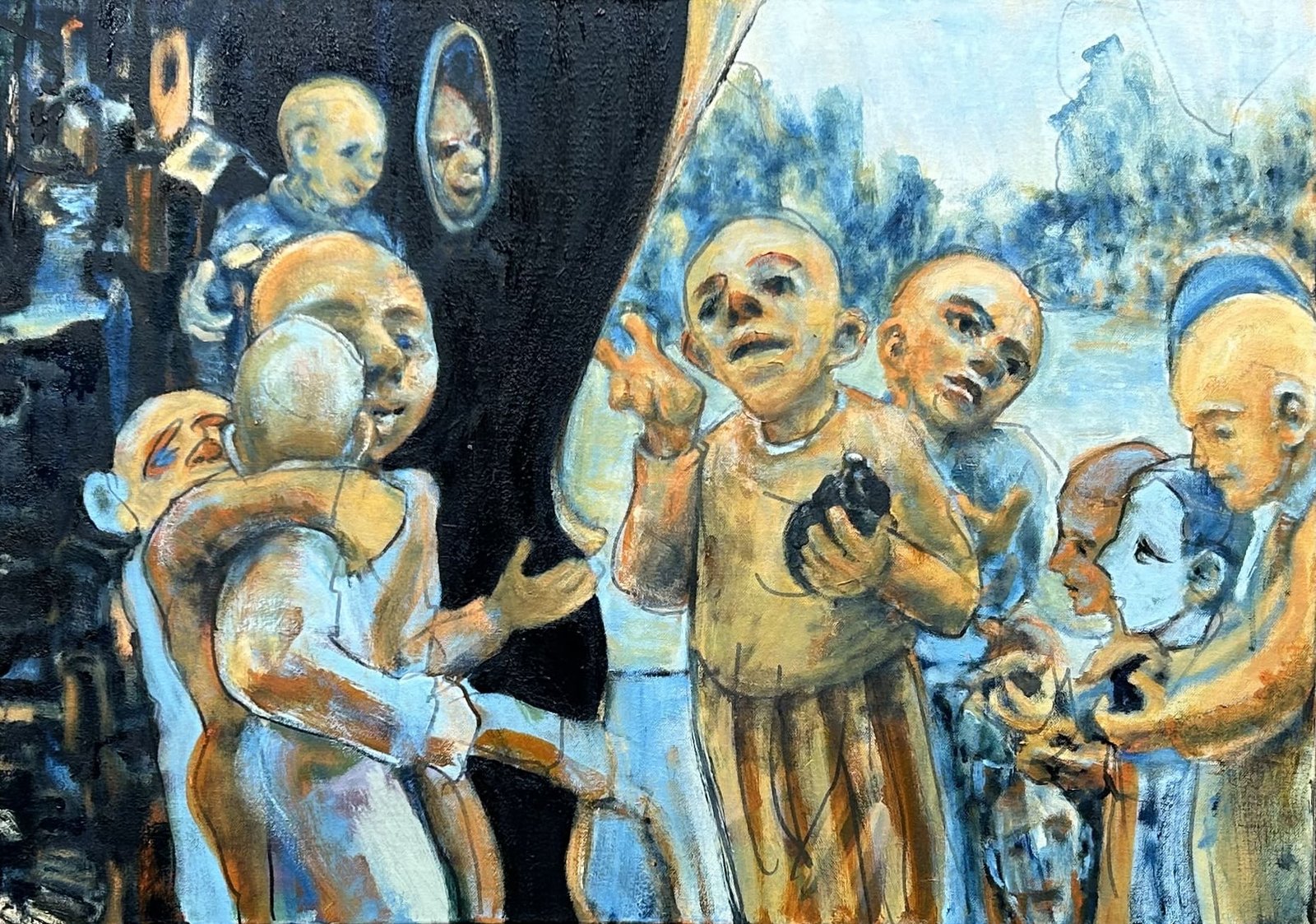
One work that demonstrates this approach is A Play Of Two Halves, created in 2026. The mixed-media painting measures 59.5 × 84 cm and was created on a found second-hand canvas.
The use of a previously painted canvas is significant to Paul’s practice because the surface already contains a visual history before he begins. He works with a limited palette consisting of Titanium White, Prussian Blue, Payne’s Grey, Cadmium Orange, and Yellow Ochre.
Interestingly, any additional colours visible in the finished painting come from the artwork that existed underneath. Rather than completely eliminating the previous painting, Paul allows traces of it to remain within the new work.
The painting began with a doodled sketch composed of figurative shapes. Paul repeatedly erased and redrew the scene, concentrating on developing the figures until he felt satisfied with their forms.
Once the composition had developed sufficiently, he projected the image onto the canvas and transferred it using a marker pen. Because the marker marks were visually prominent, Paul made the decision not to completely hide them. Some remain visible through the finished painting, becoming an integral part of its appearance.
Embracing Happy Accidents
Chance also plays an important role in Paul’s process.
Although the transferred drawing provides a structure for the painting, he does not attempt to control every outcome. As paint is applied, unexpected marks and changes can occur. Rather than treating these moments as mistakes, Paul welcomes what he describes as happy accidents.
The original lines guide the work, but the painting is allowed to develop beyond them.
This balance between control and spontaneity has become increasingly important as Paul’s practice has evolved. With each new painting, he has found himself applying paint more loosely. The finished works have developed a roughness and immediacy that he has come to appreciate.
Instead of trying to make every surface perfectly resolved, Paul allows evidence of the process to remain visible. Brushwork, marker lines, underlying colours, and unexpected changes can all contribute to the final character of the image.
The Viewer Completes the Story
Paul does not believe that his paintings need to come with a definitive explanation. For him, the scene exists as an invitation for the viewer to construct their own interpretation.
A title may provide a small indication of how Paul understands the work, but it is not intended to dictate a single reading. The viewer is encouraged to bring their own experiences, memories, and imagination to the image.
This approach removes the pressure of creating a painting with one predetermined narrative. Paul does not need to know exactly what happened within the scene. Instead, he is interested in creating an image that makes the viewer wonder what might have happened.
In this sense, the uncertainty becomes part of the artwork itself.
Searching for a Sense of Uncanniness
At the heart of Paul’s practice is his interest in creating a feeling of “uncanniness”. He hopes that viewers experience something within his paintings that is familiar enough to recognise but strange enough to remain uncertain.
His figures may suggest people encountered in everyday life, while their relationships and surroundings remain ambiguous. The scenes can appear to contain fragments of a story without ever revealing the complete narrative.
This tension between recognition and uncertainty gives Paul’s work its distinctive atmosphere.
Rather than providing straightforward representations, he creates images that occupy a space between memory, observation, and invention. The paintings retain traces of their sources while gradually becoming something more ambiguous and personal.
A Painting Becomes Its Own Story
Paul Lewey’s artistic journey demonstrates how uncertainty can become a productive force in creative practice. His early difficulty in finding subjects eventually led him toward a process in which images are discovered through repetition, alteration, erasure, and reconstruction.
Photographs become drawings. Drawings become new drawings. Doodles become figures. Old canvases become foundations for new paintings. At every stage, something is retained while something else changes.
A Play Of Two Halves embodies this philosophy particularly well. Its found canvas, restricted palette, visible marker lines, underlying colours, figurative forms, and spontaneous marks all contribute to an image that feels discovered rather than simply executed.
Ultimately, Paul leaves the final part of the creative process to the viewer. His paintings provide enough information to encourage curiosity but deliberately avoid explaining everything.
The story is therefore never entirely Paul’s to tell.
It belongs partly to the person looking at the painting, who is invited to construct their own interpretation from the figures, marks, colours, and spaces that Paul has brought together.
For Paul Lewey, perhaps the most successful painting is not the one that gives the viewer all the answers, but the one that leaves behind a question, a feeling, or an unsettling sense that something is familiar without being completely understood.

