


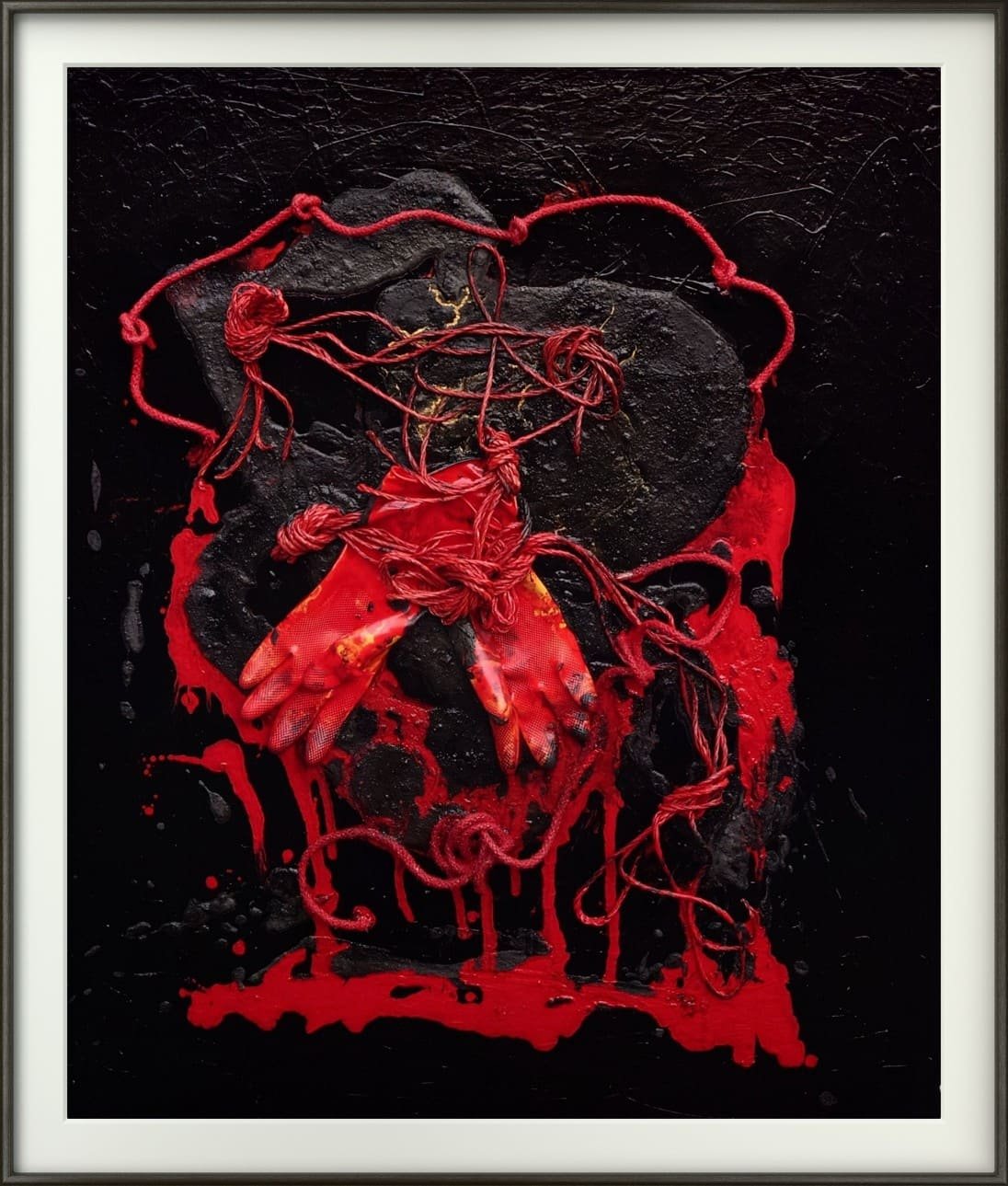
Marek Borkowski is an award-winning British artist born in Poland whose abstract expressionist practice is rooted in emotional honesty, instinct, and personal transformation. His paintings are not created to satisfy trends, follow established formulas, or provide viewers with straightforward narratives. Instead, they emerge from a deeply personal encounter between emotion, memory, struggle, and the liberating force of creative expression.
Having exhibited nationally and internationally, Borkowski has developed a body of work that reflects an uncompromising commitment to authenticity. His exhibition history includes two solo exhibitions in his hometown, a digital exhibition at Hampton, a Swiss expo, and participation in Art Basel. Across these different settings, his paintings have continued to communicate with audiences through something more immediate than conventional storytelling: raw energy.
For Borkowski, painting is not simply an artistic activity. It is a form of confrontation, release, and renewal.
An Abstract Expressionism Without Rules
Borkowski’s approach to abstract expressionism begins with a refusal to overthink the image before it exists. He does not start with detailed sketches, predetermined themes, or carefully constructed compositions. Instead, the painting develops through instinct.
Acrylic paint becomes one of his primary materials, but he rarely confines himself to traditional applications. He may dilute the paint or combine it with unconventional materials such as plaster, ground coffee, and fine gravel. His tools can include knives, metal implements, his hands, and whatever else allows him to respond directly to the surface.
The resulting works possess a physical intensity. Paint can appear poured, dragged, scraped, layered, or violently displaced across the canvas. Texture becomes just as important as colour, while gesture becomes a record of the emotional state present during creation.
There is no attempt to make the process comfortable or predictable. The uncertainty is part of the work.
Borkowski allows the painting to become an independent space where conscious control can give way to instinct. In this sense, the canvas becomes less like a surface for decoration and more like a place where emotion can physically exist.
The Canvas as a Battleground of Consciousness
At the heart of Borkowski’s practice is the idea that painting can become a confrontation with the inner self. His canvases often emerge from an internal struggle between turmoil and liberation, making each work a visual record of an emotional journey.
He describes his creative process as something spontaneous and almost trance-like. The work begins without a fixed concept, and the artist allows energy to move through the materials rather than attempting to impose a predetermined outcome.
This approach creates an unusual relationship between artist and artwork. Borkowski does not always remain at the centre of the process. As the painting develops, the conscious persona of the artist can recede, leaving behind marks that feel instinctive and immediate.
Only after the physical act of painting has taken place might a title appear. Sometimes, there may be no title at all.
This absence of predetermined meaning is important. Rather than telling viewers what they should see, Borkowski leaves space for their own emotional responses. The painting becomes an open encounter between the artwork and the person standing before it.
From Trauma to Transformation
Borkowski’s art cannot be separated entirely from his life experience. His personal journey has passed through trauma, addiction, emotional struggle, and a process of rebuilding himself. These experiences have informed the emotional intensity of his work without reducing the paintings to simple autobiographical illustrations.
Instead, the experiences become part of the energy behind the creative process.
His paintings can be understood as evidence of survival. They represent moments in which internal conflict is transformed into something physical, visible, and ultimately liberating. The act of painting provides a space where difficult experiences can be confronted rather than avoided.
For Borkowski, this process carries a therapeutic dimension. Painting allows the mind to overflow onto the canvas, creating a place where internal demons can be encountered and gradually released.
His philosophy can be summed up in his own powerful words: “Stop, question all your beliefs….live now, and let yesterday be yesterday, but tomorrow may never come.”
The statement reflects a broader principle running through his practice: freedom begins when individuals are willing to question the beliefs and expectations that have shaped them.
Camy Back Again!!!??: A Story Told Without Words
One of Borkowski’s works, Camy Back Again!!!??, is an abstract expressionist mixed-media painting on canvas measuring 38 by 44 inches.
The unusual title immediately creates a sense of uncertainty, repetition, and emotional urgency. Yet the work does not depend on its title to communicate. Its deeper meaning exists within the physical language of the painting itself.
Borkowski describes the work through an intensely personal narrative:
“I swam through stormy oceans, walked thousands miles through dark forest and climbed mountains, been traumatised hundreds times. Seen blood dripping from wounded minds. Decades of alcoholism, died to came back to life again to tell my story in silent language.”
These words reveal the emotional territory behind the painting. The stormy oceans, dark forests, mountains, wounds, and return to life function as metaphors for an extraordinary journey through adversity.
Rather than illustrating these experiences literally, Borkowski translates them into abstraction. The painting becomes a silent language, communicating what ordinary words may struggle to express.
The mixed-media surface strengthens this idea. The combination of acrylic with unconventional materials creates physical depth and tactile variation, giving the viewer a sense that the work has been built through accumulated experience.
Materials as Emotional Instruments
For Borkowski, materials are not merely technical choices. They become instruments through which emotion can be expressed.
Acrylic allows him to move quickly and instinctively. Dilution changes its behaviour, while plaster, coffee, gravel, and other materials introduce unexpected surfaces and textures. Knives and metal tools allow him to scrape, cut, drag, and manipulate the paint in ways that a conventional brush might not permit.
His hands also become part of the process.
This physical engagement gives his paintings an almost sculptural presence. Texture records movement. Layers preserve previous gestures. Glazing protects and deepens what has already happened, allowing earlier decisions to remain visible beneath later interventions.
The final painting therefore becomes an accumulation of moments rather than a single carefully planned image.
Rejecting Conformity Through Creativity
Borkowski’s artistic philosophy extends beyond the studio. His refusal to follow trends or seek external validation reflects a wider belief in individual freedom.
He does not appear interested in fitting his work neatly into an artistic category simply because the market or contemporary culture demands it. Abstract expressionism provides a foundation, but his practice remains deeply personal and fluid.
This independence is particularly important because his work encourages viewers to question conformity themselves.
His paintings do not offer easy answers. Instead, they can function as mirrors. A viewer may encounter aggression, sadness, freedom, fear, hope, chaos, or renewal depending on their own experiences.
The meaning is therefore not completely fixed by the artist.
Painting as a Mirror for the Viewer
When Borkowski’s paintings enter an exhibition space, their scale and intensity invite viewers into an immersive experience. His recent solo exhibitions have been appreciated for their ability to create an environment where audiences can encounter the breadth of his emotional landscapes.
The objective is not simply to sell a painting or explain an idea. The experience itself matters.
Standing before one of his canvases can become an opportunity for self-reflection. The viewer may begin by asking what the painting represents, but the more important question may eventually become what the painting awakens within them.
That shift from interpretation to personal resonance is central to Borkowski’s work.
A Silent Language of Survival
Marek Borkowski’s paintings are ultimately records of transformation. They emerge from experiences that have tested the limits of endurance, yet they do not remain trapped within those experiences.
Instead, pain becomes movement. Trauma becomes texture. Instinct becomes colour. Struggle becomes gesture. Survival becomes creation.
Camy Back Again!!!?? embodies this philosophy particularly strongly. Its story is not presented through a conventional narrative but through the physical language of abstraction, allowing the canvas to carry what words cannot fully contain.
Borkowski’s art asks viewers to pause, question inherited beliefs, and look beyond the structures that tell them how they are supposed to live or understand the world.
His paintings are fiercely personal, yet their openness makes them universal. They do not demand one interpretation. They invite a response.
In the end, Borkowski’s work is an echo of an unfiltered life, transformed through paint, texture, movement, and instinct. It is an invitation to confront what lies beneath the surface, release what no longer serves us, and recognize that freedom can sometimes begin with the simple decision to stop, question, and live in the present.

