


Christopher Tran’s artistic story begins in Albuquerque, New Mexico, the “Land of Enchantment,” a region shaped by the meeting of Hispanic, Native American, and Anglo cultures. Growing up within this rich cultural environment cultivated his appreciation for tradition, history, and artistic expression. These influences continue to inform his work today, particularly through his development of “Art Historicism,” a methodology and movement that brings together art history, creative studio practice, and art education.
For Tran, these disciplines are not separate areas of inquiry. Instead, they form an interconnected approach to understanding and communicating through art. He describes this structure through the “Trinitarian Model,” in which historical research, artistic creation, and educational principles are given equal importance.
Through traditional and digital visual mediums, Tran explores ideas that can engage audiences aesthetically while also encouraging historical and intellectual investigation. His works may be presented through solo or group exhibitions associated with The Art Historist Collective, where the relationship between artist, artwork, history, and audience becomes part of a broader educational experience.
His work Woman On a Hill provides an especially compelling example of this philosophy in practice. Combining visual imagery with a substantial written and poetic component, the work explores psychological confinement, the desire for escape, repetition, and the timeless human struggle to overcome adversity.
The Woman on the Hill
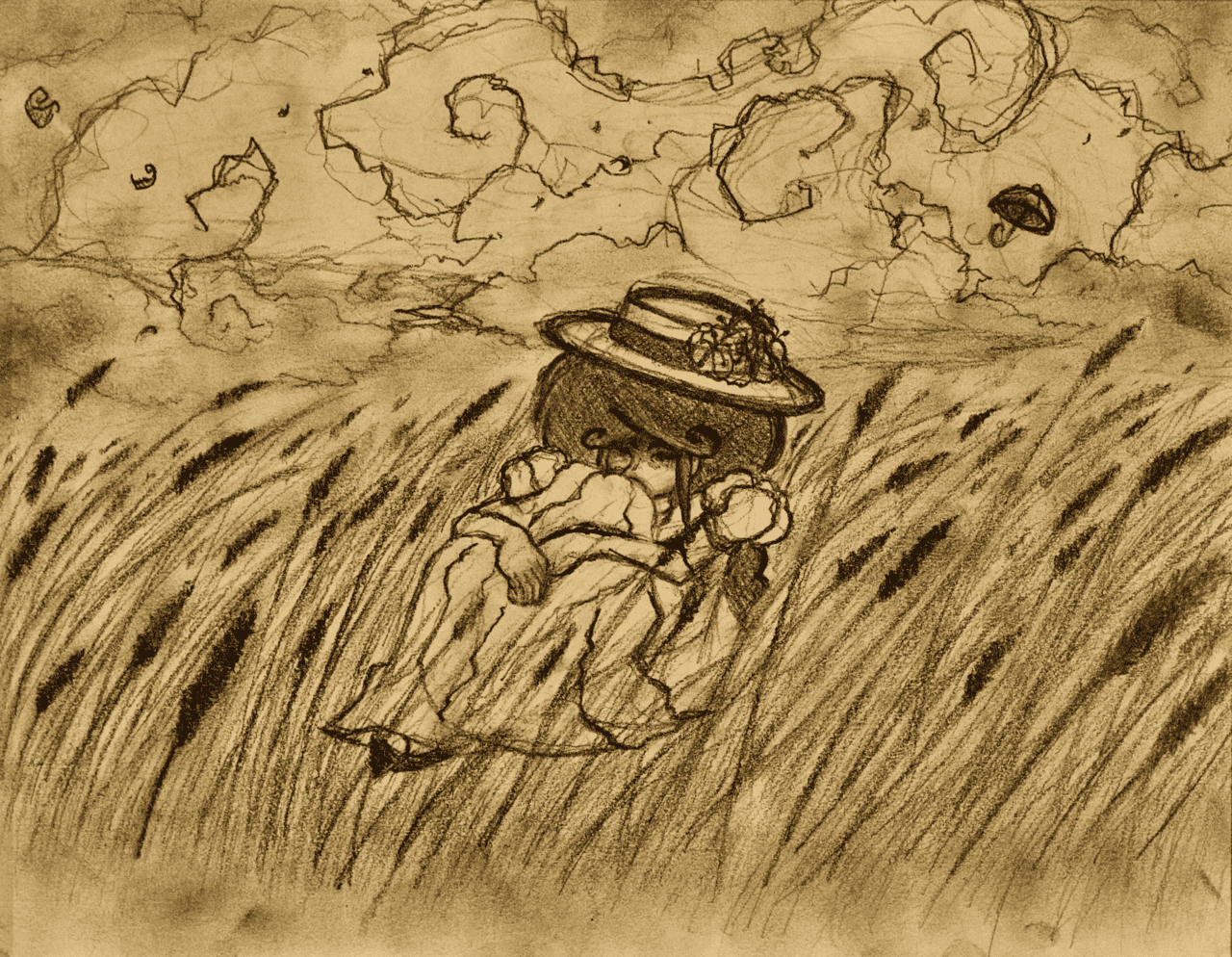
At the center of Woman On a Hill is a solitary woman sitting within an expansive wheat field. The scene immediately creates a sense of isolation. Around her are the natural elements of a landscape: wheat, trees, clouds, leaves, and wind. Yet the environment feels far from peaceful.
The sky is murky, the clouds are crooked, and the trees appear tired. The woman’s umbrella is being carried away by the wind, but she does not seem to notice. Her attention is directed somewhere deeper, suggesting that her internal world has become more important than the physical circumstances surrounding her.
What has brought her to this hill?
The work deliberately leaves the question unanswered. Perhaps she has experienced the betrayal of a lover. Perhaps she is contemplating revenge. Maybe she is consumed by an obsessive doubt or an unresolved memory. The viewer is never given a single definitive explanation.
Instead, Tran creates a psychological mystery in which the woman’s expression becomes an invitation to interpretation. Only she can truly understand the thoughts occupying her mind.
A Landscape That Reflects the Mind
The landscape in Woman On a Hill functions as more than a physical location. It can also be understood as an external representation of the woman’s emotional state.
The endless wheat suggests an environment without an obvious boundary or conclusion. The crooked clouds and murky skies introduce uncertainty, while the “crinkled leaves” and “tired trees” contribute to an atmosphere of exhaustion.
This relationship between landscape and psychology becomes even clearer through the written component accompanying the artwork.
The poem begins:
“Crooked clouds,
murky skies,
endless wheat,
and crinkled leaves
from tired trees.”
These lines establish the emotional vocabulary of the work. Nature appears worn down, just as the woman herself seems emotionally exhausted. The landscape becomes almost psychological, a place where external surroundings and internal experience overlap.
The Written Component of Woman On a Hill
An important aspect of Christopher Tran’s work is that the written component is not merely an explanation placed alongside the visual artwork. The poetry becomes another creative layer through which the narrative and ideas of Woman On a Hill are developed.
The woman is described as sitting in an elegant dress, surrounded by the suggestion of perfume and decadence. Her home is distant, described as a “land of milk and honey.” This contrast between elegance and emotional distress creates one of the work’s central tensions.
On the surface, she may appear surrounded by beauty and refinement. Internally, however, she seems trapped.
The wind becomes a possible force of liberation:
“A windy day so strong,
she can fly away
oh how she prays
she can fly away.”
The repeated desire to fly away suggests that escape has become an obsession. The woman does not simply want to leave the hill; she appears to long for freedom from whatever psychological condition has confined her.
This is an important distinction. Her physical surroundings may be beautiful, but beauty does not necessarily mean freedom.
From Confinement to Struggle
As the poem progresses, the language becomes increasingly physical and intense:
“Outside, cramped.
Breathing, gasping.
Climbing, digging.
She tries, she tries,
with all her might”
The imagery suggests someone fighting against an invisible force. Breathing and gasping communicate distress, while climbing and digging suggest effort and resistance.
The woman is not simply waiting for something to happen. She is struggling to change her circumstances.
The poem describes her desire:
“to cleanse her soul
a stubborn mind.”
This introduces another possible interpretation of the hill. It may represent the difficult process of confronting one’s own thoughts. The obstacle may not be entirely external. The woman’s greatest struggle could be with her own mind.
Ms. Sisyphus: Connecting Contemporary Experience With Art History
The historical dimension of the work becomes particularly significant when Tran introduces the figure of Sisyphus:
“Ms. Sisyphus,
with all your will,
one more push
upon this hill!”
The reference evokes the ancient Greek myth of Sisyphus, who was condemned to push a stone up a hill repeatedly, only for it to roll back down again.
Tran transforms this familiar historical and mythological idea into a contemporary psychological narrative. Rather than simply reproducing the ancient myth, he reimagines its central concept through a woman struggling against her own circumstances.
The hill therefore takes on symbolic significance. It can represent the repetitive challenges people encounter throughout their lives, the persistence required to overcome adversity, or the seemingly endless cycle of thoughts and experiences from which a person wants to escape.
The phrase “one more push” becomes particularly powerful because it contains both exhaustion and hope. The woman has struggled before, but she is encouraged to continue.
The promised land is still ahead.
The “Promised Land” and the Desire for Freedom
The poem continues with an image of hope:
“It waits for you,
the promised land.”
The promised land can be interpreted literally as a destination, but it can also represent emotional freedom, peace, redemption, or a new beginning.
This creates an important tension within the artwork. The woman is surrounded by a landscape that appears expansive, yet she feels psychologically confined. Freedom exists somewhere beyond her present condition, but reaching it requires continued effort.
The work therefore refuses to provide an easy resolution. Tran does not tell us whether she will finally escape or whether she will remain trapped in the cycle.
The struggle itself becomes the subject.
Repetition and the Cycle of the Mind
The final section of the written work intensifies this sense of repetition:
“Transcend this nightmare
where you are damned!
again and again
again and again
again and again
again and again.
again and again…”
The repeated phrase creates a feeling of an experience that cannot easily be escaped. It recalls the endless repetition of Sisyphus’s task while simultaneously suggesting the repetitive nature of obsessive thought.
A person may attempt to move forward, only to find themselves returning to the same doubts, memories, fears, or emotional wounds.
The repetition also changes how the viewer understands the hill. It is no longer simply a physical slope. It becomes a cycle.
Every attempt to reach the top may feel like progress, but another struggle may follow.
Through this structure, the poem and visual artwork reinforce each other. The image provides the physical world, while the writing reveals a deeper psychological and symbolic dimension.
Art Historicism in Practice
Woman On a Hill offers a clear example of how Christopher Tran’s concept of Art Historicism can operate as an integrated artistic methodology.
The first element is art history and historical inquiry. The reference to Sisyphus introduces an ancient mythological framework into a contemporary artistic narrative. The historical reference provides viewers with a point of entry into mythology, symbolism, and the enduring themes of human struggle.
The second element is creative studio practice. Tran does not simply write about Sisyphus or present the myth as historical information. He transforms the concept into a new visual and poetic narrative. The woman, hill, wheat field, weather, umbrella, clothing, and surrounding landscape become elements of a contemporary artistic interpretation.
The third element is art education. By embedding historical and symbolic references within the artwork, Tran creates opportunities for audiences to investigate the ideas behind what they see. A viewer encountering “Ms. Sisyphus” may be encouraged to learn about the original myth, consider its meaning, and then return to the artwork with a deeper understanding of its symbolism.
These three elements, historical research, creative expression, and education, reflect the principles of Tran’s Trinitarian Model.
The written component is particularly important because it demonstrates how these elements can work together. The poem does not merely describe the painting. It expands it, interprets it, introduces historical connections, and creates additional questions for the audience.
When Art Becomes an Educational Experience
For Christopher Tran, this relationship between artwork and learning is fundamental to the purpose of Art Historicism.
An artwork can be visually compelling while also functioning as a gateway to knowledge. Woman On a Hill demonstrates this by encouraging viewers to consider multiple layers of meaning.
Who is the woman?
What is she trying to escape?
Why is she described as “Ms. Sisyphus”?
What does the hill represent?
Why does the poem repeatedly return to the phrase “again and again”?
What is the significance of the distant “promised land”?
These questions encourage active engagement. Instead of simply receiving a predetermined interpretation, the viewer becomes part of the process of inquiry.
This is where Tran’s practice moves beyond conventional distinctions between artist, historian, and educator. His work seeks to bring these roles together.
The Art Historist Collective and Shared Interpretation
The principles behind Art Historicism also extend into the way Tran presents his work through The Art Historist Collective. Solo and group exhibitions can become environments in which art is experienced collectively, allowing audiences to engage with both the visual and intellectual dimensions of the work.
In this context, an exhibition is not simply a collection of finished objects. It can become a space for discovery.
The audience encounters an artwork, notices its visual elements, reads its accompanying text, recognizes historical references, and develops interpretations of its own.
This process reflects Tran’s belief that artistic expression and scholarly inquiry can coexist. Art can be emotional and intellectual, historical and contemporary, personal and educational.
A Hill Between Despair and Hope
Ultimately, Woman On a Hill is a meditation on the human desire to escape what confines us.
The woman sits within a beautiful landscape, yet she appears psychologically trapped. The wind suggests freedom, but it also carries her umbrella away. Her distant home promises comfort, but she remains on the hill. She struggles to cleanse her mind and soul, yet the poem’s repeated language suggests that the struggle may continue.
The reference to Sisyphus gives this personal experience a timeless dimension. Human beings have long confronted cycles of struggle, repetition, failure, persistence, and hope. Tran brings this ancient idea into a contemporary visual and poetic setting.
The work ultimately leaves the viewer with uncertainty.
Will she make it to the promised land?
Will she finally transcend the nightmare?
Or will she have to push once more?
Perhaps the answer is intentionally unknowable.
What matters is the attempt.
Through the combination of visual imagery, poetry, historical reference, and educational inquiry, Christopher Tran demonstrates the possibilities of Art Historicism in practice. Woman On a Hill is therefore not only a depiction of a solitary woman in a field. It is an invitation to examine the relationship between history, creativity, psychology, and learning.
The woman may be trapped on her hill, but through the artwork, her struggle becomes a universal question: how many times must we climb, push, fall, and begin again before we reach the place we have imagined as freedom?
For Tran, that question is where art history, artistic practice, and education meet.

