


Miroslav Spadrna, known artistically as Pintorcheco, is a Czech-born painter whose work explores the uncertain territory between abstraction and figuration. Born in 1968 in the Czech Republic and now based in Spain, Spadrna has developed a distinctive contemporary pictorial language in which recognizable forms emerge from, and gradually dissolve back into, layers of colour, texture, and gesture.
His paintings do not attempt to reproduce the visible world exactly as it appears. Instead, they explore what happens when certainty begins to disappear. Figures, trees, cities, architectural structures, and portal-like openings surface within his compositions as fragments of memory and suggestion. They may appear recognizable for a moment before becoming absorbed into the surrounding matter. In this constant movement between appearance and dissolution, Spadrna creates paintings that invite viewers to look beyond literal representation and enter a more interior landscape.
A Pictorial Language Between Abstraction and Figuration
At the heart of Spadrna’s practice is a productive tension between abstraction and figuration. His paintings often contain elements that viewers can identify, yet these elements are never presented as straightforward illustrations. A city may be suggested through architectural lines and blocks of colour. A tree may emerge through gestural marks and layered textures. A human presence may become only a trace within a larger chromatic environment.
This approach allows Spadrna to maintain a connection with the physical world while simultaneously moving beyond it. The image is not given to the viewer all at once. Instead, it seems to develop gradually, as though something hidden beneath the surface is finding its way into visibility.
His process reflects this idea of emergence. Dense layers of paint, palette-knife gestures, chromatic fractures, and textured surfaces contribute to compositions that feel both constructed and unstable. There is a sense of architecture within the paintings, but the structures are never completely fixed. They can break apart, dissolve, or transform as the eye moves across the canvas.
The Materiality of Painting
Material plays an important role in Spadrna’s visual language. Rather than treating the painted surface simply as a flat space on which an image is placed, he builds the surface into an active part of the work.
Accumulation and erosion become central elements of his process. Paint is added, disrupted, scraped, layered, and reorganized. Palette-knife gestures introduce a physical quality to the compositions, while textured passages create variations in depth and movement. These processes give the paintings a sense of history, as if each surface contains traces of previous decisions.
The resulting works can feel simultaneously immediate and contemplative. Bold marks and intense colours create energy, while areas of darkness and silence provide moments of pause. The viewer is encouraged to move between these opposing qualities rather than settling into a single interpretation.
For Spadrna, the physical substance of paint becomes more than a medium. It becomes a way of thinking about perception, memory, and transformation.
Light as an Internal Force
One of the most compelling aspects of Spadrna’s work is his treatment of light. Light is not simply an external source illuminating an object. Instead, it often appears to originate from within the painting itself.
Luminous nuclei, openings, thresholds, and portal-like forms reorganize the surrounding darkness and colour. These areas can suggest emergence, passage, or transformation. They create moments in which the composition seems to open from within.
This relationship between darkness and illumination is particularly important to the artist’s broader exploration of interior states. Light can represent possibility without providing a definitive answer. It may guide the viewer toward something recognizable, only for that recognition to become uncertain again.
The result is a visual experience that feels less like looking at a fixed scene and more like entering a space in the process of becoming.
Colour, Structure, and Instability
Colour is another defining component of Spadrna’s paintings. Deep blues, intense reds, vibrant yellows, and mineral tones interact across his surfaces, creating fields of strong chromatic contrast.
Yet the intensity of the colour is balanced by a sense of structural organization. Architectural forms and geometric suggestions provide a framework within which expressive marks can unfold. This creates a recurring tension between order and instability.
The paintings therefore resist easy categorization. They can appear structured without being rigid, expressive without becoming entirely abstract, and figurative without functioning as conventional representations.
This balance is central to Spadrna’s contemporary approach. His paintings ask viewers to accept uncertainty as part of the experience. Rather than explaining exactly what an image represents, he creates enough visual evidence for viewers to discover their own associations.
Índigo Ascent: A Passage Toward Light
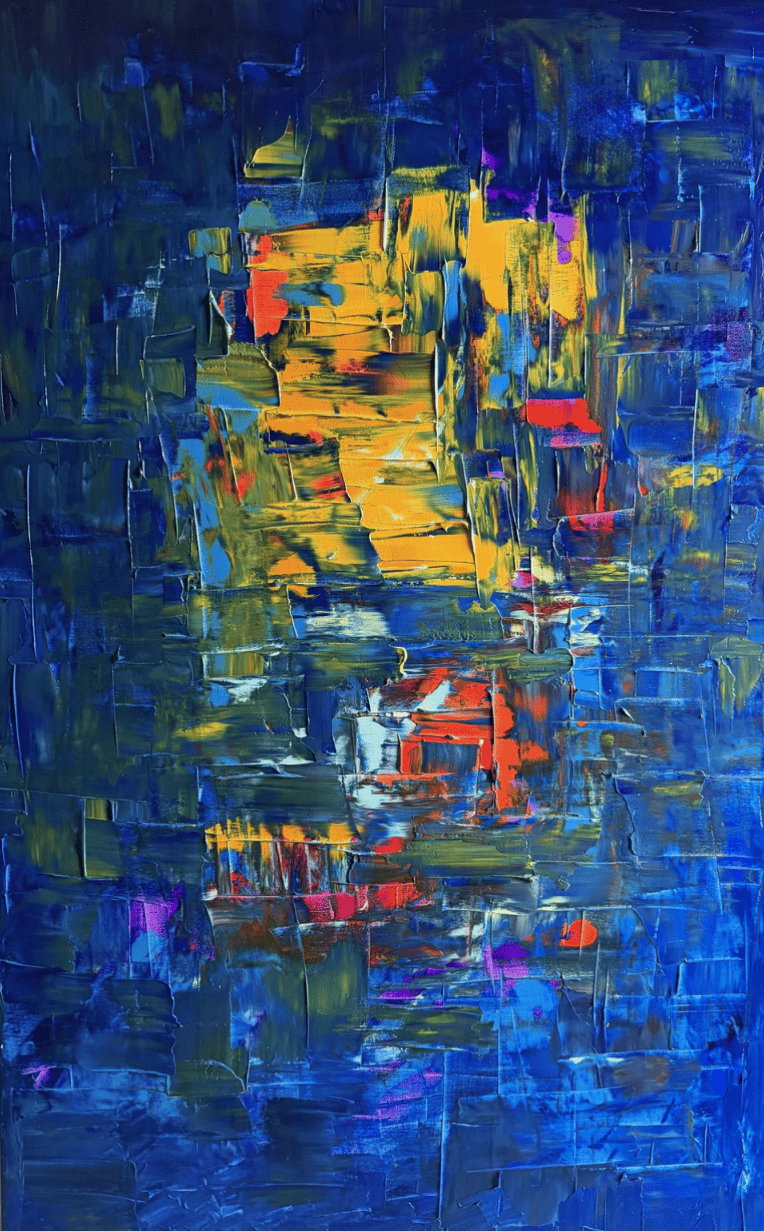
One work that strongly reflects Spadrna’s visual concerns is Índigo Ascent, an acrylic painting on canvas built around a striking relationship between deep blue and a powerful yellow-orange nucleus.
At first encounter, the painting establishes a dramatic chromatic contrast. The deep blue field creates an expansive and contemplative environment, while the yellow-orange center introduces an intense source of warmth and energy. This luminous nucleus appears to rise through the surrounding blue, giving the work a sense of upward movement.
The composition also carries a strong architectural quality. Its construction provides stability and direction, yet the chromatic intensity prevents the image from feeling static. The viewer is drawn toward the central area while simultaneously becoming aware of the surrounding structure.
The title, Índigo Ascent, reinforces this impression of movement. “Ascent” suggests rising, transformation, or passage, while indigo establishes the deep chromatic environment through which this movement takes place. Together, the two ideas create an image that can be read as both physical and psychological.
Rather than depicting a specific building or landscape, the painting seems to construct a space of transition. The yellow-orange nucleus can be understood as a threshold, a source of illumination, or an inner point of emergence. Its meaning remains open, allowing the viewer to bring personal associations to the work.
Painting as a Passage
Spadrna describes his painting as beginning where the visible world starts to lose its certainty. This idea provides an important key to understanding his practice.
His recurring figures, trees, cities, and portals are not intended to tell a single predetermined story. They function instead as traces—remnants of memory, fragments of experience, and manifestations of inner states.
This makes the act of viewing particularly important. The viewer is not simply observing a completed image but participating in its interpretation. A form may suggest a familiar object, while the surrounding abstraction challenges that recognition. Colour may evoke a particular atmosphere without defining it. Texture may recall a physical landscape while simultaneously suggesting something psychological.
In this way, Spadrna leaves room for ambiguity. His paintings do not demand that viewers identify exactly what they are seeing. Instead, they encourage recognition without complete explanation.
An Interior Landscape in Constant Emergence
Miroslav Spadrna’s work occupies a compelling space between the external world and the interior imagination. Through layered surfaces, expressive gestures, architectural structures, and luminous passages, he transforms recognizable elements into something more open-ended.
His paintings are concerned with transition: between abstraction and figuration, darkness and light, structure and dissolution, matter and atmosphere. They suggest that perception is never completely stable and that images can exist somewhere between what is seen, remembered, imagined, and felt.
Índigo Ascent embodies this philosophy through its powerful blue field, rising yellow-orange nucleus, and architectural construction. It demonstrates how Spadrna can use colour and structure to create a visual experience that is both immediate and mysterious.
Ultimately, Spadrna’s paintings do not offer fixed destinations. They offer passages. Their surfaces become spaces through which the viewer can move, discovering fragments of recognizable reality while gradually entering something more personal and elusive.
For Pintorcheco, painting is therefore not simply an act of representing the world. It is a process of moving from matter toward light, from external perception toward an interior landscape, and from certainty toward the possibilities that emerge when certainty begins to dissolve.

