


For Portuguese self-taught artist Sónia Santos e Silva, also known as Nona, art is a way of observing the world and transforming ordinary moments into meaningful visual memories. Her artistic practice is deeply connected to everyday life, personal experiences, places she has encountered, memories she carries, and the emotions and dreams that shape her inner world.
Over the years, Sónia has developed a versatile approach to art, working across a variety of mediums including watercolour, pastels, graphite, charcoal, and acrylics. Rather than limiting herself to one technique or visual language, she enjoys exploring different artistic possibilities and discovering how each medium can express a particular feeling, atmosphere, or moment.
Her journey has also been influenced by the places she has called home. Sónia lived in Macau, China, for two decades, an important chapter of her life that left a lasting impression on her creative perspective. Living in a place with a distinctive cultural identity, architecture, history, and visual character provided her with experiences that naturally became part of her artistic vocabulary.
Today, her work continues to reflect this fascination with the relationship between people and places.
Seeing Stories in Ordinary Places
One of the defining qualities of Sónia’s work is her ability to find artistic inspiration in scenes that might otherwise appear familiar or ordinary. A street, a building, a passing vehicle, a particular colour, or the atmosphere of a summer afternoon can become the starting point for a painting.
For Sónia, these details are not simply visual elements. They can hold memories and emotions. Through expressive lines, carefully observed surroundings, and a thoughtful use of colour, she transforms everyday scenes into personal artistic experiences.
This approach is especially evident in her interest in travel and urban sketching. These practices allow her to observe places closely and capture their individual character through drawing and painting. Instead of simply documenting what she sees, she interprets it through her own artistic perspective, creating works that combine observation with personal expression.
“A Festive Day”: Capturing the Character of Loures
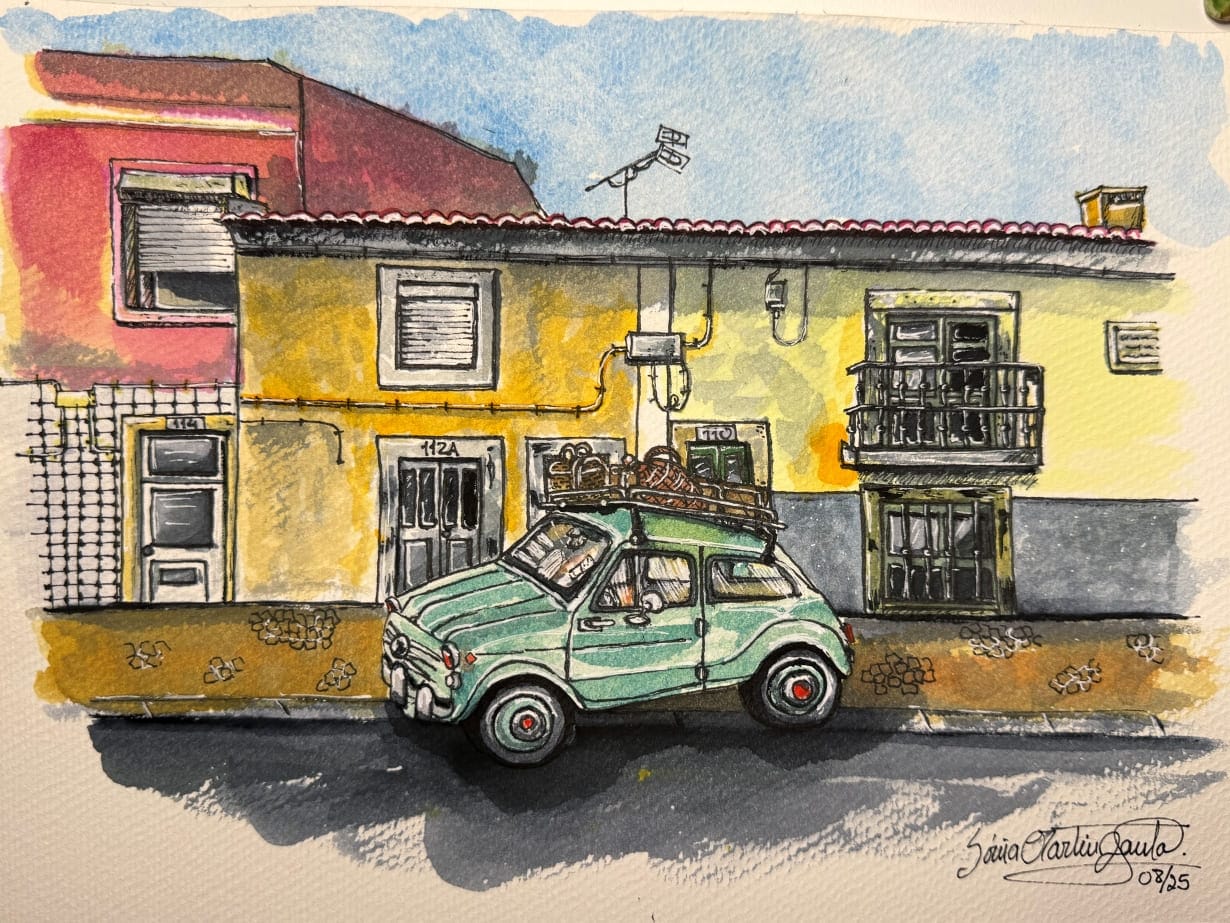
A particularly meaningful example of Sónia’s approach is her watercolour painting “A Festive Day.” The work portrays the main street of Loures, Portugal, during a festive summer day.
The painting brings together several elements that give the street its distinctive personality: colourful façades, traditional architecture, and a charming vintage car. Rather than presenting the location as a static architectural study, Sónia captures the atmosphere of a living community and the visual details that make the scene memorable.
Her expressive lines contribute a sense of movement and spontaneity, while warm and vibrant colours communicate the cheerful character of the occasion. The combination creates an inviting scene that feels both lively and intimate.
There is something particularly powerful about the way familiar places can become artistic memories. The street depicted in “A Festive Day” is not merely a geographical location. Through Sónia’s interpretation, it becomes a moment preserved in time: a summer day, a festive atmosphere, historic architecture, and the small visual details that might otherwise disappear into the flow of everyday life.
The vintage car adds another layer to the composition, contributing a nostalgic quality that connects the present scene with memories of another era. Together, these elements create a painting that celebrates the identity of Loures while remaining deeply personal.
The Language of Watercolour and Expressive Lines
Watercolour is particularly well suited to Sónia’s observational approach. Its fluidity allows her to capture atmosphere while maintaining the immediacy of a sketch. In “A Festive Day,” the medium helps convey the warmth and brightness of the summer setting while allowing the architectural details and expressive marks to remain visible.
Her use of line is equally important. Rather than pursuing an overly rigid or photographic representation, Sónia embraces expressive drawing as part of the character of her work. Lines help define buildings, vehicles, and architectural features while preserving the spontaneity associated with urban sketching.
Colour then becomes a means of communicating mood. Warm tones and vibrant façades contribute to the festive atmosphere, turning the physical environment into an emotional experience.
This balance between observation and interpretation is central to Sónia’s artistic identity.
A Creative Practice Rooted in Exploration
Sónia’s willingness to work across different mediums reflects her continuing curiosity as an artist. Watercolour, pastels, graphite, charcoal, and acrylics each offer different possibilities, and her exploration of these materials allows her to approach subjects from multiple perspectives.
This versatility is also connected to her journey as a self-taught artist. Rather than following a single predetermined path, Sónia continues to develop her visual language through observation, experience, experimentation, and a genuine desire to create.
Her work demonstrates that artistic inspiration does not always need to come from extraordinary subjects. Sometimes, it can be found in a street visited many times, a memory from a journey, the architecture of a town, or a fleeting moment that suddenly captures the imagination.
From Artistic Memory to a New Creative Space
Sónia’s connection with Loures has become even more significant as she works toward opening her own art gallery, Nona Gallery. Remarkably, the gallery will be located on the same street depicted in “A Festive Day.”
This creates a meaningful connection between her artwork and her developing artistic future. The street represented in the painting is not simply a subject from the past; it is becoming part of the physical setting in which Sónia will share her work with others.
Nona Gallery represents another step in her creative journey, offering the possibility of bringing her artistic world closer to the community and the places that inspire her. It also reflects the evolution of an artist whose practice has always been connected to observation, memory, place, and human experience.
Art as a Connection Between Inner and Outer Worlds
At the heart of Sónia Santos e Silva’s work is a desire to create intimate and inspiring pieces that connect viewers with both her inner world and the world around them.
Her paintings invite viewers to slow down and notice what is often overlooked: the colours of a familiar street, the character of traditional architecture, the atmosphere of a particular day, or the emotional significance of an ordinary moment.
Through her art, Sónia demonstrates that everyday life can contain extraordinary beauty when viewed with attention and sensitivity. Her experience of living in different cultural environments, her love of travel and urban sketching, and her exploration of multiple artistic mediums have all contributed to a practice grounded in curiosity and personal expression.
“A Festive Day” captures this philosophy beautifully. It is a celebration of Loures, but it is also a celebration of memory, observation, and the simple joy of noticing a place as it truly feels.
As Sónia continues developing her artistic practice and prepares to open Nona Gallery, her work remains a reminder that inspiration can be found almost anywhere. A familiar street can become a treasured memory, a passing moment can become a painting, and an ordinary place can become the beginning of an entirely new chapter.

