


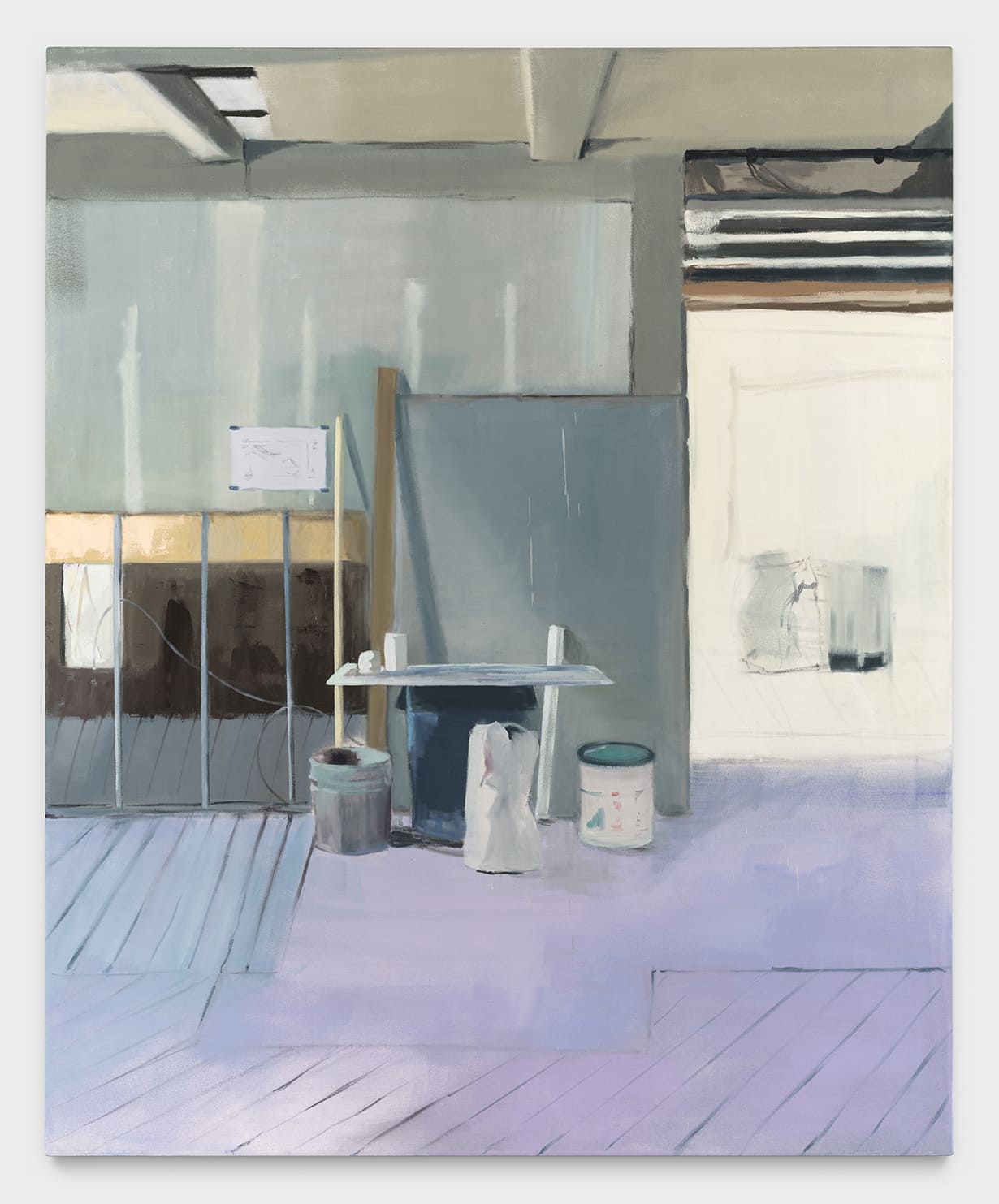
Noa Charuvi is a contemporary visual artist living and working in Brooklyn, New York. Known for her evocative paintings that explore space, light, and atmosphere, Charuvi has built a practice that examines the quiet beauty of everyday environments. Through subtle shifts in color, loose brushwork, and carefully observed compositions, she transforms ordinary scenes into poetic visual experiences.
Charuvi received her Master of Fine Arts in Fine Arts from the School of Visual Arts in New York, an institution widely recognized for nurturing influential contemporary artists. Prior to that, she earned her Bachelor of Fine Arts from the Bezalel Academy of Arts and Design in Jerusalem, Israel, one of the most prestigious art schools in the region. Her education across two culturally rich art centers helped shape a practice that blends observation with expressive interpretation.
Living in Brooklyn places Charuvi at the heart of one of the most dynamic artistic communities in the world. The city’s architecture, interiors, and constant transformation provide an ongoing source of visual inspiration. Her work reflects a sensitivity to how environments evolve over time and how light interacts with the surfaces of everyday spaces.
International Exhibitions and Recognition
Over the years, Charuvi’s paintings have been exhibited internationally in prominent museums and art institutions. Her work has been presented at venues such as the Bronx Museum of the Arts in New York, an institution known for championing contemporary artists and diverse voices. She has also exhibited in Israel at the Haifa Museum of Art and the Mishkan Museum of Art in Ein Harod.
These exhibitions demonstrate the global reach of her practice and highlight the universal resonance of her subject matter. Although her paintings often depict very specific environments, the feelings they evoke stillness, quiet transformation, and contemplation transcend geographic boundaries.
In 2018, Charuvi was awarded a grant from the Pollock-Krasner Foundation, a prestigious organization that supports artists of exceptional ability. This recognition affirmed the significance of her evolving practice and provided further opportunities for her to expand her work.
Her paintings have also been included in the 2019 publication Landscape Painting Now, an anthology dedicated to contemporary interpretations of landscape painting. The inclusion of Charuvi’s work in this volume underscores how her approach to painting redefines the concept of landscape by exploring interior spaces and constructed environments as sites of visual exploration.
A Painterly Exploration of Space and Light
At the core of Charuvi’s artistic practice is a fascination with light and its ability to transform ordinary spaces. Her paintings frequently depict interiors, architectural environments, and transitional spaces that are often overlooked but rich with visual potential.
Rather than presenting highly detailed or photorealistic scenes, Charuvi uses loose brushwork and softened edges to create an atmosphere of ambiguity. Forms dissolve slightly into one another, allowing the viewer to experience the painting not only as a depiction of space but also as a sensory impression.
This painterly approach emphasizes the emotional and atmospheric qualities of a place. Light becomes a central character within the composition, illuminating surfaces, casting subtle reflections, and shaping the overall mood of the scene.
Through this method, Charuvi invites viewers to slow down and reconsider familiar environments. What might initially appear as a simple room, corridor, or architectural fragment gradually reveals layers of visual complexity and emotional depth.
The Painting “Purple Room”
One of Charuvi’s recent works, Purple Room (2025), exemplifies many of the themes that run through her artistic practice. The large-scale oil painting, measuring 54 by 66 inches, depicts the interior of an apartment undergoing renovations in downtown Manhattan.
At first glance, the room appears sparse and unfinished. The space is largely empty, with only a few scattered objects resting on the floor and a makeshift table suggesting temporary use. Dusty surfaces, whitewashed walls, and construction debris evoke a site in transition, an environment caught between demolition and renewal.
What initially drew the artist’s attention, however, was not the renovation itself but the way light filled the room. Bright sunlight filters through the space, diffused by dust and pale surfaces, creating a soft luminosity that transforms the unfinished interior into something unexpectedly beautiful.
Charuvi captures this effect through expressive brushwork and nuanced color choices. The surfaces of the room shimmer with subtle tonal variations, and the dominant purple hues introduce a surreal quality to the scene. The color palette shifts the viewer’s perception, turning an otherwise mundane construction site into a dreamlike environment.
Atmosphere and Abstraction
In Purple Room, Charuvi deliberately avoids rigid outlines or precise architectural detail. Instead, she allows the edges of objects and walls to blur slightly into the surrounding space. This softness gives the painting an elusive quality, as though the scene exists somewhere between memory and observation.
The loose brushwork reinforces the sense of impermanence inherent in a renovation site. Walls may soon be repainted, objects moved, and the space transformed entirely. By capturing the room in this transitional moment, Charuvi preserves a fleeting visual experience that might otherwise go unnoticed.
The painting also reveals the artist’s ability to balance representation with abstraction. While the viewer can clearly recognize the room and its contents, the expressive brushstrokes and unconventional color choices introduce a layer of interpretation. The result is a composition that feels both grounded in reality and open to imaginative reading.
Transforming the Ordinary
A defining quality of Charuvi’s work is her ability to discover beauty in places that might otherwise seem unremarkable. Construction sites, empty interiors, and quiet architectural spaces become sources of visual intrigue in her paintings.
In Purple Room, the dusty surfaces and scattered objects initially suggest disorder or neglect. Yet through the artist’s use of light and color, the space becomes almost ethereal. The painting demonstrates how perception can shift when attention is focused on atmosphere and sensory experience rather than on conventional ideas of beauty.
This transformation of the ordinary into something poetic is central to Charuvi’s artistic philosophy. Her work encourages viewers to reconsider the environments they inhabit daily and to notice the subtle interplay of light, color, and space that often goes unseen.
Continuing Exploration in Contemporary Painting
Noa Charuvi’s paintings contribute to a broader conversation within contemporary art about how landscapes and environments are represented. Rather than depicting traditional outdoor vistas, she often turns inward to architectural and domestic spaces, expanding the definition of landscape painting itself.
Her work stands at the intersection of observation and interpretation, blending real environments with painterly expression. By emphasizing atmosphere and light, she creates images that feel both intimate and expansive.
As Charuvi continues to develop her practice in Brooklyn, her paintings remain grounded in a deep attentiveness to everyday surroundings. Whether portraying a quiet interior, an evolving architectural space, or a moment of shifting light, her work reveals the hidden poetry of the environments we often overlook.
Through paintings like Purple Room, Charuvi reminds us that even the most ordinary places can become extraordinary when seen through the attentive eye of an artist.

