


Antonio Godinez Roa was born in 1948 in Cartagena, Spain, a historic Mediterranean port city whose layered past and vibrant cultural identity would quietly shape his creative sensibilities. Growing up in a place where ancient history, architecture, and the sea coexist, Antonio developed an early awareness of rhythm, both visual and auditory. The geometry of old streets, the cadence of daily life, and the cultural pulse of Spain formed the backdrop of his formative years.
His entry into the arts began not with paint, but with percussion. In 1963, as a teenager, he embarked on his artistic journey through music, performing as a drummer in bands of that era. The 1960s were a time of global cultural transformation, and music was its driving force. Antonio immersed himself fully in this world, embracing the physicality and discipline of rhythm. Drumming was not simply a performance for him. It was structure, timing, energy, and emotion translated into sound.
A Life Shaped by Music and Movement
Through music, Antonio traveled extensively across much of the world. These journeys broadened his artistic horizons and exposed him to diverse cultures, artistic movements, and creative philosophies. During this vibrant chapter of his life, he even had the opportunity to meet figures such as Paul McCartney, an encounter symbolic of the dynamic musical era in which he was immersed.
Touring and performing cultivated in Antonio a deep understanding of tempo, improvisation, and emotional expression. These qualities would later resurface in his painting practice. Music trained him to sense tension and release, harmony and contrast, spontaneity and control. In many ways, his later visual works echo the sensibilities of a seasoned musician, compositions unfolding like symphonies of color and gesture.
Yet even while he traveled the world with his drums, another artistic calling quietly matured within him. Painting was not an abrupt change of direction, but rather a natural progression. His father’s vocation in the field of painting served as a powerful influence. The presence of art in his family life provided both inspiration and a sense of continuity. Visual expression was already woven into his personal history.
Transition to Painting: A Natural Evolution
Gradually, Antonio moved into painting, discovering that his visual language could express what rhythm alone could not. The shift from sound to canvas did not mean abandoning music. Instead, it marked the expansion of his artistic vocabulary. The sensibility of a musician translated into brushstrokes. Movement became gesture. Rhythm became composition.
In 1978, Antonio held his first exhibition in Madrid. This milestone confirmed his commitment to painting as a serious and enduring pursuit. From that point onward, he developed both music and painting simultaneously, maintaining a dual creative identity that continues to define his practice today.
Balancing two disciplines requires rare dedication. Antonio’s career demonstrates that creativity need not be confined to a single medium. For him, music and painting are not separate paths but interconnected forms of expression. One feeds the other. The emotional resonance of a drumbeat may find its echo in a bold stroke of acrylic. The silence of a canvas may carry the memory of rhythm.
Abstract Expressionism as Personal Language
Antonio Godinez Roa’s work aligns with the spirit of Abstract Expressionism, a movement defined by emotional intensity, gestural freedom, and the prioritization of inner experience over literal representation. In his paintings, form dissolves into energy. Color becomes a vehicle for feeling rather than depiction. Structure emerges from movement rather than rigid design.
This approach reflects both his musical background and his philosophical outlook. Abstract Expressionism allows him to communicate instinctively. It invites viewers to engage emotionally rather than intellectually. There are no prescribed narratives, only sensations, vibrations of color that resonate like chords.
His canvases often feel alive with motion. Layers of paint interact dynamically, suggesting improvisation while retaining compositional balance. Just as a drummer must hold the rhythm steady while exploring variation, Antonio navigates the tension between spontaneity and control.
Remembering Vitruvius (2025)
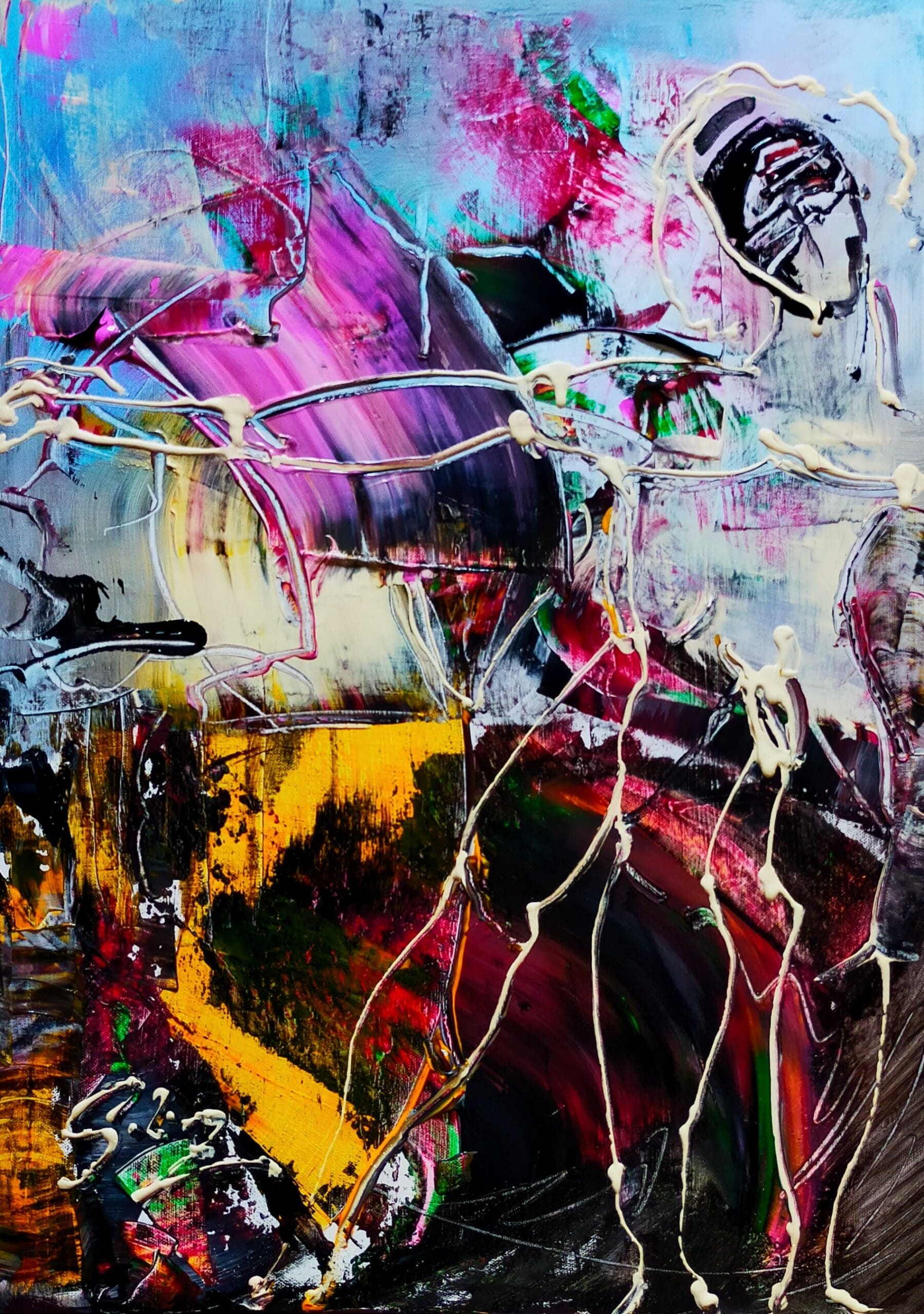
One of his works, Remembering Vitruvius (2025), exemplifies this mature synthesis of structure and expression. Executed in acrylic on canvas and measuring 70 x 50 cm, the piece embodies the essence of Abstract Expressionism while engaging conceptually with classical thought.
The title references the ancient Roman architect and theorist Vitruvius, whose writings on proportion and harmony profoundly influenced Western art and architecture. By invoking Vitruvius, Antonio bridges antiquity and modern abstraction. Rather than illustrating classical ideals directly, he reinterprets them through gesture and color.
In Remembering Vitruvius, geometry does not appear as rigid lines but as underlying balance. There is an invisible architecture within the composition, a subtle equilibrium that holds the dynamic brushwork together. The painting feels both free and grounded, chaotic yet ordered. This duality mirrors Vitruvius’s own principles of harmony and proportion, reimagined through contemporary abstraction.
The use of acrylic enhances immediacy. Acrylic paint, with its quick drying time and vibrant pigmentation, allows Antonio to work intuitively and responsively. Each layer builds upon the previous one, creating depth and texture. The surface becomes a field of emotional and intellectual interplay.
Rhythm, Memory, and Continuity
What makes Antonio Godinez Roa’s artistic journey particularly compelling is its continuity. Since 1963, he has remained devoted to creative expression, first through drums, then through paint, and ultimately through the dialogue between both. Few artists sustain such long-term engagement across disciplines while maintaining authenticity.
His work reflects a life lived in motion, traveling, performing, exhibiting, evolving. Yet beneath this movement lies a consistent core, an enduring commitment to exploration. From his first exhibition in Madrid in 1978 to his present-day practice, Antonio has embraced transformation without losing his artistic identity.
In many ways, his paintings can be understood as visual compositions. They carry echoes of stage lights, distant cities, and resonant beats. They also carry the quiet influence of his father’s vocation, anchoring his work in personal heritage.
An Ongoing Creative Journey
Now, decades after his beginnings in Cartagena, Antonio continues to create with the same vitality that marked his youth. His art stands as testimony to the idea that creativity does not diminish with time. It deepens. Experience enriches expression. Memory becomes material.
Through works like Remembering Vitruvius, Antonio Godinez Roa invites viewers to reflect on balance, between past and present, sound and silence, order and spontaneity. His life demonstrates that artistic evolution is not a departure from origins but an expansion of them.
From the rhythm of a drum to the rhythm of a brushstroke, his journey reveals a singular truth. Art, in all its forms, is a continuous act of remembering and reimagining.

