


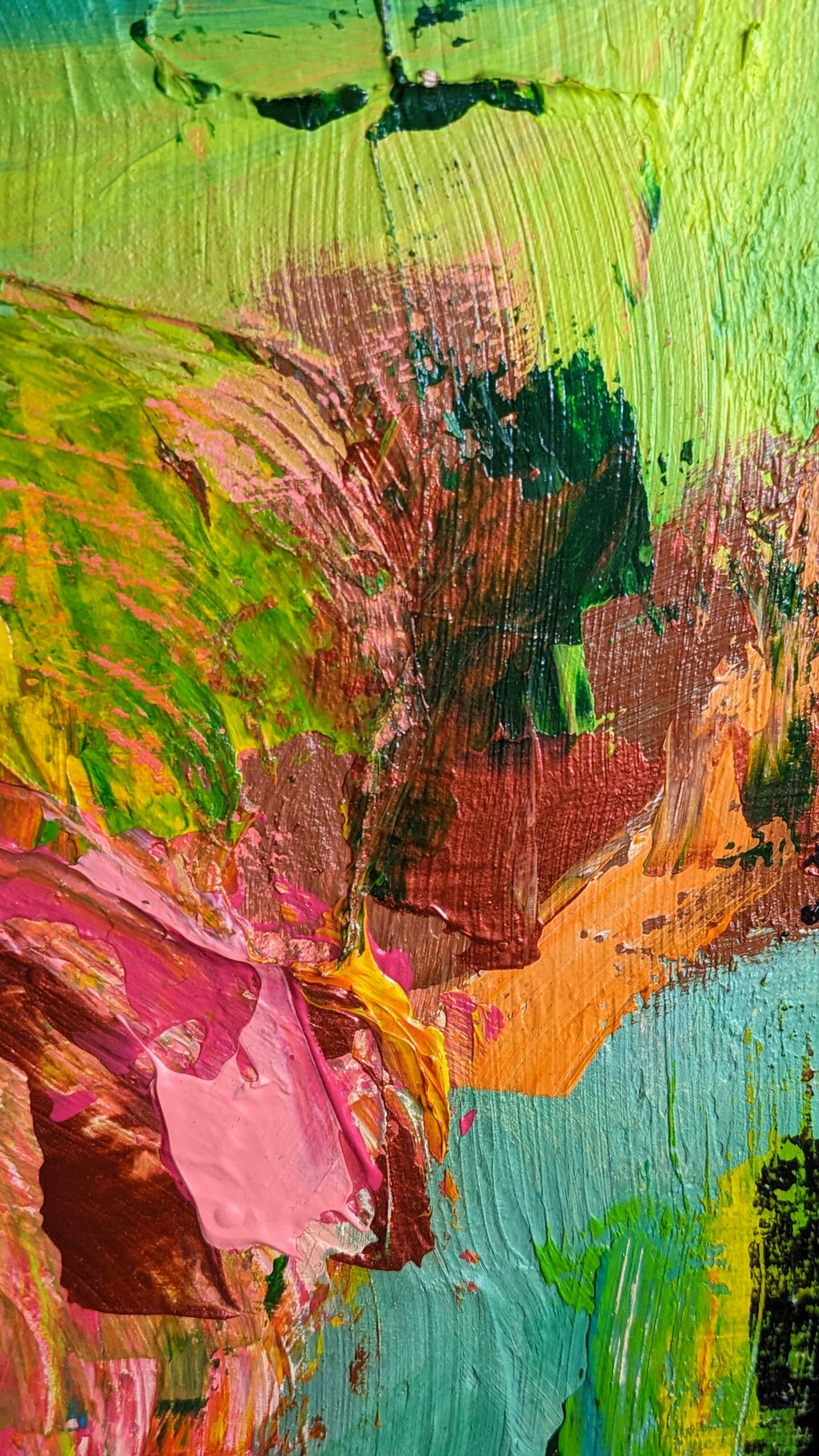
Marcele Silvina’s story is one of resilience, discovery, and transformation. As an autistic artist who spent much of her life undiagnosed, Marcele navigated the world feeling different without always having the language to explain why. Like many autistic women whose traits can be misunderstood or overlooked, she learned to adapt, mask, and push through challenges that others could not see. Yet beneath those struggles lived a deep well of creativity that would eventually become her anchor.
From an early age, art offered Marcele something the world often did not: clarity, safety, and a sense of control. Colors, textures, and forms became a vocabulary for emotions that were otherwise difficult to express. What began as a personal refuge gradually evolved into a life path. Today, Marcele not only creates art but also uses it as a tool for advocacy, community building, and empowerment.
Her journey toward diagnosis later in life reframed her past experiences. Instead of seeing her differences as shortcomings, she began to understand them as part of her unique perception. Art, she realized, had not only helped her survive but had helped her understand herself. It gave her direction, purpose, and a way to transform internal complexity into visual language.
Art as a Lifeline
For Marcele, art is more than a profession or hobby; it is a lifeline. She often speaks about how art saved her during times of confusion and emotional overload. The act of creating allowed her to regulate feelings, process experiences, and communicate without the pressure of conventional social rules.
On her Instagram page thoughts_art_poem, she shares both her artworks and reflections on her lived experience as an autistic woman. Her platform is not curated for perfection but for honesty. She opens conversations about neurodiversity, mental health, and identity, helping followers feel less alone in their own journeys.
This openness resonates with many people, both neurodivergent and neurotypical, because it speaks to a universal truth. Creativity can be healing. Through her posts, Marcele shows that art is not only about aesthetics; it is about survival, self-acceptance, and growth.
Building Visibility for Others
While many artists focus solely on their own careers, Marcele has expanded her role into that of an organizer and curator. She actively works to give visibility to autistic and disabled artists, recognizing how often their talents are overlooked in mainstream spaces.
She organizes events and initiatives that center artists on the spectrum, creating environments where they can showcase their work without pressure to conform to traditional norms. These spaces are not only about exposure but also about safety, understanding, and mutual support.
Her recent work as an art curator for a Daisy-Chain event in Guildford reflects this commitment. By curating and supporting exhibitions, she helps ensure that neurodivergent voices are included in cultural conversations. For Marcele, representation is not a trend but a necessity. She understands firsthand how life-changing it can be to feel seen.
Evoking Connections: A Community-Centered Vision
One of Marcele’s most meaningful initiatives is her project Evoking Connections. The name itself captures her philosophy that art should connect people, emotions, and experiences. The project provides opportunities for artists on the autism spectrum to present their work, gain confidence, and develop their artistic gifts.
Evoking Connections is not just about exhibitions; it is about nurturing potential. Many neurodivergent artists struggle with access to networks, resources, or inclusive platforms. Marcele’s project helps bridge that gap. She creates supportive contexts where artists can grow without feeling pressured to fit into rigid industry expectations.
Through this initiative, Marcele shifts the narrative around disability and art. Instead of framing neurodivergence as a limitation, she highlights it as a source of perspective, originality, and depth. The project celebrates difference as a creative strength.
The Language of Abstraction
Marcele’s own artistic practice centers on abstract art, a form that aligns naturally with her inner world. Her philosophy on abstraction is thoughtful and layered.
Abstract art culture lives between what is seen and what is felt. It holds contradictions such as order beside chaos and silence beside noise. Rather than delivering clear answers, it invites questions. Rather than telling a story, it opens space for many stories.
She believes the viewer is not passive but active. Each person completes the work through memory, emotion, and personal bias. Two people can look at the same piece and experience entirely different meanings. That openness is not a flaw but the point.
Abstract art does not explain the world; it mirrors its instability. Life is rarely linear or easily explained. It is layered, unpredictable, and full of contrasts. Her work embraces that reality instead of simplifying it.
Duality at the Core
Duality sits at the heart of Marcele’s artistic culture. Light and dark, calm and intensity, structure and fluidity coexist in her work. This reflects both the external world and her internal experience. Living as an autistic person in a predominantly neurotypical society often involves navigating dual realities: the inner self and the outer mask, the authentic response and the socially expected one.
Her art becomes a space where those dualities do not need to be resolved. They can simply exist. In that sense, her work offers freedom not only for herself but also for viewers who recognize their own contradictions within it.
Art With Purpose
What makes Marcele Silvina’s journey especially compelling is the integration of art and advocacy. She does not separate her identity from her practice. Instead, she allows her lived experience to inform her work, her projects, and her community efforts.
Her story challenges common myths that art must follow strict rules, that disability limits creativity, or that success must look a certain way. She demonstrates that purpose-driven art can be both deeply personal and socially impactful.
By sharing her story, organizing events, and uplifting other artists, Marcele extends the meaning of her work beyond the canvas. She builds networks, fosters understanding, and encourages others to embrace their differences.
A Continuing Evolution
Marcele Silvina’s path is still unfolding. As she continues to create, curate, and connect, her impact grows. She represents a generation of artists who see creativity not only as self-expression but also as community care.
Her journey reminds us that art can be a compass when life feels disorienting. It can offer direction when words fail. And perhaps most importantly, it can connect people across differences.
In Marcele’s world, art is not about fitting in; it is about opening up. Through that openness, she helps others find visibility, confidence, and voice. Her work stands as a testament to the power of creativity to shape identity, build community, and transform challenge into meaning.

