


Antonie Josefa Latscha was born in a small town in the north of Czech Republic, where her connection to art began early and deeply. As a child, she was drawn to drawing and painting as a natural way to express what she felt and observed around her. Paper and color were not simply hobbies for her; they were a language. Through art, she could explore emotions, landscapes, and inner worlds that words could not fully capture.
Her early artistic path was not without obstacles. Growing up under a communist regime meant facing strict external limitations. One of the most significant restrictions she encountered was the prohibition against studying art formally. For many, such barriers might have discouraged creative ambitions. For Latscha, they had the opposite effect. Her passion for painting did not fade; instead, it quietly intensified. Art became both a personal refuge and a subtle form of resistance, a way to maintain individuality and inner freedom in a constrained environment.
A Turning Point: Flight and Renewal
A decisive moment in her life came in 1980, when she fled to Switzerland. This move was not only geographical but also symbolic. It marked a transition from restriction to possibility and from limitation to exploration. In Switzerland, she was finally able to nurture her artistic interests more openly.
Rather than following a single rigid academic path, Latscha chose a more organic route. She continued her education over the years by learning from various artists and absorbing different perspectives, techniques, and philosophies. This diverse and informal education allowed her to develop a voice that was truly her own, rather than one shaped by a single school or trend.
Over time, she built a life centered on art. For more than 15 years, she has worked as a freelance artist, dedicating herself fully to her practice. Her works have found homes far beyond her immediate surroundings and are now held in Switzerland, Germany, Czech Republic, Australia, and the United States. This international presence speaks to the universal resonance of her visual language.
Creating from Feeling and Chance
At the core of Latscha’s work is a creative approach guided by feeling and chance. She does not begin with a fixed plan or a rigid concept. Instead, she allows intuition to lead the process. This openness creates space for spontaneity, surprise, and authenticity.
Her paintings often evolve organically. A color, a gesture, or a texture may suggest the next step. Rather than forcing the work toward a predetermined result, she listens to what the painting seems to ask for. This dialogue between artist and artwork is central to her process.
Such an approach requires trust in her own instincts and in the process itself. The result is a body of work that feels powerful and honest. Viewers often sense that these paintings are not manufactured or over-calculated, but lived through. They carry traces of decisions, revisions, and discoveries made along the way.
Between Landscape and Abstraction
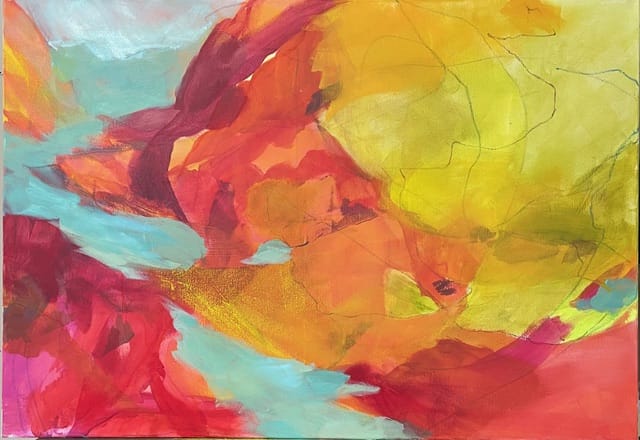
One of the defining characteristics of Latscha’s art is her exploration of the space between landscape and abstraction. She is strongly inspired by nature, yet she does not aim to reproduce it realistically. Instead, she translates natural impressions into a visual language that balances recognition and mystery.
Her landscapes are not based on direct observation, sketches, or specific real-life models. They emerge during the act of painting itself. Memories of walks, travels, and flights, including fleeting impressions of horizons, fields, skies, and shifting light, settle somewhere in her mind. Later, these impressions resurface unconsciously on the canvas.
Because of this, her works often feel familiar yet undefined. A viewer might sense a horizon line, a misty valley, or an expanse of sky, but nothing is fixed or literal. The paintings exist in a space between memory and imagination. They suggest rather than describe.
This balance between landscape and abstraction also reflects her openness to the unknown and unpredictable. She does not try to control every outcome. Instead, she welcomes unexpected marks and evolving forms as part of the creative journey.
Layering, Depth, and Complexity
Technically, Latscha’s work is characterized by layering and reworking. She builds her paintings gradually, adding and sometimes removing elements. Layers of pigment, pastel chalk, and ink interact on the canvas, creating surfaces rich in texture and nuance. More recently, she has also incorporated oil paints into her practice, expanding her range of possibilities.
This layered process gives her works a sense of depth, both visually and conceptually. What the viewer sees on the surface is often only the final stage of a longer history hidden underneath. Earlier marks may be partially concealed, yet they continue to influence the overall atmosphere of the piece.
Such complexity invites slow looking. Her paintings are not images to be consumed in a glance. They reveal themselves over time, as the eye wanders through subtle transitions of color, traces of lines, and delicate shifts in tone.
Art as Dialogue
For Latscha, creating art is not just about producing objects; it is about initiating a dialogue. Each painting becomes a meeting point between her inner world and the viewer’s perception. She deliberately leaves room for interpretation, allowing others to bring their own memories, emotions, and associations to the work.
This idea is especially clear in her decision not to title her works. By avoiding titles, she resists directing the viewer toward a single meaning. Instead, she invites each person to discover a personal landscape or image within the painting.
In today’s art world, which can sometimes feel overly conceptualized or heavily explained, this openness is refreshing. Many people appreciate the freedom her works offer and the permission to feel rather than analyze, to experience rather than decode.
Work No. 368: A Glimpse into Her Current Exploration
Work No. 368 (100 x 70 cm) reflects her current exploration of landscape painting. Like much of her work, it was not planned in detail beforehand. It grew from impressions stored in memory and from the interaction between materials and intuition.
In this piece, viewers may sense echoes of distant horizons or atmospheric spaces, yet nothing is explicitly defined. The painting becomes a field of possibility. Each viewer might see something different, such as a memory of a journey, a quiet natural scene, or a purely emotional landscape.
Her preferred materials, including pigments, pastel chalks, ink, and increasingly oils, contribute to the tactile and layered quality of the work. The surface carries the history of its making and invites viewers to look closely and immerse themselves.
A Quiet but Lasting Presence
Antonie Josefa Latscha’s artistic journey is one of persistence, freedom, and trust in intuition. From a childhood shaped by political restriction to a mature career spanning multiple countries, her path reflects resilience and dedication.
Her paintings do not shout; they resonate quietly. They offer space to pause, to feel, and to reflect. In a fast and noisy world, this quality gives her work a particular relevance. It reminds us that art can still be a place of openness, dialogue, and personal discovery.
Through her landscapes that are not quite landscapes and her abstractions that still echo nature, Latscha continues to explore the delicate territory between the seen and the felt. In doing so, she invites us to explore it with her.

