


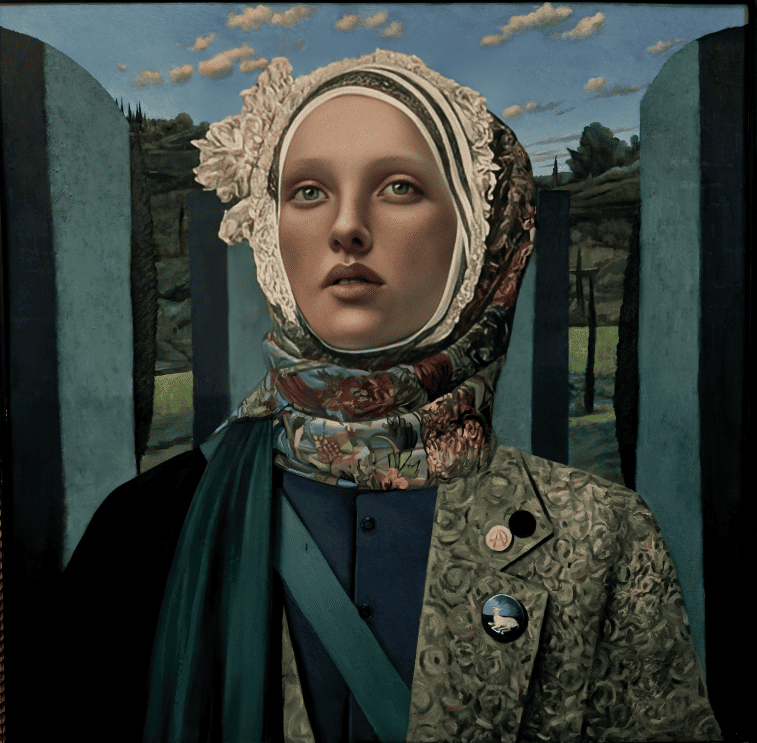
Neil David Field-Williams FRSA is a British artist whose work investigates structure, order, and contemporary meaning through what he defines as a Neo-Formalist lens. His practice stands at the intersection of classical visual discipline and present-day cultural questioning. With roots in the Bristol street-art scene and decades of experience in education, Field-Williams has developed an approach that is both intellectually grounded and visually precise. His art does not simply present images; it invites viewers to examine how meaning is built, maintained, and sometimes destabilized.
Field-Williams belongs to a generation of artists shaped by rapid social change, shifting cultural values, and evolving visual languages. His work reflects a sustained inquiry into how systems of order operate within art and society. Across painting, public commissions, and conceptual frameworks, he explores the tension between stability and fragility, between inherited forms and contemporary uncertainty.
From Street Art to Structured Inquiry
Field-Williams emerged from the Bristol street-art culture of the late 1980s and early 1990s, a time when urban art served as a direct and often urgent form of communication. The Bristol scene was known for its energy, political undertones, and strong visual presence in public space. For many artists, it was a platform for resistance and identity. For Field-Williams, it also became a training ground in clarity, composition, and audience engagement.
Street art requires immediacy. It speaks to people who may encounter a work for only a moment. This demand for direct visual address helped shape his sensitivity to structure and impact. Even as his practice moved toward more formal studio work, the awareness of public dialogue remained central. His art continues to communicate with viewers rather than isolate itself within purely private or academic discourse.
This early exposure to public space also cultivated an understanding of art as part of lived environments. Rather than viewing art as separate from society, Field-Williams sees it as embedded within social frameworks, cultural narratives, and civic life.
Education, Metacognition, and Creative Method
Alongside his artistic career, Field-Williams has spent nearly four decades working within UK education. He has also lectured and led classes internationally, sharing his knowledge across cultural contexts. This long engagement with learning deeply informs his artistic philosophy.
His approach to making art is methodical yet exploratory. He emphasizes metacognitive thinking, encouraging awareness of one’s own thought processes during creation. In practice, this means understanding not only what decisions are made in a work, but why they are made. This reflective process fosters clarity and intentionality.
Field-Williams promotes creative initiative through step-by-step development. Rather than relying solely on intuition, he integrates analysis, structure, and revision. This does not limit creativity; instead, it provides a framework that allows ideas to evolve with coherence. For him, discipline and imagination are not opposites but partners.
His dual role as educator and artist creates a feedback loop. Teaching refines his articulation of ideas, while studio practice keeps his thinking dynamic and grounded in experience.
The Neo-Formalist Framework
Field-Williams is the initiator of the Neo-Formalist group, a platform that advances renewed relationships between classical construction and contemporary cultural uncertainty. Neo-Formalism does not simply return to historical forms; it reconsiders them in light of present realities.
Classical construction in art often implies balance, proportion, and harmony. Neo-Formalism acknowledges these qualities but places them within a world marked by instability and shifting meaning. In this framework, order is not assumed to be permanent. Instead, it becomes something examined, tested, and sometimes revealed as fragile.
By aligning himself with international think tanks and founding creative platforms, Field-Williams positions Neo-Formalism as both artistic and intellectual inquiry. It is not only about how art looks but how it thinks. It asks how visual structure can respond to cultural ambiguity and how tradition can coexist with uncertainty.
Civic Engagement and Public Legacy
Field-Williams’ commissioned civic works demonstrate his commitment to place and public dialogue. Notable among these are the Gates and Clocktower of Haverhill. Such works carry symbolic weight: gates mark thresholds, and clocktowers represent time, continuity, and shared reference points.
Through these commissions, Field-Williams engages with collective memory and civic identity. Public artworks must resonate with diverse audiences and endure beyond short-term trends. They require sensitivity to context, history, and community.
His focus on legacy does not suggest nostalgia. Rather, it reflects a belief that art contributes to the cultural fabric of a place. Public works become markers of shared experience, linking personal perception with communal space.
After Arcadia: The Fragility of Assumptions
A compelling example of Field-Williams’ conceptual direction is the painting After Arcadia, part of the 2026 series The Fragility of Assumptions. Set within the Acadian landscape, the work presents a scene that appears ordered and timeless. Yet this sense of stability is quietly unsettled.
At the center of the composition is Deya, a figure who occupies a space that feels both grounded and uncertain. The environment suggests harmony, but subtle cues indicate instability. This tension reflects Field-Williams’ interest in how authority and identity are constructed.
The painting examines the narratives we inherit about ideal places, ideal systems, and ideal selves. Arcadia traditionally symbolizes pastoral perfection and balance. By placing his subject after Arcadia, Field-Williams signals a moment beyond idealization, where inherited assumptions no longer fully hold.
Beneath the calm surface, the work proposes a contemporary condition shaped by uncertainty and the possibility of rupture. It does not declare collapse but hints at vulnerability. The viewer is invited to question what appears secure and to consider how identities are maintained within fragile frameworks.
A Practice Rooted in Reflection
What distinguishes Field-Williams is his sustained commitment to reflection. His career spans street culture, formal art discourse, education, and civic engagement. Rather than moving in a straight line, his path forms a layered practice where each experience informs the others.
His Neo-Formalist perspective offers a way to think about art in a complex world. It values structure while acknowledging instability. It respects tradition without being confined by it. It invites viewers to look closely, think critically, and remain aware of the assumptions shaping perception.
In a cultural moment often driven by speed and surface, Field-Williams’ work encourages depth and deliberation. His art asks not only what we see, but how we understand what we see. It suggests that meaning is constructed, not given, and that order itself can be a subject of inquiry.

