


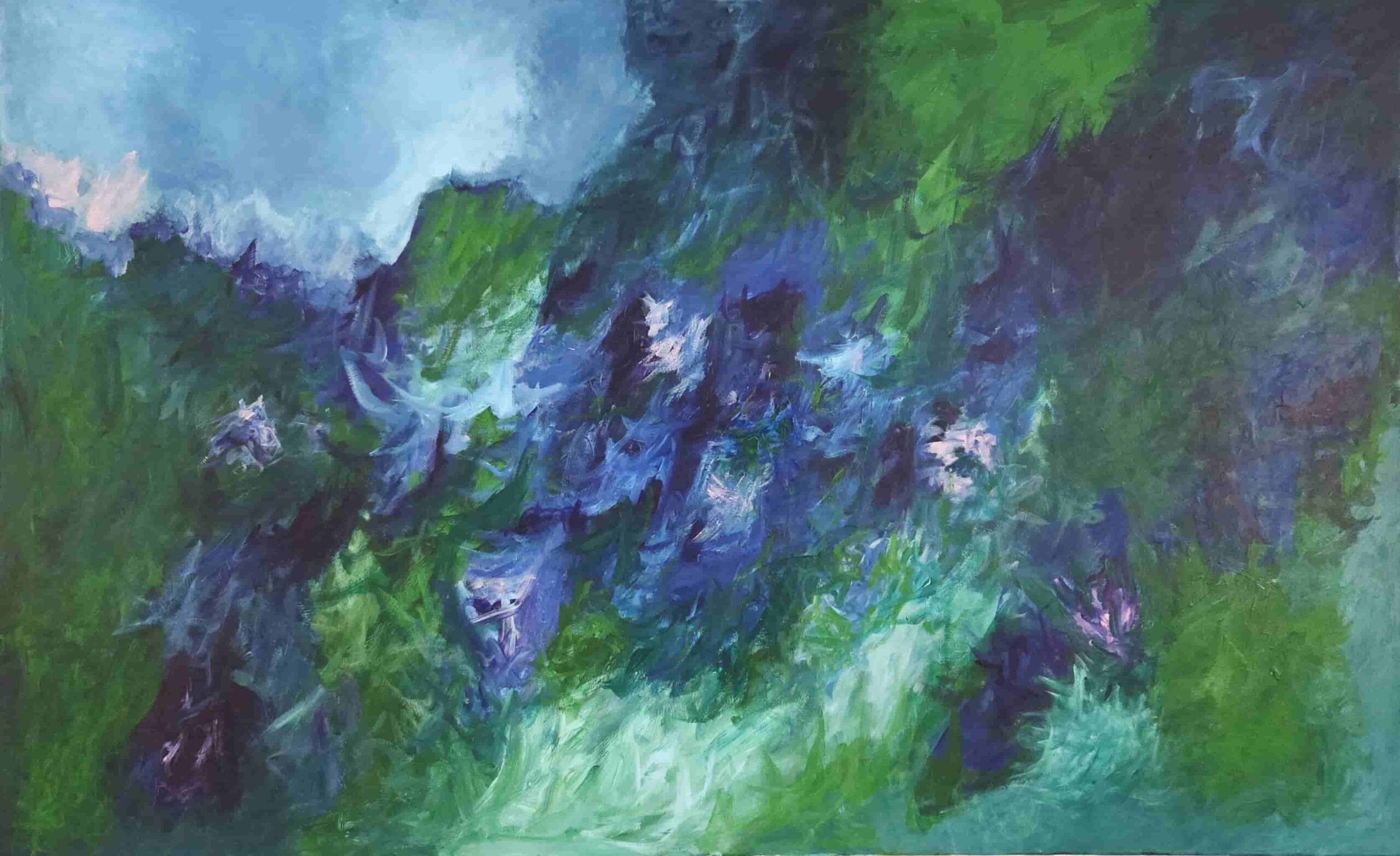
Ines Rosenholm was born in 1974 in a small village in the south of Germany, a setting that would quietly but powerfully shape the course of her creative life. Surrounded by forests, rolling hills, open meadows, and the gentle presence of a nearby river, her childhood unfolded in close dialogue with nature. These early experiences were not simply pleasant memories. They formed a deep, ongoing relationship with the natural world that continues to inform her art today.
As a child, Rosenholm spent much of her time outdoors, absorbing the subtle moods of the landscape, the changing light in the forest, the textures of grass and leaves, and the feeling of space and silence. Nature was not a backdrop but a living presence. It offered freedom, refuge, and a sense of connection. Even now, she describes these places as the environments where she feels most at home. It is therefore no surprise that nature remains the greatest source of inspiration in her artistic practice.
Yet her connection to the world was never only visual. From an early age, she felt a strong need to express herself, to translate inner experiences into outward forms. This urge toward expression would lead her first to the stage and later to the canvas, but the underlying impulse remained the same: to explore and communicate the inner life.
From Stage to Canvas: A Life of Expression
Before fully embracing painting, Rosenholm found her voice in performance. She began acting in school and discovered in theater a powerful channel for storytelling and emotional exploration. By her early twenties, she had become a professional actress, working in theater and also as a storyteller. For several years, the stage was her primary creative home.
Acting allowed her to inhabit different perspectives, emotions, and narratives. It trained her sensitivity to mood, rhythm, and human experience, qualities that would later resurface in her visual art. Storytelling, in particular, strengthened her understanding that art can be a bridge between inner and outer worlds and between personal feeling and shared meaning.
However, her path took another meaningful turn when she left the stage to become a Gestalt therapist. This shift was not a departure from creativity but an expansion of it. Gestalt therapy, with its focus on awareness, presence, and the integration of thoughts, feelings, and sensations, deepened her understanding of the human psyche. It brought her even closer to the inner landscapes that would later become central in her paintings.
When she stepped away from acting, painting gradually emerged as her most important form of expression. What the stage once offered, a space for stories, emotions, and transformation, the canvas now provided in a new, quieter, but equally profound way.
Painting as an Intuitive Journey
Rosenholm describes her style as intuitively abstract, a term that captures both her process and her philosophy. For her, painting is not about executing a predefined plan but about entering into a dialogue with the unknown.
Before beginning a work, she leans against the blank canvas and listens. This simple but symbolic gesture reflects her entire approach. She does not impose an image but allows one to emerge. There are no sketches, no fixed concepts, and no predetermined outcomes. Each painting is a journey without a map.
This intuitive process requires trust in feeling, in impulse, and in the subtle signals that arise during creation. It also requires letting go of control. Rosenholm embraces this uncertainty because it keeps the work alive and authentic. The painting evolves as a conversation between the artist, the materials, and the moment.
Her background in therapy is palpable here. The act of painting becomes a form of exploration, not only for herself but also for the viewer. Rather than delivering a clear message, she opens a space where meaning can unfold individually.
“Inner Landscapes”: A Portal to the Self
A powerful example of her approach is her painting Inner Landscapes (160 x 120 cm, acrylic on canvas, 2026), part of an ongoing series of the same name. The title itself suggests a merging of outer and inner worlds, the landscapes of nature and the landscapes of the psyche.
In this series, Rosenholm invites viewers to travel inward. The works are not literal depictions of places but emotional and psychological terrains. Colors, forms, and textures interact in ways that evoke moods rather than objects. A viewer might sense a horizon, a movement, or a depth, but these remain open to interpretation.
Her intention is not to dictate what one should see or feel. On the contrary, she deliberately leaves space for personal associations, thoughts, and fantasies. Each viewer brings their own experiences, memories, and emotions to the painting, completing it in a unique way. In this sense, the artwork becomes a meeting point between the artist’s intuition and the viewer’s inner world.
This openness is one of the defining strengths of her work. In a time when images are often fast and explicit, Rosenholm’s paintings ask for pause and reflection. They reward those willing to look longer and feel deeper.
Storytelling Beyond Words
Although Rosenholm no longer stands on a stage, storytelling remains at the heart of her practice. She simply tells stories differently now. Instead of scripts and spoken words, she uses color, gesture, and composition. Instead of linear narratives, she offers emotional and symbolic ones.
Her journey from actress to therapist to painter might seem varied, but a clear thread runs through it: a fascination with human experience and inner truth. Each phase has enriched the next. Theater gave her sensitivity to expression, therapy gave her insight into the psyche, and painting unites both in a visual language.
Her art can be seen as a quiet invitation to slow down, to feel, to imagine, and to reconnect with one’s own inner landscapes. The natural world that shaped her childhood still echoes in her work, but it is filtered through intuition and introspection. Forests, rivers, and fields become metaphors for emotional states and inner journeys.
An Ongoing Exploration
Ines Rosenholm’s artistic path is not about arriving at a fixed style or message. It is about continuous exploration. Each canvas is a new beginning, a new listening, and a new dialogue. Her work reminds us that art does not always need to explain. Sometimes it simply needs to open a door.
By combining her deep connection to nature, her experience in storytelling, and her psychological insight, Rosenholm creates paintings that resonate on multiple levels. They are personal yet universal, abstract yet emotionally tangible.
Ultimately, her art reflects a simple but profound belief that within each person lies a rich landscape worth exploring. Through her intuitively abstract paintings, she offers gentle guidance into that terrain, not as a mapmaker but as a fellow traveler.

