


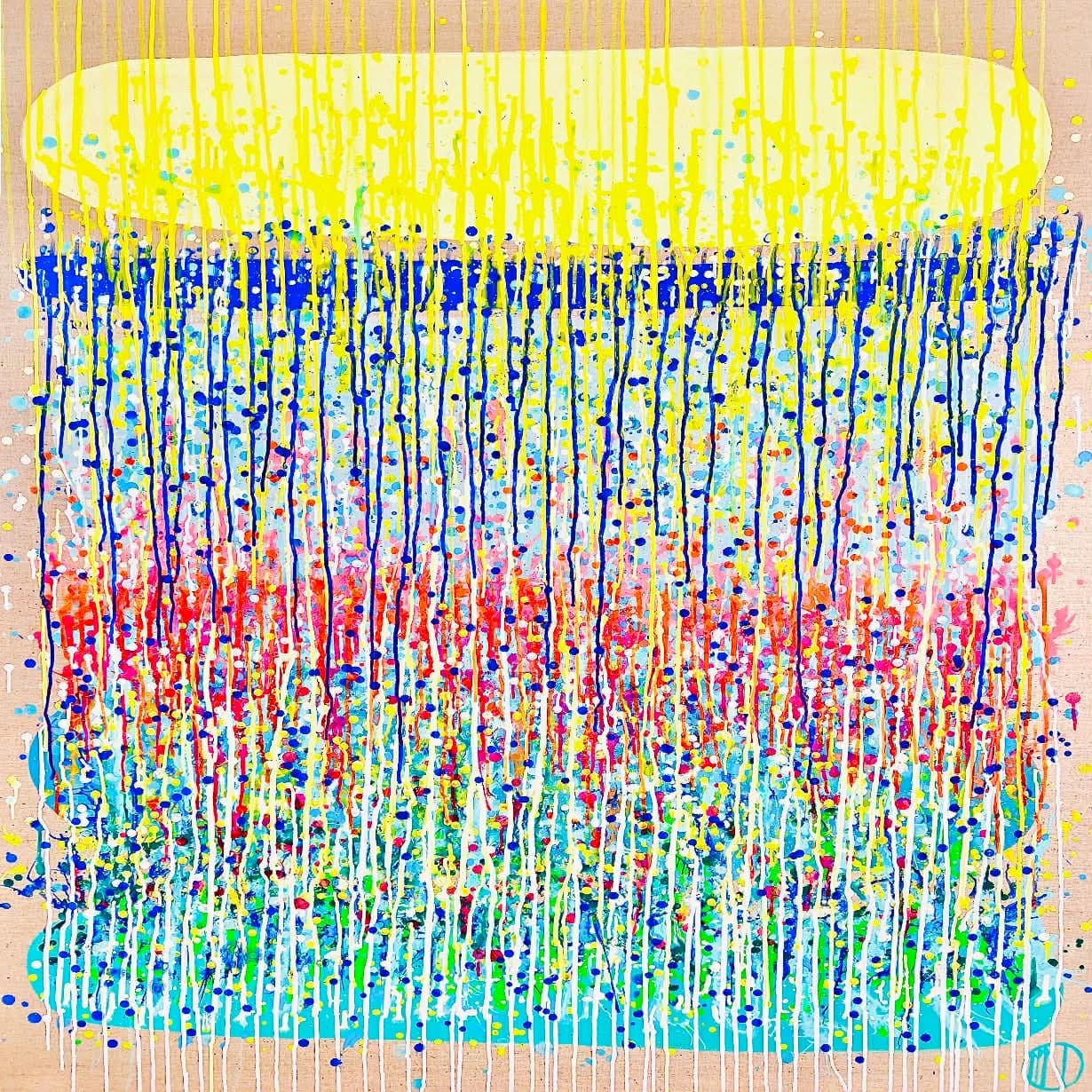
Mino Baechler is an artist who approaches creation with a philosophy that is both poetic and conceptual. At the core of his practice lies a distinctive and deeply personal system: every artwork he produces carries the latitude and longitude of the place where its first impulse began. This impulse, which he describes as the “sight of the oath,” is the moment when an inner spark meets an external reality. It is the point at which a feeling, memory, or perception crystallizes into the need to create.
For Mino, these coordinates are not technical details or decorative additions. They are integral to the meaning of the work. They mark the birthplace of an idea, the exact location where an emotional or spiritual resonance first appeared. In a world where digital images can be created anywhere and shared everywhere, his practice reintroduces a powerful sense of grounding. Each piece is tied to a specific point on Earth, reminding viewers that inspiration is not abstract but lived, encountered, and felt in real places.
The Language of Latitude and Longitude
Latitude and longitude are usually associated with navigation, geography, and science. Mino Baechler transforms them into a language of art and introspection. In his vision, each degree of latitude reflects the depth of his perception. It symbolizes how profoundly he has absorbed a moment, a landscape, or an encounter. Longitude, on the other hand, represents the direction of his inner journey. It speaks to movement, evolution, and the path of his thoughts and emotions.
Through this framework, his works become more than visual compositions. They function as records of experience. A painting or mixed-media piece is not only an aesthetic object but also a coordinate of consciousness. It captures where the artist stood in the world and where he stood within himself at a particular instant.
This approach invites viewers to think differently about art. Instead of asking only what they see, they may ask where it began and why that place mattered. The coordinates encourage a dialogue between the physical and the emotional, between measurable space and immeasurable feeling.
The “Sight of the Oath”
The phrase “sight of the oath” carries a sense of promise and commitment. It suggests that when Mino experiences the first impulse for a work, he is making a silent vow to honor that moment through creation. The sight is not merely visual. It can be a sensation, a realization, or an intuitive recognition. It is the instant when something in the outer world aligns with something in his inner world.
By recording the coordinates of this moment, Mino preserves the authenticity of his inspiration. He acknowledges that art does not emerge in isolation but in relationship with the environment. A city street, a quiet shoreline, a mountain view, or even an ordinary interior space can become the site of revelation. What matters is the intensity of connection he feels there.
This practice also adds a ritualistic dimension to his work. The act of noting the coordinates is like sealing the origin of the piece. It is a reminder that creation is not random for him; it is anchored in awareness and intention.
Art as a Testament to Space and Feeling
Mino Baechler’s artworks can be understood as testimonies. They testify to where a feeling met a place, where time and space intersected with perception. Each image is anchored in both time and earth, carrying the trace of a real-world location and a real inner state.
This dual anchoring gives his work a unique resonance. On one level, it is universal. Anyone can relate to the idea that certain places hold emotional significance. Many people remember where they were when something meaningful happened. On another level, his art is intensely personal. The exact coordinates belong to his journey, his experiences, and his way of seeing.
Viewers encountering his work may feel invited to reflect on their own coordinates of memory. They might think of the places that shaped them, the locations tied to love, change, loss, or discovery. In this sense, Mino’s art extends beyond the canvas. It activates the viewer’s own map of emotions and experiences.
Bridging the Tangible and the Intangible
One of the most compelling aspects of Mino Baechler’s concept is how it bridges the tangible and the intangible. Coordinates are precise and factual. They can be entered into a map and located exactly. Feelings, by contrast, are fluid and subjective. By linking the two, he creates a dialogue between certainty and mystery.
The viewer knows that the numbers correspond to a real place, yet the emotional content behind them remains open to interpretation. This tension creates depth. The work is grounded but not limited. It has a factual anchor and a poetic horizon.
This balance reflects a broader human condition. People live in physical spaces but carry rich inner worlds. Mino’s art mirrors this reality, showing that the outer and inner dimensions of life are constantly interacting.
A Contemporary Cartography of the Soul
In many ways, Mino Baechler can be seen as creating a contemporary cartography of the soul. Traditional maps chart territories, borders, and distances. His artistic maps chart perception, connection, and meaning. Instead of countries and oceans, his coordinates point to moments of awareness.
This idea feels especially relevant in a time when mobility and digital life can make experiences feel detached from place. By emphasizing location, he restores a sense of presence. He suggests that where we are matters, that creativity is shaped by environment as much as by imagination.
His work quietly resists placelessness. It asserts that every meaningful impulse has a somewhere. That somewhere becomes part of the artwork’s identity.
An Invitation to See Differently
Ultimately, Mino Baechler’s practice is an invitation. It invites viewers to see art not just as an object but as a trace of lived experience. It encourages them to consider the relationship between geography and emotion, between standing somewhere and feeling something.
His use of coordinates does not limit interpretation; it expands it. It adds a layer of story without dictating a single narrative. Each viewer can approach the work with curiosity, perhaps even looking up a location or imagining what the artist might have felt there.
In doing so, they participate in the journey. They move from passive observation to active reflection.
Conclusion: Anchored Yet Open
Mino Baechler’s art stands at a fascinating intersection of precision and poetry. By embedding latitude and longitude into his works, he grounds them in the real world while opening them to inner exploration. Each piece becomes a meeting point of space and feeling, time and perception.
His concept reminds us that art can be both map and mirror. It can locate a moment on the globe while also pointing inward. In a simple set of numbers, he encodes a story of connection, presence, and awareness.
Through this unique approach, Mino Baechler offers more than images. He offers coordinates of experience, inviting us to consider our own places of origin, our own sights of the oath, and the many ways the world around us shapes the world within.

