


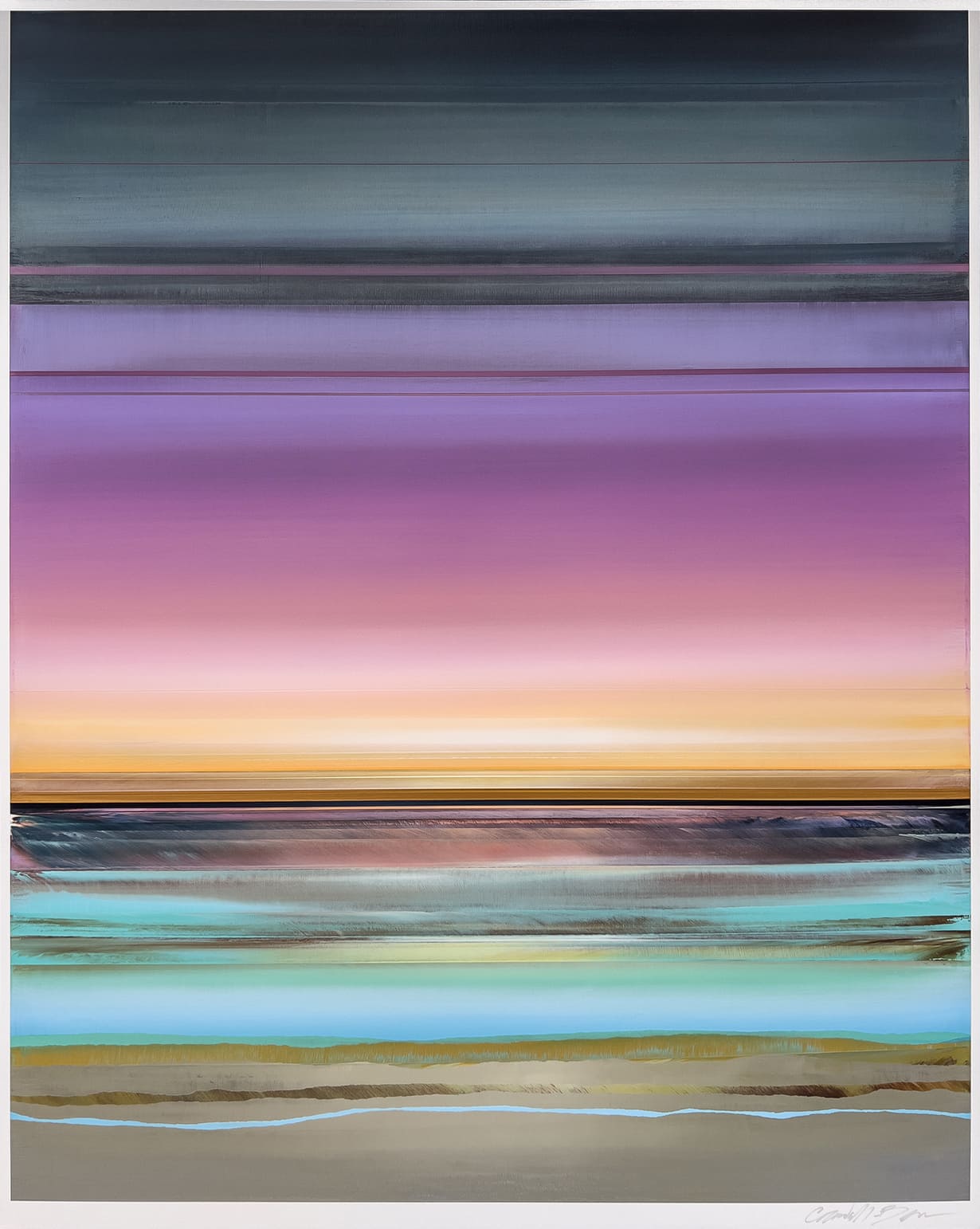
Micah Crandall-Bear is a contemporary painter whose abstract landscape paintings examine Earth’s intrinsic resources and our disposition toward their accelerated transformation. His work does not simply portray nature as scenery; it considers nature as a living system that reflects human behavior, emotion, and consequence. Through layered compositions, nuanced color relationships, and a sensitivity to light, he creates paintings that feel both expansive and intimate, like horizons that also function as mirrors.
Rooted in Sacramento, California, Crandall-Bear has built a practice that is locally grounded yet internationally resonant. His paintings speak a universal visual language while remaining deeply connected to the rhythms and atmospheres of his native environment. Across his body of work, viewers encounter a sustained meditation on balance between melancholy and joy, stillness and motion, and human intervention and natural continuity.
Early Roots and Artistic Formation
Crandall-Bear’s artistic journey is closely tied to Sacramento, the city where he was born and where he continues to live and work. His early immersion in the local art scene played a crucial role in shaping his direction. In the late 1990s, he interned at the well-known Michael Himovitz Gallery in Sacramento. There, under the mentorship of owner Chuck Miller, he gained direct exposure to professional artistic practice, exhibition culture, and the discipline required to sustain a creative career.
This formative period sparked his exploration across painting, sculpture, and design. Rather than limiting himself to a single medium, he developed a broad visual sensibility and a strong understanding of how form, space, and material interact. That multidisciplinary awareness remains visible in his paintings today, where compositional structure often feels architectural and spatial depth is carefully constructed.
By 2010, his work began appearing in exhibitions at venues such as Skinner Howard Gallery, Urban Hive, the Sacramento State Union Gallery, and Elliott Fouts Gallery. These early shows established his presence in the regional art community and laid the groundwork for wider recognition.
A Visual Language of Layers
At the core of Crandall-Bear’s practice is a distinctive visual language built on linear layers that move from atmospheric to subterranean. His paintings often feel stratified, as though the viewer is seeing multiple dimensions at once: sky, land, memory, and emotion compressed into a single field. These cascading layers mirror the complexities of human experience, suggesting that inner life, like the landscape, contains both visible surfaces and hidden depths.
Light plays a critical role in this language. Subtle tonal shifts evoke daily and seasonal changes, recalling dawns, dusks, and transitional hours. Panoramic details stretch across the canvas and encourage the eye to wander slowly rather than settle on a single focal point. The viewing experience unfolds gradually, much like observing an actual landscape.
Color is equally significant. Crandall-Bear frequently works with vibrant apricot hues alongside muted clay and earth tones. This interplay produces gentle tension between warmth and restraint, brightness and groundedness. Emotionally, these palettes act as quiet reminders that melancholy and joy can exist together within the same space.
Nature, Time, and Perception
Nature, for Crandall-Bear, is not a static subject but a dynamic system. His work explores nature’s rhythm, its ephemerality, its contrasts, and its lasting effect on human perception. Rather than painting literal scenes, he abstracts the experience of being in a landscape: the way light shifts across terrain, the way weather influences mood, and the way memory merges multiple moments into one.
Each painting begins with a foundational wash that recalls atmospheric change. He builds upon this base through careful layering, allowing organic textures to emerge and shape the composition. Earlier marks often remain partially visible, creating a sense of history within the painting. Each layer feels like a record of time passing.
His approach balances structure and fluidity. Minimalist influences appear in the clarity and restraint of his compositions, while the richness of color field painting is evident in his handling of pigment and space. He avoids defined figures or direct narratives, leaving interpretive space for the viewer. This openness allows individuals to project their own emotions and memories onto the work, making each encounter personal and unique.
Recognition and Global Presence
Although deeply tied to Sacramento, Crandall-Bear’s reach extends far beyond it. His work is represented across the United States, Asia, and Europe, reflecting a broad international appeal. His paintings are permanently installed in major institutional and corporate collections, including Facebook, HBO, Visa, the Chan Zuckerberg Initiative, the Crocker Art Museum, and the Resnick Foundation. These placements demonstrate both aesthetic value and cultural relevance, as his works occupy spaces connected to contemporary life and global dialogue.
His practice also enters the public realm. A recent large-scale exterior mural at Aggie Square in Sacramento highlights his ability to translate his painterly sensibility into architectural and communal contexts. Even at a monumental scale, his focus on atmosphere, balance, and reflection remains consistent.
His upcoming exhibition scheduled for October 2025 in Jakarta, Indonesia signals continued international momentum. The themes he explores, such as nature, transformation, and perception, resonate across cultural and geographic boundaries.
“Reminder” (2024)
The 2024 acrylic on canvas painting titled Reminder encapsulates many of Crandall-Bear’s central concerns. While abstract, the work suggests a horizon-like structure with layered tones that feel grounded yet luminous. The painting can be experienced as a meditation on memory and presence, on how certain impressions linger and shape perception.
In Reminder, the dialogue between vibrant and muted hues becomes especially poignant. The composition invites pause and sustained looking. It does not rely on spectacle; instead, it rewards quiet attention. The title implies a gentle prompt to recall our connection to the earth, to time, or to our own emotional landscapes.
Art as Introspective Space
Ultimately, Crandall-Bear’s work is about creating spaces for introspection. Whether on canvas or in large-scale installations, he offers a visual language that connects memory with the present moment. His paintings do not dictate meaning; they open possibilities for interpretation.
In a fast-paced world marked by constant change, his art proposes a slower tempo. It encourages viewers to notice subtle shifts in tone and texture and to sit with ambiguity. The balance he seeks in his process between chaos and serenity, depth and simplicity extends to the experience he offers his audience.
By examining Earth’s resources and humanity’s relationship to their transformation, Crandall-Bear also raises quiet ecological and philosophical questions. How do we inhabit the landscapes we alter? What do we carry forward, and what do we leave behind? His paintings do not provide direct answers, but they create room for reflection.
From Sacramento studios to international collections and public spaces, Micah Crandall-Bear continues to shape a practice defined by sensitivity, discipline, and thoughtful exploration. His abstract landscapes remind viewers that the outer world and inner life are interconnected terrains that influence one another layer by layer.

