


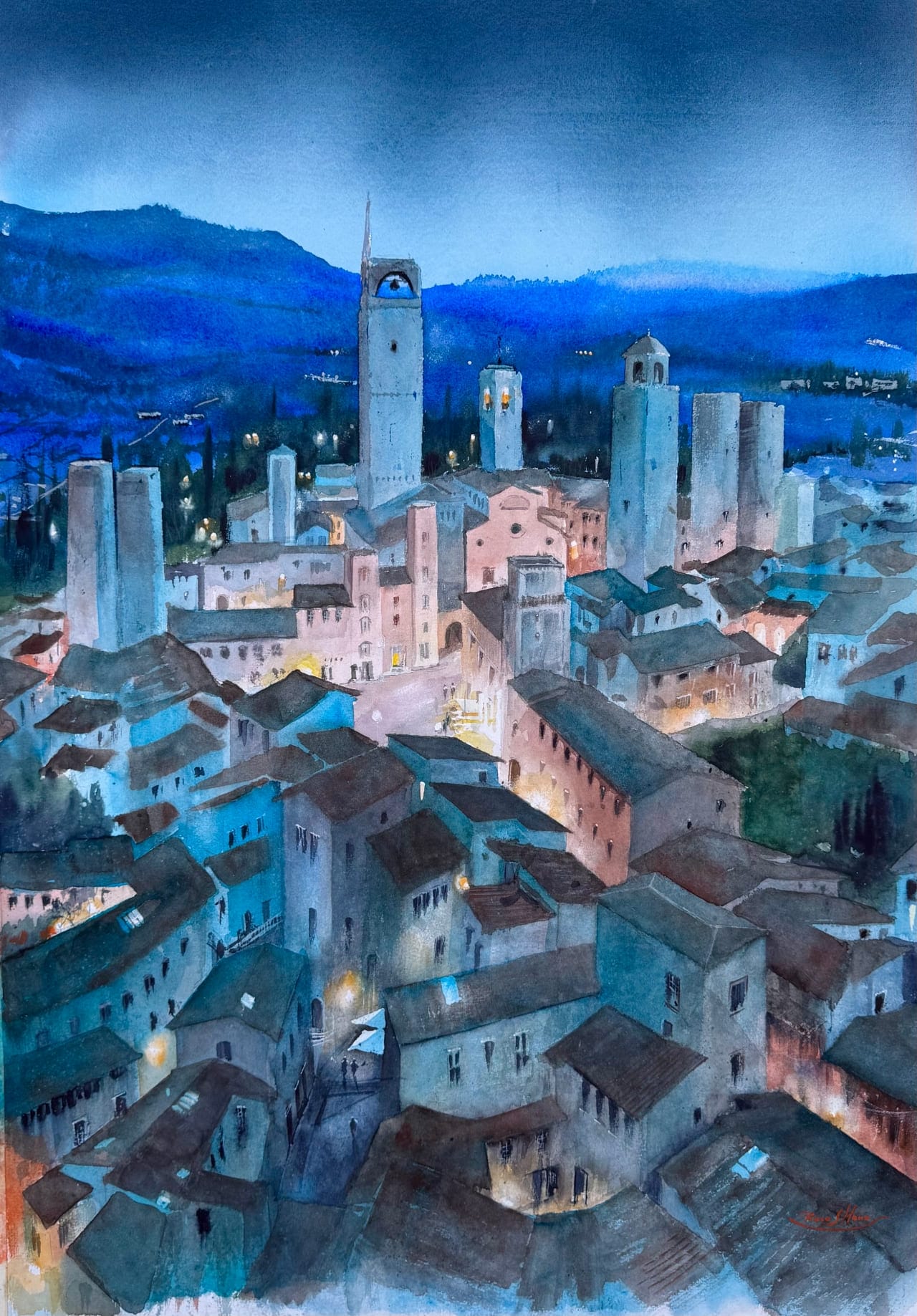
Rodrigo Aros Llanos is a Chilean visual artist whose watercolor practice stands at the intersection of architecture, urban observation, and poetic atmosphere. Trained as an architect, Aros Llanos brings a structural intelligence to his work that distinguishes his approach to watercolor, a medium often associated with spontaneity and fluidity. Through disciplined composition, formal synthesis, and a sensitive study of light, he has developed a pictorial language that is both expressive and controlled, capable of transforming everyday landscapes into evocative nocturnal narratives.
His artistic production spans urban landscapes, seascapes, and rural scenes, yet it is in his nocturnal city views that his voice becomes particularly distinctive. These works are not merely representations of place. They are meditations on space, rhythm, and illumination, moments where architecture dissolves into atmosphere, and light assumes a central emotional role.
Architectural Foundations and Visual Structure
Aros Llanos’ background in architecture profoundly informs his artistic vision. Rather than treating buildings and urban forms as incidental backdrops, he approaches them as compositional frameworks through which visual tension and balance are constructed. Perspective, spatial sequencing, and structural clarity are not secondary concerns but foundational elements in his paintings.
This architectural sensibility allows him to organize complex cityscapes into legible yet dynamic compositions. Planes of depth unfold methodically, guiding the viewer’s eye through layered spaces. Streets, rooftops, and facades become instruments of visual rhythm, reinforcing a sense of order while leaving room for expressive interpretation. In this way, Aros Llanos bridges analytical precision with painterly intuition.
Watercolor as a Medium of Control and Expression
While watercolor is often perceived as unpredictable, Rodrigo Aros Llanos embraces its challenges through mastery rather than avoidance. His technique demonstrates a deep understanding of the medium’s behavior, including how pigment, water, and paper interact to create both sharp definition and atmospheric softness.
He frequently combines wet-in-wet passages to establish broad tonal fields with more deliberate, constructed architectural details applied in later stages. This balance allows his paintings to retain luminosity and depth without sacrificing structural integrity. Color is used expressively but with restraint, with each hue carefully calibrated to support the overall harmony of the composition.
Rather than overwhelming the viewer with detail, Aros Llanos practices formal synthesis, reducing visual information to its essential elements. This approach heightens emotional resonance and reinforces the poetic quality of his scenes.
Nocturnal Landscapes and the Study of Light
One of the most compelling aspects of Aros Llanos’ work is his exploration of nocturnal environments. Night, in his paintings, is not darkness but a field of subtle relationships between shadow, reflection, and artificial illumination. Streetlights, windows, and distant glows punctuate the darkness, creating focal points that structure the composition and guide perception.
Light becomes the primary organizing principle, both visually and conceptually. It reveals form, suggests movement, and evokes mood. Cool tonalities often dominate his nocturnal scenes, establishing a quiet, contemplative atmosphere, while warm lights introduce contrast, human presence, and emotional warmth.
This nuanced handling of light reflects a deep observational practice, as well as an understanding of how illumination shapes spatial experience within the urban environment.
TECHOS II: A Poetic Urban Nightscape
TECHOS II exemplifies Rodrigo Aros Llanos’ mature approach to watercolor and his fascination with nocturnal urban spaces. Constructed from an elevated viewpoint, the composition unfolds through successive spatial planes that draw the viewer toward a luminous central core. Rooftops, streets, and architectural silhouettes overlap rhythmically, creating a sense of urban density without visual congestion.
The painting’s atmosphere is shaped by a carefully controlled contrast between cool blue tonalities and warm artificial lights. These opposing temperatures generate both visual tension and harmony, reinforcing the depth of the scene while anchoring the viewer’s gaze. The wet in wet background establishes a soft, enveloping darkness, against which more structured architectural passages emerge with clarity and intention.
In TECHOS II, light does more than illuminate. It narrates. It suggests life continuing beyond the visible frame, quiet movement within the city, and the fragile balance between solitude and connectivity that defines nocturnal urban experience. The work stands as a poetic meditation on the city at rest, observed from a distance yet rendered with emotional intimacy.
International Presence and Artistic Recognition
Rodrigo Aros Llanos’ work has been exhibited extensively across the Americas, Europe, and Asia. His participation in international biennials, festivals, and exhibitions dedicated to contemporary watercolor has positioned him as a significant voice within the global watercolor community. These platforms have allowed his work to engage in dialogue with diverse artistic traditions while maintaining a distinct personal identity.
His paintings resonate with international audiences precisely because they transcend specific locations. Though rooted in Chilean urban and coastal environments, his scenes speak to universal experiences of place, memory, and atmosphere.
Teaching, Mentorship, and Artistic Legacy
Parallel to his artistic career, Aros Llanos maintains an active and influential role as an educator. He serves as an instructor and workshop leader at the National Society of Fine Arts of Chile and collaborates with various international online academies and educational platforms. Through specialized courses in landscape, perspective, composition, and advanced watercolor technique, he shares not only technical knowledge but a comprehensive visual philosophy.
His teaching emphasizes observation, structural thinking, and intentional decision making. These principles reflect his own practice and contribute to the evolution of contemporary watercolor by nurturing a new generation of artists who approach the medium with both rigor and sensitivity.
Conclusion: A Contemporary Voice in Watercolor
Rodrigo Aros Llanos represents a contemporary approach to watercolor that honors tradition while pushing its expressive boundaries. Through architectural precision, atmospheric sensitivity, and a profound understanding of light, he transforms familiar environments into poetic visual experiences. Works like TECHOS II demonstrate his ability to balance control and fluidity, structure and emotion, making his practice both intellectually grounded and deeply evocative.
In an era where speed and spectacle often dominate visual culture, Aros Llanos invites viewers to slow down, to observe, to feel, and to inhabit the quiet poetry of light within the urban night.

