


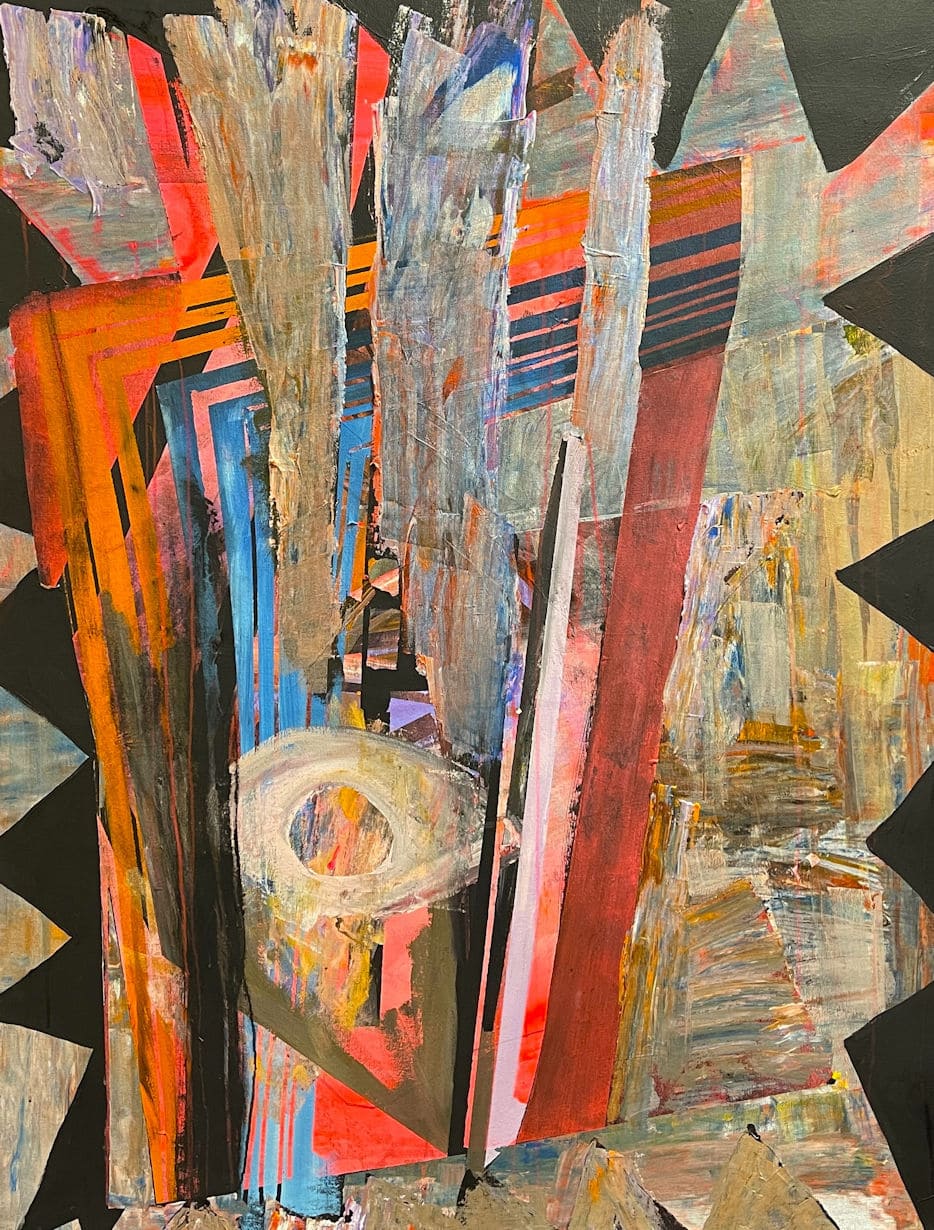
Jenny Hager is a Los Angeles based abstract painter whose work occupies a charged space between clarity and confusion, structure and disruption, control and surrender. Originally from Detroit, Michigan, Hager’s artistic journey reflects both rigorous formal training and a sustained commitment to experimentation. Through layered surfaces, scraped gestures, and carefully constructed patterns, her paintings confront the viewer with moments of visual tension where meaning feels both present and perpetually out of reach.
Hager’s practice does not aim to resolve uncertainty. Instead, it embraces it. Her work invites viewers to sit with ambiguity, to feel rather than decode, and to encounter abstraction as a visceral experience rather than a purely intellectual one.
Educational Foundation and Artistic Formation
Jenny Hager’s artistic voice is grounded in a strong academic foundation that spans multiple disciplines and institutions. She earned her Bachelor of Arts degree from Knox College in Illinois, where she began developing a critical and conceptual approach to art making. Seeking deeper engagement with painting and drawing, she completed a post baccalaureate program at the New York Studio of Drawing, Painting, and Sculpture in New York City, an environment known for its emphasis on observation, material awareness, and painterly discipline.
Hager later received her Master of Fine Arts in Painting from the University of Pennsylvania, a program recognized for fostering rigorous studio practices and theoretical inquiry. This layered educational background has informed her ability to balance structure with intuition and concept with material exploration.
A Practice Rooted in Tension and Transformation
At the core of Hager’s work is an investigation into the tension between the explicable and the inexplicable. Her paintings operate as visual sites of confrontation, where carefully constructed systems collide with organic and unpredictable elements.
Hager employs processes such as scraping, building layers, and taping to create surfaces that feel both deliberate and unsettled. Taped grids and patterned interruptions function as screens or barriers, suggesting systems of order, protection, and control, while beneath and around them emerge gestural marks and ephemeral forms that resist containment. These opposing forces generate compositions that remain unresolved and alive with friction.
Rather than offering clarity, Hager’s paintings hold space for incomprehensibility. They echo the experience of encountering something simultaneously beautiful and unsettling, rooted in the visceral and the uncanny.
Material Language and Visual Strategy
Working primarily with acrylic on canvas, Hager uses the medium’s flexibility to push her surfaces through cycles of construction and erosion. Acrylic allows her to build dense layers quickly, scrape them back, and reapply pigment in ways that preserve traces of earlier decisions. These visible histories give her paintings a sense of time, memory, and physical engagement.
Pattern plays a central role in her visual language. Through taping techniques, Hager introduces repeating forms that resemble screens, interference, or visual noise. These interruptions obstruct the organic flow of paint and heighten awareness of what is concealed versus what is revealed.
The resulting surfaces feel intentional yet unstable, balancing control with vulnerability and structure with collapse.
Exhibitions and International Presence
Jenny Hager has exhibited widely on both national and international stages. Her work has been shown in New York City, Los Angeles, San Francisco, London, and Berlin, reflecting a practice that resonates across diverse cultural contexts.
She has participated in major art fairs and projects, including Miami Projects in Miami, Supermarket Art Fair in Stockholm, Spring Break in Los Angeles, and QiPO 01 in Mexico City. These platforms situate her work within contemporary conversations surrounding abstraction and material exploration.
Hager’s paintings have also been exhibited at institutions such as the Reykjavik Art Museum in Iceland, the Torrance Art Museum in Los Angeles, the Riverside Art Museum in Los Angeles, the Figge Art Museum in Davenport, Iowa, and the San Diego Art Institute. These exhibitions underscore the critical recognition of her work within museum and institutional settings.
Awards, Grants, and Professional Recognition
Hager’s artistic contributions have been recognized through significant awards and grants. She is a two-time recipient of the Joan Mitchell Foundation Grant, an honor awarded to artists demonstrating exceptional commitment and excellence in their practice.
She has also received a Professional Artist in Residence Scholarship from Ox Bow, one of the most respected artist residency programs in the United States. These distinctions highlight both the strength of her work and her ongoing dedication to artistic growth and experimentation.
Community and Collective Engagement
In addition to her studio practice, Jenny Hager is an active participant in the Los Angeles art community. She is a member of the collective and gallery Durden and Ray, a collaborative space dedicated to supporting contemporary artists. Her involvement reflects a commitment to dialogue, shared inquiry, and collective exchange.
Featured Artwork: Volpine 2024
Volpine 2024 exemplifies the central concerns of Hager’s practice. Created using acrylic on canvas and measuring 54 x 42 inches, the painting asserts a strong physical presence while drawing viewers into its layered complexity.
In this work, structured patterning intersects with organic gestures, producing a surface that feels both confrontational and inviting. The painting embodies a sense of wonder that is inseparable from uncertainty, encouraging viewers to experience the work intuitively rather than seek definitive meaning.
Conclusion
Jenny Hager’s work demonstrates abstraction’s capacity to communicate what resists clear explanation. Through layered processes, intentional obstruction, and visceral mark making, she creates paintings that ask viewers to engage with uncertainty rather than avoid it.
Grounded in rigorous training, enriched by international exhibitions, and supported by critical recognition, Hager’s practice continues to evolve as a compelling exploration of perception, tension, and the unknown. Her paintings do not offer answers. They offer encounters that linger beyond the moment of viewing.

