


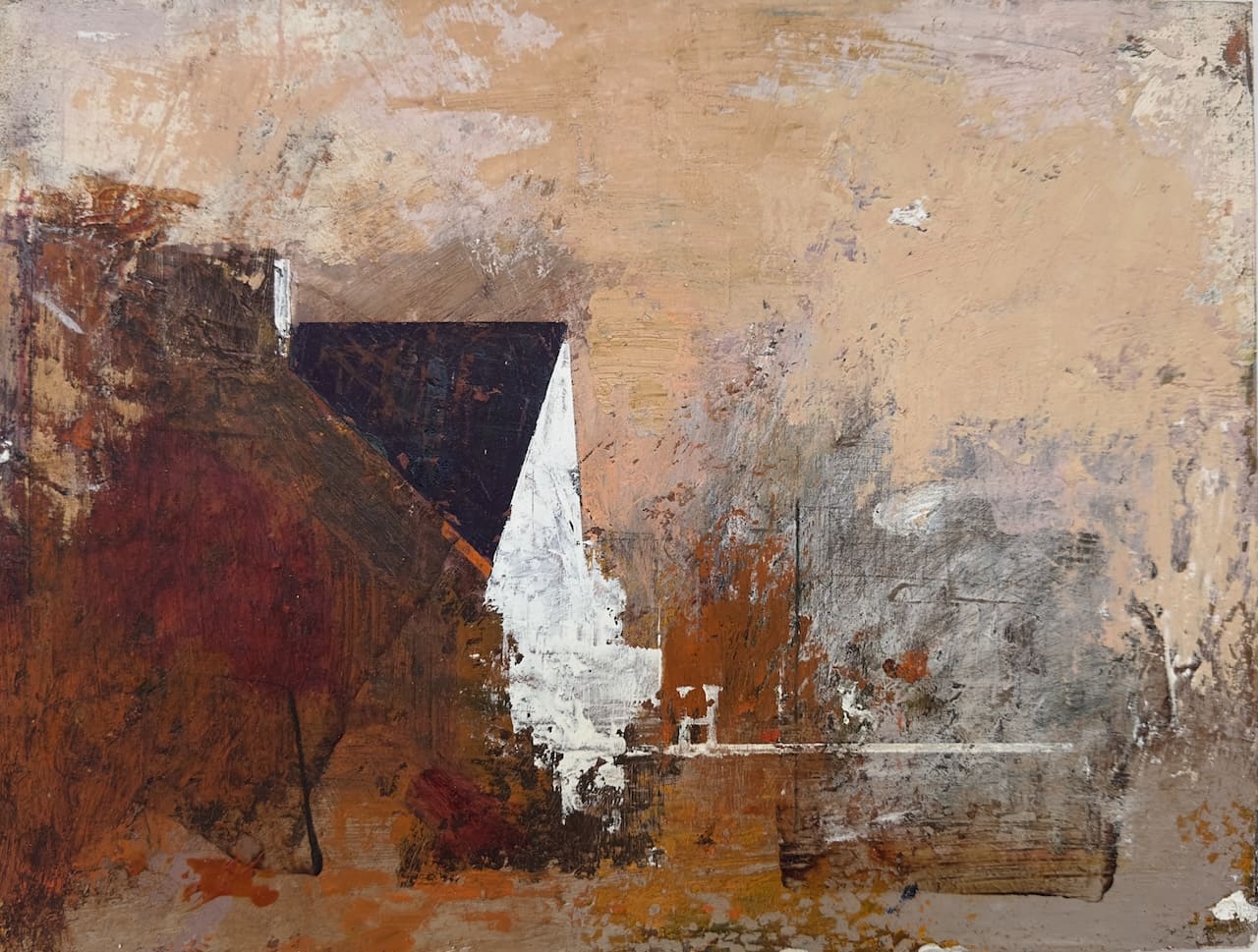
Mashiul Chowdhury is a Philadelphia-based artist whose work navigates the intersection of lived experience, urban transformation, and intuitive process. An alumnus of the prestigious Pennsylvania Academy of the Fine Arts (PAFA), Chowdhury’s artistic journey is marked by an uncommon synthesis of disciplines, cultures, and personal histories. Born in Dhaka, Bangladesh, and later immigrating to the United States in his late twenties, his life experiences span continents, professions, and environments. These layered realities find resonance in his paintings, where dense surfaces, shifting forms, and expressive color fields reflect the complexity of urban life and the emotional presence embedded within it.
From Medicine to Art: A Transformative Journey
Before fully committing to his artistic practice, Chowdhury completed medical school in Bangladesh. This early training instilled in him a disciplined way of seeing, observing, and understanding structure, skills that continue to inform his visual language today. After immigrating to the United States in his late twenties, he pursued a parallel path in both medicine and art. Chowdhury is currently an Associate Professor of Medicine at Rowan University School of Osteopathic Medicine, maintaining an active medical career alongside his work as a practicing artist.
In 2002, Chowdhury began attending alumni figure drawing sessions at PAFA. This experience marked the beginning of his professional artistic path. These sessions provided not only technical grounding but also a space for rediscovery, allowing him to reconnect with a deeper, intuitive mode of expression. Over time, this engagement evolved into a sustained practice rooted in observation, experimentation, and personal reflection.
Artistic Development and Teaching Practice
Chowdhury’s relationship with Philadelphia’s art community has been both immersive and reciprocal. He is currently on the faculty of several respected institutions, including Cerulean Arts and the Penn Studio School of Art. As an educator, he brings a sensitivity shaped by his own nonlinear journey, encouraging students to value process, curiosity, and authenticity over fixed outcomes.
Teaching has also reinforced his own studio practice. The act of guiding others through foundational skills and conceptual exploration has sharpened his awareness of gesture, structure, and intention. This dialogue between teaching and making continues to inform the evolution of his work, grounding it in both rigor and openness.
Urban Experience as Source and Subject
Chowdhury’s paintings emerge directly from lived experience within dense, vibrant cities. Philadelphia, with its layered history, textured architecture, and shifting neighborhoods, plays a significant role in shaping his visual vocabulary. Rather than depicting the city in a literal sense, his work absorbs its rhythms, contradictions, and emotional charge.
Layered surfaces, scraped textures, and shifting forms echo cycles of urban change, including decay, renewal, construction, and erasure. These elements mirror the way cities constantly reinvent themselves while holding traces of the past. His paintings resist static narratives, instead embracing ambiguity and flux as essential qualities of contemporary urban life.
Process Over Prescription
Central to Chowdhury’s practice is a commitment to process-driven creation. Rather than beginning with a predetermined image or concept, he allows the act of painting itself to guide meaning. Each layer responds to the previous one, creating a visual conversation that unfolds over time.
Scraping, reworking, and rebuilding the surface are not corrective acts but essential gestures within the work. These marks reveal time, decision-making, and vulnerability, allowing the viewer to sense the history embedded in the painting. This openness to uncertainty mirrors the unpredictability of lived experience and reinforces the emotional authenticity of the work.
Color, Rhythm, and Emotional Presence
Color plays a dynamic and expressive role in Chowdhury’s paintings. Hues collide and interact much like the rhythms of a city, discordant at times and harmonious at others. These chromatic tensions invite prolonged looking, encouraging viewers to slow down and engage with the subtle shifts and relationships within the surface.
While his work often carries an abstract sensibility, there is a palpable human presence embedded within it. This presence is not represented through figures but through movement, energy, and emotional resonance. The paintings suggest memory, sensation, and interior states, offering spaces where viewers can project their own experiences and interpretations.
Medium and Materiality
Chowdhury works primarily in oil on paper mounted on masonite board, a choice that reflects his interest in both intimacy and durability. Paper allows for immediacy and responsiveness, while the masonite support provides stability and permanence. This balance mirrors the conceptual tension within his work, between fragility and resilience, transience and structure.
The materiality of his surfaces is integral to the viewing experience. Textural variations catch light differently, revealing new details as the viewer moves closer. This physical engagement reinforces the idea that meaning is not immediately apparent but unfolds through attention and time.
Recognition and Collections
Chowdhury’s work has received significant recognition within the art community. In 2014, he was awarded the Best Landscape Award at the Philadelphia Sketch Club, acknowledging his ability to reinterpret traditional genres through a contemporary lens. In 2022, his work was featured in Artist Magazine’s “Strokes of Genius” special edition, further affirming his standing as a compelling voice in contemporary painting.
His works are held in several permanent collections, reflecting both institutional and private recognition of his artistic contribution. These acquisitions underscore the enduring relevance of his explorations into place, process, and perception.
Conclusion
Mashiul Chowdhury’s art stands as a testament to transformation, personal, urban, and artistic. Drawing from a life shaped by cultural displacement, professional reinvention, and deep engagement with the city, his paintings offer spaces of reflection within the complexity of modern existence. Through layered surfaces, intuitive process, and evocative color, he invites viewers to rediscover wonder within the everyday and to linger within the emotional textures of urban life.
Rather than offering definitive statements, Chowdhury’s work opens conversations between past and present, structure and spontaneity, the seen and the felt. In doing so, it affirms painting as a living, evolving practice capable of holding both memory and possibility.

