


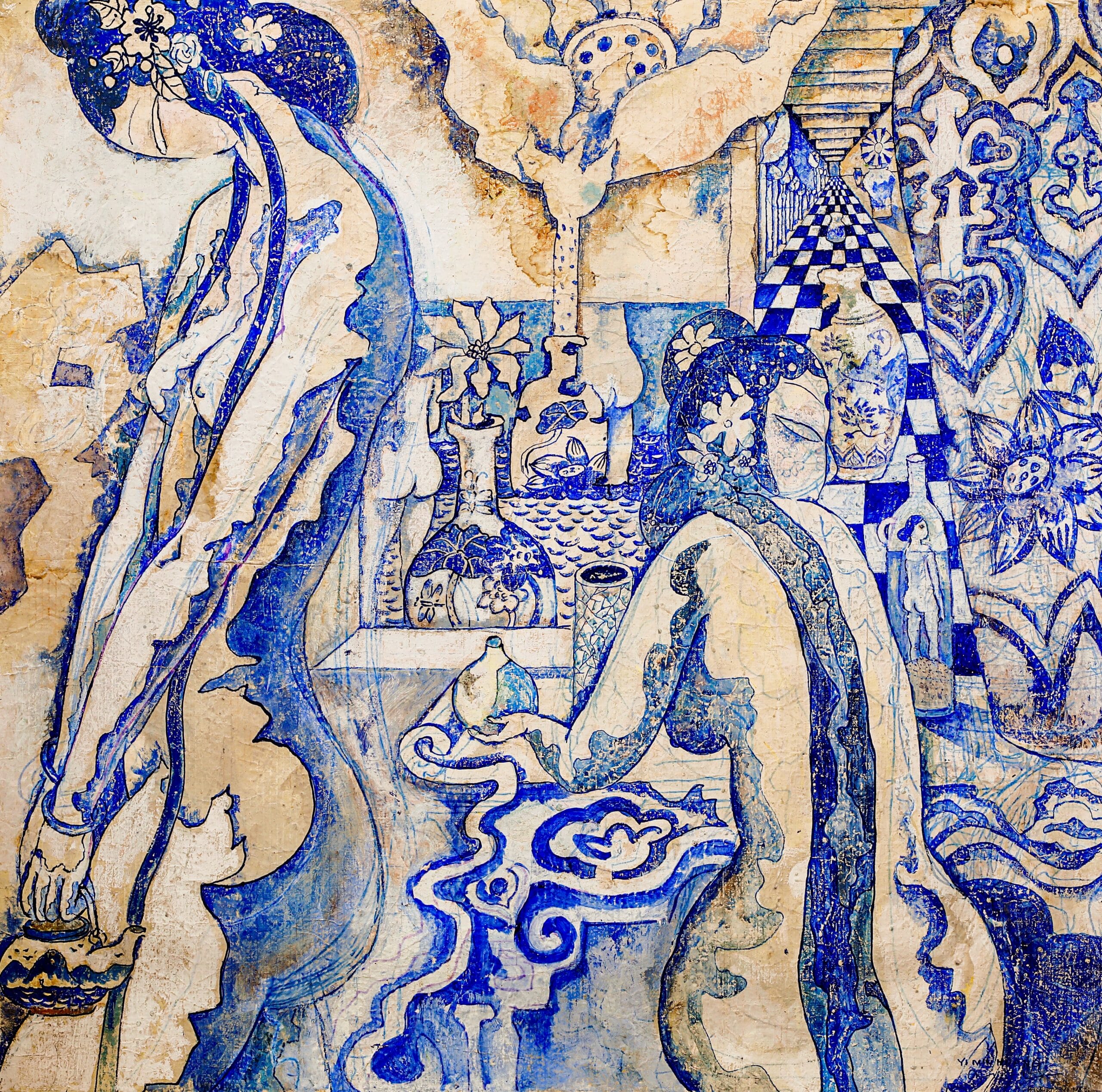
Huang Yi Min was born in Shanghai, China, in 1950, into a world rich with artistic heritage yet soon to be marked by profound social upheaval. Her formative years coincided with one of the most turbulent periods in modern Chinese history. At the age of sixteen, Huang experienced the beginning of the Cultural Revolution, a decade-long movement that disrupted formal education and led to the widespread rejection of traditional Chinese culture. For many, this era represented a loss of continuity, but for Huang, it became a crucible in which resilience, observation, and creative endurance were forged.
During this period, Huang was sent to work as a farmer, laboring in the fields far from academic institutions or art studios. Yet even under these conditions, her engagement with art never ceased. She continued to practice drawing, observe her surroundings, and cultivate a deep love for traditional culture. This coexistence of physical labor and inner artistic discipline would later become a defining aspect of her work, grounding her practice in lived experience rather than abstraction alone.
Academic Training and Artistic Formation
After the Cultural Revolution, Huang resumed her formal education and graduated from the Fine Arts Department of Beijing Normal University. This academic foundation allowed her to reconnect with classical techniques while developing a critical understanding of art history and visual language. Her training emphasized discipline, draftsmanship, and narrative clarity, all of which would later merge with her more imaginative and surreal tendencies.
Following graduation, Huang began working as an art editor at the China Children’s Publishing House. This role required her to constantly produce character sketches and landscape illustrations, sharpening her ability to tell stories visually. Over time, her artistic language evolved into a surrealist style rooted firmly in tradition. Rather than abandoning cultural references, she reimagined them, blending historical symbols with contemporary emotional states.
Surrealism Between History and the Everyday
One of the most distinctive aspects of Huang Yi Min’s work is her chosen performance and visual setting. For nearly two decades, she has explored imagery situated at the intersection of the Ming Dynasty’s Forbidden City in Beijing and ordinary residential buildings. This deliberate juxtaposition creates a powerful visual dialogue between imperial history and everyday life, between collective memory and personal emotion.
Within these imagined spaces, Huang allows emotional expression and imagination to unfold freely. Her work does not attempt to recreate history but instead reinterprets it, transforming architectural symbols into psychological landscapes. This approach has drawn international attention, including reviews from The New York Times, and earned her the prestigious Anna Walinska Academic Achievement Award in the United States.
Immigration and Global Recognition
In 1997, Huang Yi Min immigrated to the United States as an outstanding talent, bringing with her a deeply formed artistic vision shaped by decades of cultural reflection. Settling in New York, she entered a global art environment that both challenged and expanded her practice. The city’s diversity and openness allowed her to further develop ideas that had been forming long before her arrival.
Her works have since been collected by major institutions and private collectors, including the Singapore Museum of Art, Hong Kong Museum of Art, Singapore Simin Art Gallery, the New York Crystal Art Foundation, the New York Chinese Gallery, the Director of the Newark Museum of Art, and numerous private collections. These acquisitions reflect the universal resonance of her themes, which transcend geographic and cultural boundaries.
The Blue and White Porcelain Series
Among Huang Yi Min’s most significant bodies of work is the Blue and White Porcelain Series, executed on paper at a monumental scale of 120 x 120 cm. This series stands as a profound meditation on femininity, cultural identity, and historical continuity.
In Chinese culture, blue and white porcelain is one of the highest forms of praise. It is neither poetry nor painting but an object born from clay and fire, carrying the emotions, patience, and endurance of generations. For Huang, blue and white porcelain embodies the warmth and strength of women, reflecting both fragility and resilience.
She has long believed that one can taste the emotions of Chinese people through blue and white porcelain. It holds memory, labor, and quiet dignity, much like the lives of women whose stories often remain unspoken. By combining blue and white porcelain imagery with the female body and elements of Chinese opera, Huang transforms the ceramic vessel into a living, breathing presence.
Conceptual Origins and Artistic Evolution
The idea for the Blue and White Porcelain Series was conceived in 1996, before Huang arrived in New York. It was not a response to Western influence but a continuation of her lifelong engagement with Chinese tradition. When she brought this concept with her to the United States in 1997, it began to evolve within a new artistic context.
While studying and painting human figures in the body studio of the Art Students League on 57th Street in New York, the concept gradually became clearer. The fusion of porcelain patterns, human anatomy, and theatrical gesture took form, resulting in a series of large-scale paper works that balance delicacy with strength.
Advocacy, Recognition, and Legacy
The first person to recognize, promote, and collect this groundbreaking series was Susan, a New York art dealer and former assistant director of the Guggenheim Museum, who ran the Susan Fine Arts Company specializing in works on paper. Her early support played a crucial role in bringing Huang’s vision to a wider audience.
This recognition came years before major institutional exhibitions such as the 2015 exhibition A Mirage: Porcelain and Clothing at the Metropolitan Museum of Art, underscoring Huang Yi Min’s foresight and originality. Her work anticipated global conversations about identity, tradition, and the female body, positioning her as a visionary rather than a follower of trends.
Conclusion: An Enduring Artistic Voice
Huang Yi Min’s art is a testament to endurance, memory, and transformation. From the fields of rural China during the Cultural Revolution to the studios and galleries of New York, her journey reflects a rare continuity of purpose. By weaving together history, personal experience, and cultural symbolism, she has created a body of work that speaks quietly yet powerfully across cultures.
The Blue and White Porcelain Series stands as both homage and reinvention, honoring the strength of women and the emotional depth of Chinese tradition while asserting a contemporary artistic voice. Through her work, Huang Yi Min reminds us that true art does not abandon its roots; it carries them forward, refined by time, fire, and unwavering belief.

