


Bea Last is a professional creative practitioner whose work sits at the powerful intersection of drawing, sculpture, and social commentary. Born in Cyprus in 1963 and now based in South West Scotland in the United Kingdom, Last has developed a distinctive practice she describes as Sculptural Drawing. Her work expands the traditional definition of drawing beyond paper and pencil, transforming line, mark, and surface into three dimensional, immersive installations. Through the use of repurposed, recycled, salvaged, and gifted materials, she responds to urgent global issues such as conflict and humanitarian crisis, while reflecting deeply on the vulnerability, fragility, endurance, and hope of humanity.
At the heart of Bea Last’s practice is a commitment to material meaning. Every element carries symbolic weight. Fragile fabrics, weathered surfaces, frayed edges, and punctured forms become metaphors for lived experience, resilience, and survival. Her internationally recognized installation The Red Bags stands as a poignant example of how drawing can function not only as an artistic act but also as a form of witnessing and remembrance.
Expanding the Language of Drawing
Drawing, in Bea Last’s practice, is not confined to flat surfaces or representational imagery. Instead, it is a spatial, tactile, and temporal process. Her Sculptural Drawings are constructed through repetitive gestures, accumulated marks, and material decisions that echo the rhythms of traditional drawing, while unfolding in physical space.
By working with repurposed and recycled materials, Last introduces histories that already exist within the objects themselves. These materials arrive carrying traces of previous use, wear, and human contact. She does not attempt to erase these histories. Instead, she amplifies them. Sun bleaching, fraying, staining, and puncturing are not flaws but essential components of the work. They become marks in the same way graphite marks paper, recording time, pressure, and intention.
This approach allows drawing to function as a living process rather than a fixed outcome. Her installations evolve as they are installed, exposed to light, air, and environment, and encountered by viewers. In doing so, Last positions drawing as an act that exists in dialogue with the world rather than apart from it.
Responding to Conflict and Crisis
Bea Last’s work is deeply informed by global conflict and humanitarian crises. Without resorting to literal imagery or didactic statements, she creates spaces that encourage reflection on the human cost of violence and displacement. Her choice of materials reflects fragility and impermanence, yet the act of assembling and repeating forms speaks to endurance and collective strength.
The themes of vulnerability and resilience are inseparable in her work. The delicate nature of fabric and salvaged materials mirrors the precarity of human life, particularly in contexts of war and crisis. At the same time, the sheer scale of her installations and the labor involved in their creation signal perseverance, care, and hope. Through this balance, Last invites viewers to consider not only suffering, but also survival and solidarity.
The Red Bags: A Sculptural Drawing Installation
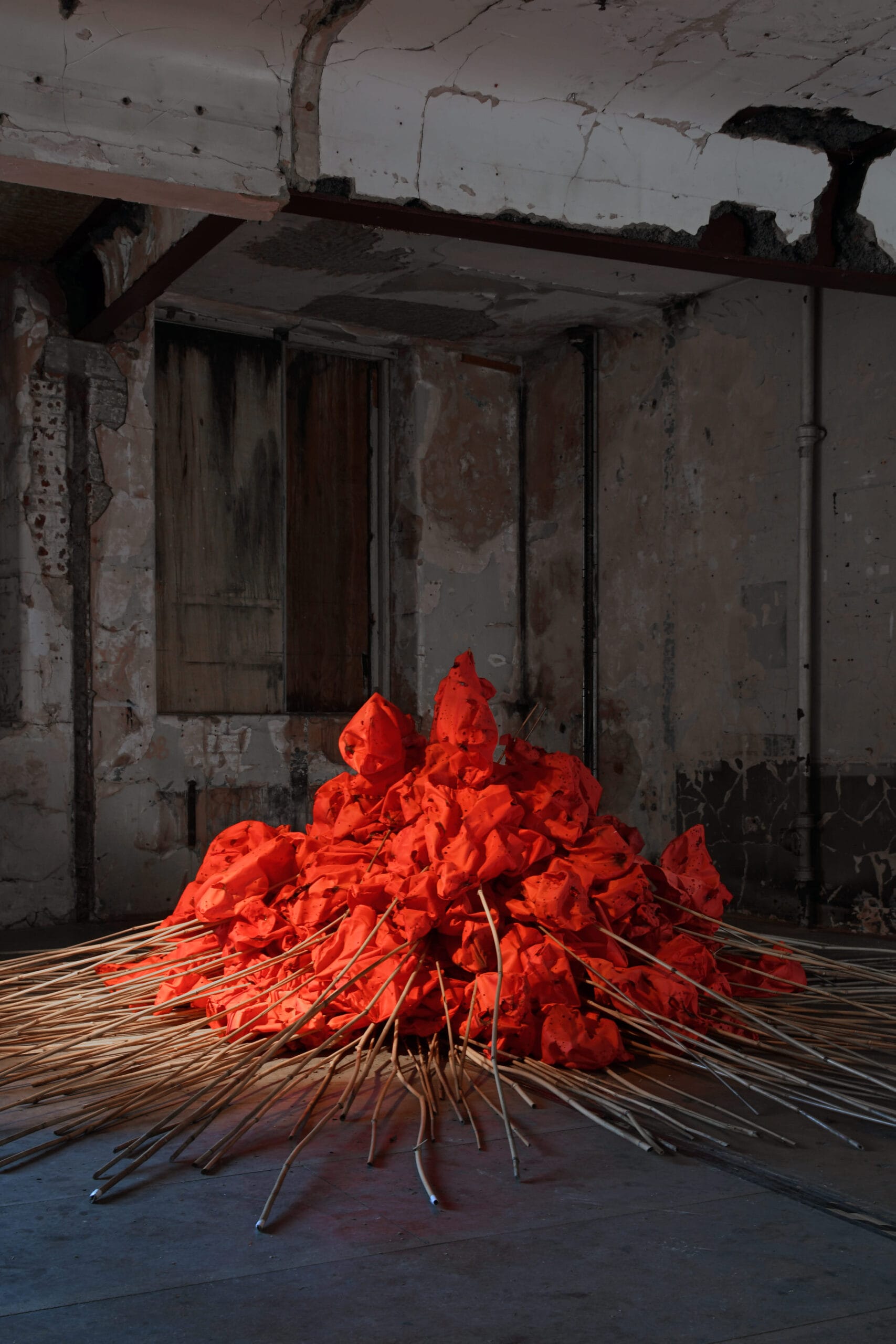
The Red Bags is one of Bea Last’s most significant and widely exhibited works. Developed between 2022 and 2025, this ongoing Sculptural Drawing installation is constructed from recycled and repurposed materials, bamboo, and fabric marked by bullet holes. The installation is variable in size, adapting to each location and responding to both indoor and outdoor environments.
The red bags themselves are hand crafted, each one a unique object yet part of a larger collective. Their repetition creates a visual rhythm reminiscent of drawn marks repeated across a surface. Installed en masse, they form a powerful spatial drawing that surrounds and confronts the viewer.
Over time, exposure to the elements becomes part of the work. Sun-bleached canvas fades and softens, debris accumulates, and frayed edges deepen the sense of wear and vulnerability. These changes are not incidental. They are integral to the process, marking the passage of time and reinforcing the themes of endurance and memory.
The presence of bullet holes introduces a stark and unsettling reality. Blackened edges frame the punctures, yet light passes through them. This deliberate choice transforms symbols of violence into openings, allowing light to enter and offering a quiet but profound gesture of hope.
Recognition and International Exhibitions
The Red Bags has received significant recognition on an international level. In 2023, the installation was exhibited in York as part of the Aesthetica Art Prize finalists show, placing Last’s work among some of the most compelling contemporary practices responding to social and cultural issues.
In 2024, The Red Bags was selected for the Laguna Arte Prize 19th edition in Venice, further affirming the global relevance and resonance of the work. That same year, Bea Last was awarded Artist of the Year 2024 by the Visual Arts Association. As part of this recognition, The Red Bags was showcased at The Minster Building in London EC3, where 700 hand crafted sculptural bags were installed, creating a monumental and emotionally charged environment.
These exhibitions not only highlight the artistic strength of Last’s practice but also underscore the capacity of Sculptural Drawing to engage audiences across cultural and geographical contexts.
Education, Mentorship, and Social Impact
Alongside her artistic practice, Bea Last is an educator and mentor deeply committed to supporting others through creativity. She facilitates portfolio preparation courses and provides one to one support for individuals with learning difficulties, using creative processes as tools for confidence, communication, and personal development.
This educational work mirrors the values present in her art. Care, patience, repetition, and attention to individual experience are central to both. By fostering creative expression in others, Last extends the impact of her practice beyond galleries and institutions, reinforcing art’s role as a means of empowerment and connection.
Conclusion
Bea Last’s work stands as a powerful testament to the expanded possibilities of drawing in contemporary art. Through her Sculptural Drawings, she transforms humble, vulnerable materials into profound statements on humanity, conflict, and hope. The Red Bags, in particular, embodies her ability to balance fragility with strength, loss with resilience, and darkness with light.
Rooted in material sensitivity and social awareness, Last’s practice invites viewers to slow down, to witness, and to reflect. In a world marked by ongoing crisis, her work offers not easy answers, but spaces for contemplation and empathy. Through drawing that exists in three dimensions and through time itself, Bea Last reminds us that even in the face of violence and uncertainty, there remains the possibility of endurance, connection, and hope.

