


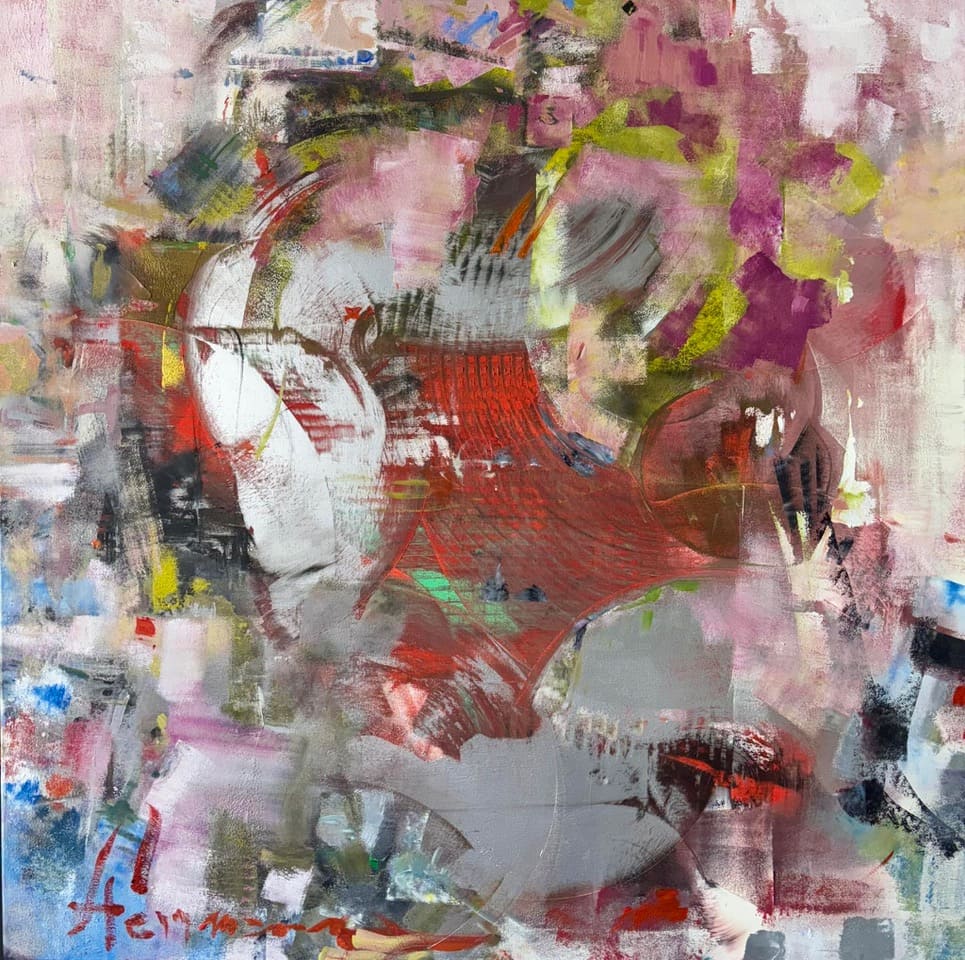
Dina Herrmann is an accomplished abstract painter whose work bridges the physical and spiritual realms through rhythm, movement, and intuitive expression. Influenced by modern masters such as Kandinsky, Pollock, Miró, O’Keefe, and Picasso, Herrmann has developed a powerful visual language that is both timeless and deeply personal. Her paintings invite viewers into a layered universe where balance, beauty, and emotional intensity coexist.
Herrmann’s artistic goal is to create harmony within a complex and ever-shifting world. This intention is evident in her richly textured canvases, which resonate with energy and structure while maintaining an organic flow. Drawing from both inner consciousness and the natural universe, her work offers a contemplative experience that transcends the purely visual.
Influences and Artistic Foundations
The legacy of abstract art is clearly present in Herrmann’s work, yet it is transformed through her unique sensibility. From Kandinsky, she inherits the belief that abstraction can serve as a spiritual language. Pollock’s influence emerges in her fearless physical engagement with the canvas. Miró’s playful cosmology, O’Keefe’s emotional relationship with form, and Picasso’s relentless experimentation all contribute to the depth of her visual vocabulary.
Rather than replicating these influences, Herrmann synthesizes them into a cohesive artistic voice. Her mastery of shadow, form, and composition allows her to balance spontaneity with control. This duality gives her paintings a sense of purpose and clarity while preserving their raw emotional power.
Exploring Multidimensional Space
A defining aspect of Herrmann’s work is her interest in spiritual systems, philosophy, and therapeutic bodywork. These studies have significantly shaped her understanding of energy, perception, and embodiment. Her paintings undertake the challenging task of rendering multiple dimensions, allowing viewers to experience both macrocosmic and microcosmic realities within a single frame.
Layers of color and texture interact dynamically, creating a rhythmic visual language that feels alive and expansive. Each composition functions as an entry point into an unseen realm, encouraging introspection and discovery. The viewer is not merely observing the artwork but participating in its unfolding experience.
Process, Material, and Physicality
Herrmann’s painting process is intuitive and intensely physical. She approaches each canvas as a sculptural surface, discovering shapes and forms through direct engagement with her materials. Working primarily in oil on canvas, she also incorporates acrylics and employs a variety of tools, including brushes, palette and spackle knives, rags, rollers, and her hands.
This tactile process results in surfaces that are richly layered and emotionally charged. Every mark reflects a moment of decision and movement, reinforcing the connection between the artist’s body and the finished work. Her disciplined technique supports her intuitive approach, allowing her to maintain balance within complexity.
Artwork Focus: The Ruination
One of Herrmann’s compelling works, The Ruination, is executed in oil and acrylic on canvas. The painting embodies her exploration of transformation, decay, and renewal. Through layered textures and bold compositional choices, the work suggests both collapse and reconstruction, echoing the cyclical nature of existence.
The Ruination reflects Herrmann’s ability to convey emotional depth through abstraction. The interplay between oil and acrylic enhances the surface tension of the piece, allowing gestures and forms to emerge with intensity. As with much of her work, the painting invites viewers to confront uncertainty while finding beauty within disruption.
A Series Rooted in Legacy
In her most recent body of work, Herrmann found inspiration in painter Joan Sneider and in the legacy of her late father, Robert Herrmann. He left behind hundreds of small abstract paintings, which profoundly influenced her creative direction. In response, Herrmann began developing a new series that pays homage to his work while asserting her own artistic evolution.
This series reflects a new boldness in shape, color, and composition. While honoring her father’s artistic spirit, Herrmann reinterprets his abstractions through her own contemporary lens. The result is a dialogue across generations that merges memory, experimentation, and emotional resonance.
Her first work in this series was awarded Best Oil Painting at the Black and White Show held at the Brooklyn Waterfront Artists Coalition. She continues to interpret and expand upon her father’s work, allowing this series to remain fluid and deeply personal.
Early Life and Education
Herrmann’s artistic path was shaped early in life while growing up in New York City. Raised by parents who were both acclaimed men’s fashion illustrators, she was encouraged to pursue creativity with dedication and curiosity. This supportive environment fostered a lifelong commitment to artistic expression.
At the age of thirteen, she studied painting with Anthony Tony. By fifteen, she had begun studying at Cornell University. She continued her formal education at Bennington College and Alfred University, ultimately earning her Bachelor of Fine Arts from the State University of New York at Purchase. This diverse academic background provided her with both technical precision and conceptual depth.
Exhibitions and Recognition
In 1985, Herrmann held her first solo exhibition at the Vorpal Gallery in Soho, New York. The success of this exhibition led to numerous solo and group shows, establishing her reputation within the contemporary art world. Throughout the 1990s, her work was exhibited at the National Endowment for the Arts in Washington, DC, further solidifying her standing as a significant abstract painter.
Despite evolving artistic trends, Herrmann remains dedicated to traditional media, valuing the expressive potential and depth of oil on canvas.
Painting as Intuition and Renewal
For Dina Herrmann, painting is an intuitive search guided by curiosity and openness. Inspired by the natural world and the universe’s geometric harmony, she approaches each canvas without rigid expectations. Her process teaches her to remain receptive to the unexpected and to trust instinct over certainty.
Painting serves as a cathartic and regenerative act, allowing her to reconnect with herself on a deeper level. Through her work, Herrmann creates structured yet emotional worlds that resonate with balance, movement, and spiritual awareness. Her paintings stand as enduring expressions of transformation, offering viewers a space for reflection and connection beyond the visible world.

