


Stefan Wimmreuter is a Vienna-based contemporary visionary artist whose work operates at the intersection of human presence and technological influence. Rooted in drawing and expanded through painting, sculpture, and digital layering, Wimmreuter’s practice investigates how identity, memory, and perception are reshaped within increasingly mediated realities. His art does not simply depict the contemporary condition; it interrogates it, positioning the human figure within spaces of fragmentation, compression, and transformation.
Through a precise balance of realism and disruption, Wimmreuter creates works that feel intimate yet unsettled. His imagery speaks to the psychological tension of existing in a world where technology filters experience, identity is fragmented across platforms, and the boundaries between organic and artificial grow increasingly blurred. Each artwork becomes a site of confrontation, asking viewers to reflect on what remains human when perception itself is constantly mediated.
Vienna as a Foundation for Visionary Practice
Living and working in Vienna, a city historically rich in intellectual, philosophical, and artistic movements, Wimmreuter’s work draws from a lineage of introspective and forward-thinking creative traditions. Vienna’s legacy of psychological inquiry, from early modernism to contemporary experimental art, provides fertile ground for an artist deeply engaged with questions of identity and perception.
Yet Wimmreuter’s practice is not nostalgic. Instead, it is future-facing, engaging directly with the anxieties and possibilities of a digital age. His multidisciplinary approach allows him to shift fluidly between traditional and contemporary techniques, reflecting the hybrid realities he seeks to explore. Painting, sculpture, and digital processes are not separate disciplines in his work but interconnected layers that mirror the complexity of modern identity.
Artistic Vision: Identity in an Age of Fragmentation
At the core of Stefan Wimmreuter’s artistic vision is an exploration of identity under pressure. His work suggests that identity today is no longer singular or stable but constantly reshaped by digital systems, screens, and data-driven environments. Memory becomes compressed, experience becomes filtered, and the self is often fragmented across multiple representations.
Rather than offering clear resolutions, Wimmreuter embraces ambiguity. His compositions often hover between clarity and dissolution, presence and absence. This tension reflects a broader cultural condition in which individuals must negotiate intimacy and exposure, authenticity and distortion. His work does not reject technology outright but examines its psychological and emotional consequences, particularly its impact on human vulnerability.
The Drawing: Human Presence Versus Digital Disruption
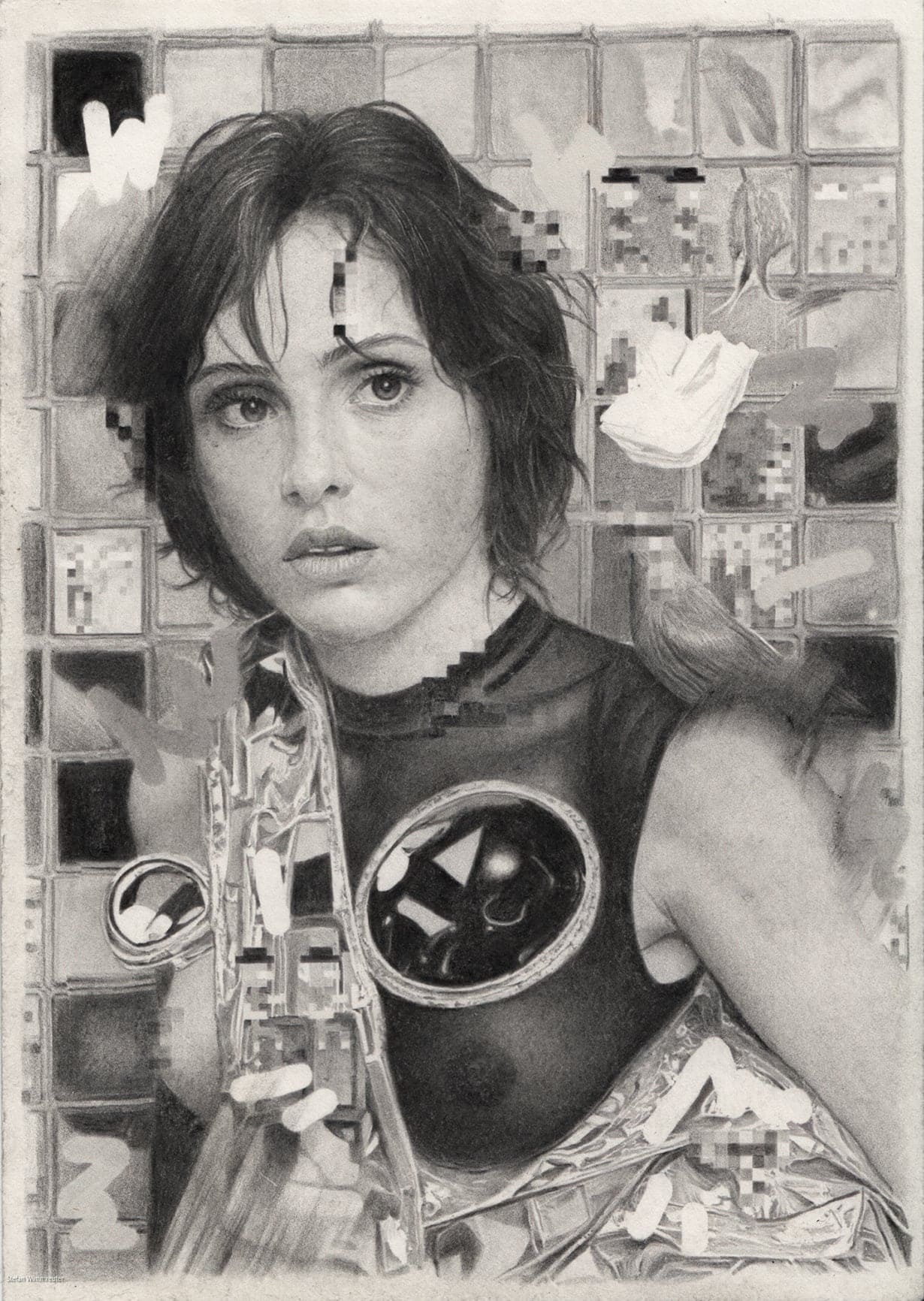
One of Wimmreuter’s graphite drawings powerfully encapsulates these themes. The artwork presents a quiet yet intense confrontation between human presence and digital fragmentation. Rendered with meticulous realism, the human figure appears suspended in a state of transition, caught between intimacy and distortion.
The graphite surface oscillates between softness and rupture. Smooth, carefully observed areas of the figure dissolve into pixelated interruptions, as if the image itself is breaking apart or being corrupted. This visual fragmentation suggests memory under compression or identity filtered through technological systems that reduce complexity into data.
The background grid reinforces this tension. Evoking tiled interfaces, screens, or data structures, it situates the figure within a digital framework that feels both ordered and oppressive. The grid does not merely function as a backdrop; it becomes an active force, pressing against the organic form and threatening to overtake it.
The Gaze as an Anchor of Humanity
Despite the surrounding fragmentation, one element remains intact: the gaze. The figure’s eyes anchor the work emotionally, resisting dissolution and asserting a quiet but powerful presence. This gaze becomes a point of connection between the artwork and the viewer, emphasizing vulnerability rather than dominance.
In a world increasingly defined by mediated images and digital avatars, Wimmreuter’s focus on the gaze serves as a reminder of what cannot be fully digitized. The eyes retain emotional depth and psychological complexity, standing as a final stronghold of human presence within an unstable visual environment. Through this subtle yet profound gesture, the artist suggests that while systems may fragment identity, human consciousness continues to seek clarity and connection.
Material Sensitivity and Conceptual Depth
Wimmreuter’s choice of graphite is particularly significant. Traditionally associated with drawing, study, and intimacy, graphite allows for a nuanced exploration of light, texture, and fragility. Its susceptibility to smudging and erasure mirrors the conceptual themes of instability and impermanence present in the work.
The contrast between finely rendered realism and abrupt pixel-like disruptions heightens the emotional impact of the piece. This interplay between control and breakdown reflects the broader human experience within technological systems that promise efficiency but often result in alienation. The drawing becomes both a visual and psychological space where vulnerability and resilience coexist.
Positioning the Human in Future Realities
Stefan Wimmreuter’s work ultimately positions the human subject within future realities that are still unfolding. His art does not speculate through science fiction aesthetics alone but through subtle psychological inquiry. By focusing on the individual figure, he grounds abstract concepts such as data, technology, and digital mediation in lived human experience.
His practice suggests that the future of identity will be negotiated through tension rather than harmony. Organic presence and artificial systems will continue to collide, producing new forms of perception and self-understanding. Wimmreuter’s work invites viewers to pause within this collision, to recognize both the fragility and persistence of human presence.
Conclusion
Stefan Wimmreuter is a contemporary visionary artist whose work offers a compelling reflection on identity, perception, and vulnerability in a technologically mediated world. Through his multidisciplinary approach and precise visual language, he captures the psychological complexity of modern existence.
His graphite drawing stands as a quiet yet powerful meditation on what it means to remain human amid fragmentation. By allowing vulnerability and clarity to coexist, Wimmreuter creates art that is both deeply personal and universally resonant. In doing so, he asserts that even within systems of distortion and data, human presence continues to resist dissolution, anchored by consciousness, memory, and the unwavering power of the gaze.

