


Andrew Freeman is a Houston-based contemporary abstract and mixed-media artist whose practice centers on psychological intensity, fractured memory, emotional confinement, and spiritual transformation. Working within the orbit of the Glassell School of Art and the broader Museum of Fine Arts, Houston community, Freeman develops layered paintings that merge vivid color, dense texture, fragmented figuration, and mask-like symbolic forms. His work exists at the intersection of abstraction and psychological narrative, where image and emotion become inseparable.
Across his evolving body of work, Freeman builds visual environments that feel unstable yet deeply intentional. Faces appear fractured, structures dissolve into gesture, and color operates as both atmosphere and emotional force. Rather than presenting fixed narratives, his paintings function as psychological spaces, records of inner states shaped by trauma, memory, and the ongoing effort of transformation.
A Multidisciplinary Foundation: Writing, Music, and Emotional Language
Before fully committing to painting, Freeman developed his creative language through writing, poetry, lyrics, and music. His project Closing Cell and his published writing on shatteredmind.com formed an early foundation for exploring emotional rupture, isolation, survival, and psychological pressure. These works were not separate from his visual practice; they became its conceptual backbone.
In his music and writing, Freeman repeatedly returned to themes of internal conflict and fragmented identity. Memory was not linear but disrupted; emotion was not resolved but carried forward. This approach now directly informs his visual work, where paintings often feel like decomposed narratives reconstructed through color, texture, and symbolic form.
In this sense, Freeman’s painting practice is not a departure from his earlier work but an extension of it. The shift from sound and text to image allowed him to compress emotional language into a more immediate visual system, one where gesture replaces sentence, and texture replaces voice.
Cultural Memory and the Influence of Mexico
Freeman’s time at The American School in Mexico added a significant cultural and visual dimension to his development. His experiences in Mexico, particularly in places such as Guanajuato, introduced him to a landscape rich in symbolic imagery, architectural density, and ritualized expressions of memory and death.
The visual culture of Mexico, including Day of the Dead traditions, painted masks, religious iconography, and ceremonial color systems, continues to influence his work. These elements appear in his recurring use of mask-like faces, vivid reds, and symbolic structures that hover between life and afterlife.
In particular, the imagery associated with Day of the Dead, where mourning and celebration coexist, aligns closely with Freeman’s interest in trauma and survival. The painted mask becomes a central metaphor in his practice: a surface that conceals and reveals simultaneously, suggesting identity as something both constructed and fragile.
Guanajuato’s dense visual environment its colonial architecture, narrow streets, saturated color, and historical associations with mortality also contribute to Freeman’s psychological aesthetic. His paintings often echo this atmosphere, where space feels compressed and time feels layered, as if memory itself is architecturally constructed.
Painting After Trauma: The Emergence of a Visual Language
Freeman began painting three years ago following a series of traumatic personal events. This shift marked a turning point in his creative trajectory. Painting became not only an artistic medium but also a survival mechanism, a way of processing emotional instability and reconstructing personal time.
His approach to painting is defined by urgency and intensity. Works are built through layered gestures, thick surfaces, and repeated revisions that mirror psychological struggle. Rather than aiming for resolution, Freeman’s process embraces instability, allowing contradiction and fragmentation to remain visible.
This urgency is also tied to periods of isolation and uncertainty, during which painting became a way of reclaiming structure and agency. Each canvas functions as both documentation and transformation an attempt to turn internal rupture into visual coherence without erasing its complexity.
Exhibitions and Institutional Context
Freeman’s work has been presented in contexts connected to the Art League Houston, the Chicago Fine Art Salon (Art City Chicago), and exhibitions associated with Kinder Morgan. These varied contexts position his practice within both regional and broader contemporary art conversations.
Within the Glassell School of Art, Freeman’s participation includes studio critiques, student exhibitions, and mixed-media development grounded in the MFAH education system. This environment encourages experimentation and dialogue around abstraction, materiality, and conceptual approaches to painting.
These institutional connections situate Freeman’s work within a wider discourse on contemporary psychological abstraction where personal narrative, cultural symbolism, and material experimentation intersect.
“Screaming in Silence”: A Painting of Emotional Duality
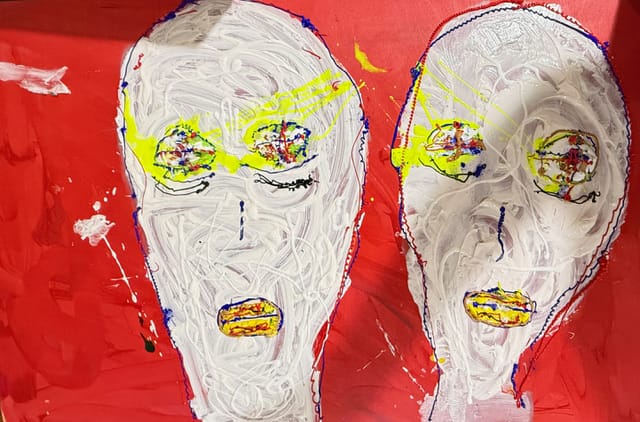
One of Freeman’s works, Screaming in Silence, is currently exhibited at the Glassell School of Art. The work presents two elongated, mask-like faces set against an intense red field. The composition is both minimal and emotionally charged, relying on contrast, repetition, and symbolic distortion.
The faces are pale, textured, and worn, appearing almost eroded by time or pressure. Bright yellow marks cut across the eye areas, suggesting blocked vision, psychic interruption, or internal overload. The mouths are small and constrained, reduced to minimal points of expression, reinforcing the paradox implied by the title: expression trapped within silence.
The red background functions as more than color it becomes atmosphere. It evokes urgency, emotional heat, memory, and psychological intensity. Rather than receding, the background presses forward, surrounding the figures as if it were a force they cannot escape.
Mask, Ritual, and the Psychology of the Face
The mask-like quality of the figures in Screaming in Silence connects strongly to Freeman’s broader visual vocabulary. The faces resemble ritual objects rather than individual portraits. They suggest witnesses, spirits, or fragmented selves suspended between presence and disappearance.
This symbolism resonates with Mexican cultural influences, particularly the ritualized imagery of Day of the Dead traditions. In this context, the face becomes a site of memory rather than identity, a surface where emotion, loss, and survival coexist.
The two figures can also be interpreted as a psychological split: one representing the burden of memory and trauma, the other embodying an uncertain but persistent future. Together, they form a dual structure of selfhood, one defined by what has been experienced and another defined by what is still being formed.
Endurance, Reconstruction, and the Role of Painting
At its core, Freeman’s work is about endurance. Screaming in Silence does not resolve its tension; instead, it holds it. The figures remain present, suspended within a field of intensity that refuses closure. This persistence becomes a form of strength.
Across his practice, Freeman transforms emotional pressure into visual structure. Texture becomes memory, color becomes atmosphere, and fragmentation becomes language. Painting becomes a method of reconstructing time, turning instability into form without neutralizing its force.
His work ultimately reflects a belief in transformation through process. Pain is not erased but reconfigured; silence is not absence but containment; memory is not fixed but continuously reshaped. In this way, Freeman’s paintings function as both records and acts of survival.
Conclusion: Art as Psychological and Spiritual Reconstruction
Andrew Freeman’s practice occupies a space where abstraction meets psychological narrative, and where material experimentation becomes a way of processing lived experience. Through layered surfaces, symbolic faces, and emotionally charged compositions, he builds a visual language rooted in trauma, memory, and transformation.
Works like Screaming in Silence demonstrate how painting can operate as both confession and construction, a place where fragmentation becomes form and where silence itself becomes expressive. Within this ongoing practice, Freeman continues to develop a body of work that reflects not only personal reconstruction but also a broader exploration of how art can translate inner experience into visual meaning.

