


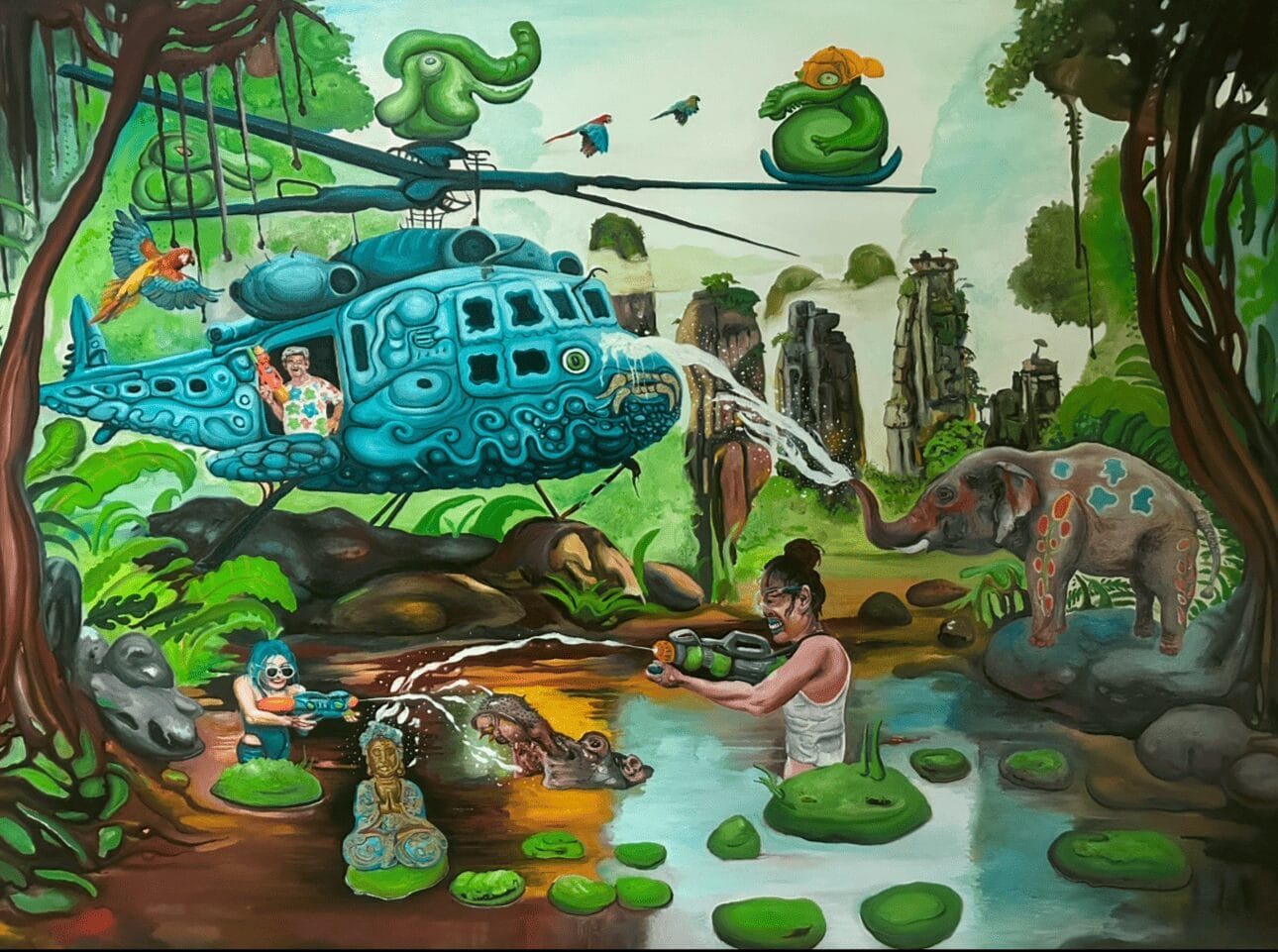
Paolo Chiarloni’s artistic universe exists in a delicate space between dream and reality, where playful imagery meets an undercurrent of unease. His work invites viewers into a world that is at once lighthearted and subtly disturbing, where humor and irony coexist with deeper emotional reflections. Through a distinctive visual language, Chiarloni constructs scenes that are immediate, visually engaging, and layered with meaning yet never overly complicated. His art does not demand interpretation rather, it offers itself openly, allowing each viewer to engage with it in a personal and instinctive way.
Micro Stories on Canvas
At the heart of Chiarloni’s work lies the concept of storytelling. Each painting functions as a self-contained narrative, a micro story designed to be experienced visually rather than intellectually dissected. These are not grand sweeping tales but rather fleeting moments, fragments of imagination captured and suspended in time.
His compositions often resemble sarcastic cartoons, infused with wit and subtle satire. There is a playful quality in the way figures interact within the canvas, yet this playfulness is never entirely innocent. Beneath the surface lies a bitter aftertaste, a quiet tension that adds depth to the viewing experience. This duality, humor paired with discomfort, is what gives his work its unique emotional resonance.
By focusing on the element of pure play, Chiarloni encourages viewers to reconnect with a more instinctive and less analytical way of experiencing art. In doing so, he offers an alternative to the often overly conceptual and demanding nature of contemporary art.
A Refuge in Contemporary Art
In an era where much of the art world is deeply conceptual, politically charged, and intellectually dense, Chiarloni’s work provides something rare a sense of refuge. His paintings create a space where viewers can momentarily step away from complexity and simply observe, feel, and enjoy.
This does not mean his work lacks depth, far from it. Instead, its depth is embedded in its accessibility. The images speak directly to the viewer, without the need for extensive explanation or theoretical frameworks. This immediacy is one of the defining qualities of his practice.
Chiarloni’s art becomes a safe haven, a place where both the eye and the mind can rest. It allows for a pause, a moment of clarity and refreshment, amid the often overwhelming landscape of contemporary visual culture. In this sense, his work fulfills an essential role, reminding us that art can be both meaningful and enjoyable, complex yet approachable.
The Language of Imagination
Chiarloni’s paintings can be understood as a journey into the imagination, populated by eccentric and sometimes grotesque cross-references. These elements are not meant to be decoded in a strict sense but rather experienced as part of a playful visual dialogue.
There is a sense of regression in his approach, not in a negative sense but as a deliberate return to a more childlike mode of perception. This regression allows for spontaneity, curiosity, and freedom from rigid artistic conventions. It is through this lens that his work should be viewed, not as a puzzle to be solved but as a game to be played.
This game, however, is layered. While it may appear whimsical at first glance, it often carries subtle commentary on human behavior, perception, and the nature of reality itself. The grotesque elements in particular serve to disrupt the viewer’s comfort, prompting a deeper engagement with the image.
Formal Choices and Composition
A closer analysis of Chiarloni’s formal choices reveals a carefully constructed visual strategy. One of the most notable features of his work is the prominence of the background, which often occupies at least half of the canvas. This background serves as a neutral stage upon which the main figures are placed.
These figures appear almost as satellites, slightly detached and drifting within the pictorial space. This creates a sense of suspension, as if the subjects exist outside of conventional spatial constraints. The relationship between figure and background becomes a key element in the overall composition, influencing how the viewer perceives depth and movement.
Over time, Chiarloni has simplified his backgrounds, moving toward flatter, more monochromatic surfaces. This evolution marks a significant shift in his artistic process. In his earlier works, backgrounds were often enriched with gold leaf, creating reflective surfaces and a sense of dimensionality. These elements added visual complexity but also competed with the main subjects for attention.
In his more recent works, the absence of such decorative elements allows for a clearer focus on the figures themselves. The background becomes a quiet, supportive presence, similar to the dark, unvarying backdrops found in classical portraiture. This restraint enhances the overall clarity of the composition, directing the viewer’s gaze exactly where it is needed.
Play, Irony, and Emotional Tension
One of the defining characteristics of Chiarloni’s art is its ability to balance playfulness with emotional tension. The imagery may appear whimsical or humorous, but it often carries an underlying sense of unease. This contrast is what gives his work its lasting impact.
The irony present in his paintings is subtle yet effective. It invites the viewer to look beyond the surface and consider the deeper implications of what is being depicted. At the same time, the playful elements ensure that the work remains engaging and accessible.
This balance reflects a broader understanding of human experience, where joy and discomfort often coexist. By capturing this duality, Chiarloni creates works that are both entertaining and thought-provoking.
Artwork Focus Thay Art Force
One notable example of Chiarloni’s artistic approach is the painting Thay Art Force, executed in oil on canvas. Created and completed during an art residency, this work exemplifies the artist’s commitment to both technical precision and conceptual clarity.
The use of oil paint allows for rich textures and nuanced color transitions, enhancing the visual impact of the piece. The finishing reflects a careful attention to detail, with each element thoughtfully integrated into the overall composition.
As with much of Chiarloni’s work, Thay Art Force can be seen as a micro story, an isolated moment that invites interpretation without imposing it. The setting of an art residency adds another layer to the work, suggesting a period of focused exploration and creative immersion.
Conclusion
Paolo Chiarloni’s work stands as a testament to the enduring power of imagination in art. By embracing play, simplicity, and narrative, he creates paintings that are both accessible and deeply engaging. His ability to balance humor with subtle tension and clarity with complexity sets his work apart in the contemporary art landscape.
In a world where art often demands explanation, Chiarloni offers something refreshingly different, an invitation to simply look, feel, and experience. His paintings remind us that art does not always need to challenge us intellectually to be meaningful; it can also delight, amuse, and quietly provoke all at once.
Through his unique visual language, Chiarloni continues to expand the boundaries of storytelling in art, transforming each canvas into a window into the imagination, a place where reality bends, humor lingers, and meaning unfolds in unexpected ways.

